Vertex vs Vertices: Meaning, Examples and Correct Use
Vertex and vertices refer to the same basic concept, but they differ in number. Vertex is singular, while vertices is its traditional plural form. You will often see these terms in geometry, mathematics, and graph theory, where they describe points at which lines, sides, or edges meet.
The unusual change from vertex to vertices can make the pair confusing, especially if you expect the plural to be formed simply by adding -s or -es. Fortunately, the distinction is straightforward once you know the rule.
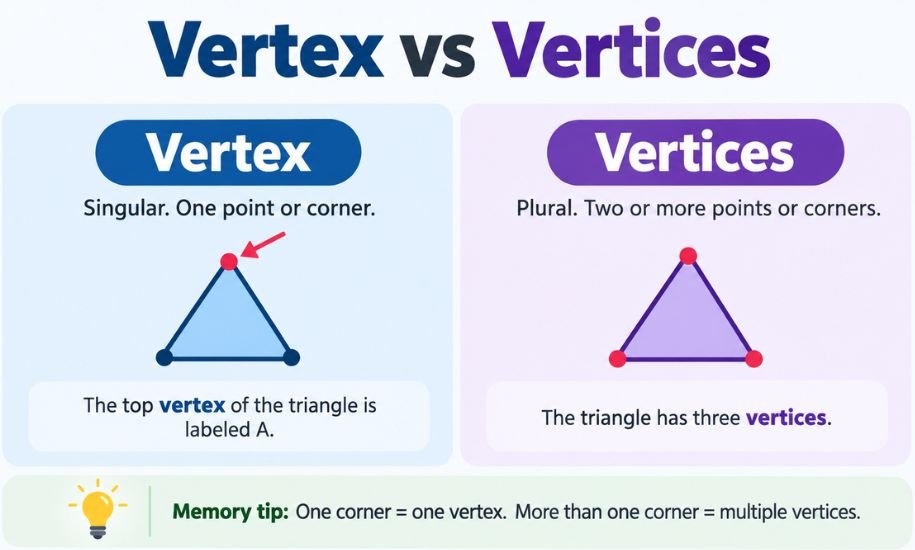
Vertex is singular, while vertices is plural. Use vertex when referring to one point or corner and vertices when referring to two or more. For example, a triangle has three vertices, and each individual corner is a vertex.
Vertex vs. Vertices: What’s the Difference?
The main difference is grammatical rather than mathematical. Vertex refers to one point, whereas vertices refers to multiple points.
| Feature | Vertex | Vertices |
|---|---|---|
| Number | Singular | Plural |
| Meaning | One point or corner | Two or more points or corners |
| Common use | Geometry, graphs, mathematics | Geometry, graphs, mathematics |
| Example | This vertex forms an angle. | The triangle has three vertices. |
This pattern is similar to other English words derived from Latin, such as index → indices and matrix → matrices.
The easiest rule is simply:
One = vertex
More than one = vertices
What Does “Vertex” Mean?
A vertex is a point at which lines, line segments, rays, sides, or edges meet, depending on the mathematical context.
In basic geometry, it is often easiest to think of a vertex as a corner.
Consider a triangle. Two sides meet at each corner, so each corner is a vertex. Because a triangle has three corners, it has three vertices.
Here are some examples of the singular form:
- The top vertex of the triangle is labeled A.
- Each angle has a vertex.
- One vertex of the square touches the circle.
- The arrow points toward a vertex of the cube.
The exact technical meaning can vary slightly depending on whether you are discussing angles, polygons, polyhedra, or graphs, but the grammatical rule remains unchanged.
What Does “Vertices” Mean?
Vertices is the plural form of vertex. It describes two or more points of the type described above.
For example:
- A triangle has three vertices.
- A rectangle has four vertices.
- A pentagon has five vertices.
- A cube has eight vertices.
The number of vertices in familiar polygons is easy to understand because each corner counts as one vertex.
| Shape | Number of Vertices |
|---|---|
| Triangle | 3 |
| Square | 4 |
| Rectangle | 4 |
| Pentagon | 5 |
| Hexagon | 6 |
| Octagon | 8 |
So, if you point to a single corner of a pentagon, you are identifying a vertex. When discussing all five corners together, you are discussing its vertices.
What Is a Vertex in Math?
The meaning of vertex in math depends somewhat on the mathematical object being discussed.
For a polygon, a vertex is a point where two sides meet. A square, for example, consists of four sides meeting at four vertices.
For an angle, the vertex is the common endpoint of its two rays.
For a three-dimensional polyhedron, a vertex is a corner where edges meet. A cube provides a familiar example: it has 8 vertices, 12 edges, and 6 faces.
The term is therefore broader than simply “corner,” although describing a vertex as a corner is often useful when introducing geometry.
Is There a Vertex vs. Vertices Formula?
There is no special vertex vs. vertices formula because the distinction between the two words is grammatical: one is singular and the other is plural.
However, the number of vertices does appear in mathematical formulas. A well-known example is Euler’s formula for convex polyhedra:
V − E + F = 2
Here:
V = number of vertices
E = number of edges
F = number of faces
Take a cube as an example. It has 8 vertices, 12 edges, and 6 faces:
8 − 12 + 6 = 2
This formula concerns the relationship among vertices, edges, and faces. It does not determine whether the English word vertex or vertices should be used; that still depends simply on whether you are referring to one or more than one.
Vertices vs. Edges: What Is the Difference?
Vertices and edges describe different parts of a geometric object.
A vertex is a point where edges or sides meet. An edge is a line segment connecting vertices in a polyhedron or a connection between vertices in a graph.
A cube, for instance, has:
- 8 vertices
- 12 edges
- 6 faces
Imagine tracing one straight boundary of a cube with your finger. That boundary is an edge. The corner where several edges meet is a vertex.
This distinction becomes especially important with three-dimensional shapes, where vertices, edges, and faces are counted separately.
Vertices vs. Sides
For two-dimensional polygons, vertices and sides are closely connected but are not the same thing.
A side is one of the line segments forming the boundary of a polygon. A vertex is a point where two sides meet.
For example, a pentagon has:
5 sides + 5 vertices
A triangle has:
3 sides + 3 vertices
And a hexagon has:
6 sides + 6 vertices
For a simple polygon, the number of sides equals the number of vertices, but the terms describe different features. The sides are the line segments; the vertices are the points where those segments meet.
Vertex and Vertices in a Graph
The words also have an important meaning in graph theory.
A graph consists of vertices and edges. A vertex represents an individual point or object, while an edge represents a connection between vertices.
Suppose a simple graph contains points labeled A, B, C, and D. Each individual point is a vertex, while A, B, C, and D collectively are the graph’s vertices.
In many computing contexts, a graph vertex is also informally called a node.
The same singular/plural rule therefore applies:
- one vertex
- two vertices
- several vertices
The mathematical setting may change, but the grammar does not.
Vertex and Vertices Pronunciation
The change in spelling also produces a noticeable change in pronunciation.
Vertex is approximately pronounced:
VER-teks
Vertices is approximately pronounced:
VER-tuh-seez
This can help reinforce the distinction. Vertices is not simply vertex with an extra -s sound at the end; its ending changes in both spelling and pronunciation.
When writing, remember that the standard traditional pair is:
vertex → vertices
Is “Vertexes” Also Correct?
Yes. Vertexes exists as an accepted alternative plural of vertex. However, vertices is the traditional plural and is especially familiar in mathematical and technical contexts.
For example, both of these plural constructions can be grammatical:
vertices
vertexes
For mathematics and geometry writing, vertices is generally the safest and most conventional choice.
Do not confuse either plural with vertice. In standard English, vertice is not the singular form of vertices. The singular word is vertex.
Examples of Vertex and Vertices in Sentences
Seeing the two forms side by side makes the distinction particularly easy to remember:
Singular: The highest vertex of the triangle is labeled C.
Plural: All three vertices of the triangle are labeled.
Singular: Select one vertex of the graph.
Plural: Connect the two vertices with an edge.
Singular: This vertex is shared by two sides of the polygon.
Plural: The polygon’s vertices are marked with dots.
Singular: Look at the upper-right vertex of the rectangle.
Plural: A rectangle has four vertices.
The common mistake is to use vertex after a plural number:
Incorrect: The triangle has three vertex.
Correct: The triangle has three vertices.
Likewise, vertices should not normally follow a singular quantity:
Incorrect: Choose one vertices.
Correct: Choose one vertex.
Easy Way to Remember the Difference
The simplest memory rule is:
One corner = one vertex. Multiple corners = multiple vertices.
You can also associate the ending -ices with a plural form. Other words show a similar pattern:
- index → indices
- matrix → matrices
- appendix → appendices
Not every English word ending in -x follows this pattern, so it is better to remember vertex → vertices as a pair rather than treating it as a universal spelling rule.
Common Mistakes to Avoid
One common error is using vertex for several points: “A square has four vertex.” Because four is plural, the sentence requires vertices.
Another is assuming that vertices refers to a different part of a shape. It does not. It is simply the plural form of vertex.
Writers may also confuse vertices with edges or sides. Remember that a vertex is a point, while an edge or side is a line segment or connection.
Finally, avoid using vertice as the singular. If you are discussing exactly one point, the correct standard English form is vertex.
The Bottom Line
Use vertex when referring to one point and vertices when referring to more than one. A triangle therefore has three vertices, but each individual corner is a vertex. The distinction remains the same whether you are discussing polygons, three-dimensional shapes, angles, or graph theory. Remembering the simple rule one vertex, multiple vertices is enough for most situations, and it fits Grammarifyr’s goal: know the difference and use the right words.
Frequently Asked Questions
Is vertices singular or plural?
Vertices is plural. The singular form is vertex. For example, a triangle has three vertices, but any individual corner of that triangle is one vertex.
Is it three vertex or three vertices?
The correct phrase is three vertices because three requires a plural noun. You would use vertex only with a singular reference, such as “one vertex” or “the top vertex.”
Are vertexes and vertices both correct?
Yes. Vertexes is an accepted alternative plural, but vertices is the traditional form and is particularly common in mathematics and technical writing.
What is the difference between vertices and edges?
A vertex is a point where sides or edges meet. An edge is a line segment or connection between vertices. A cube, for example, has 8 vertices and 12 edges.
What is the difference between vertices and sides?
Vertices are the points or corners where sides meet, while sides are the line segments forming a polygon. A square has four sides and four vertices.
How do you pronounce vertices?
Vertices is approximately pronounced VER-tuh-seez. The singular vertex is pronounced approximately VER-teks.
You may also Read : Mustache vs Moustache: American vs British English