What Does OTG Mean in Text? Meaning and Examples
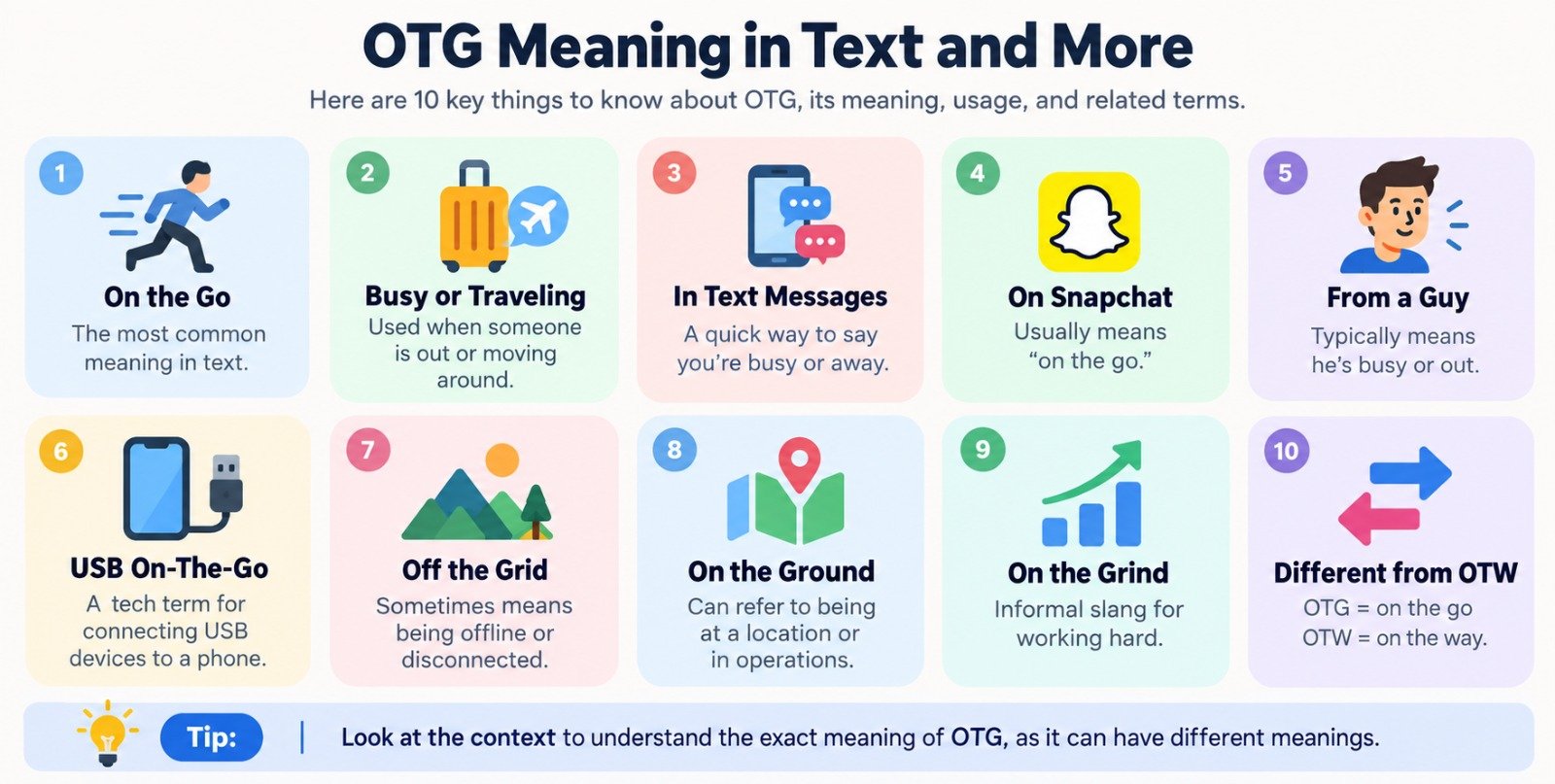
If you have received a message containing “OTG,” you may wonder what those three letters mean. In everyday texting and social media conversations, OTG most commonly means “on the go.” It usually tells someone that the person is busy, traveling, moving around, or away from a fixed place. However, OTG can have other meanings depending on the context, including “off the grid” and “USB On-The-Go.” Understanding the surrounding message makes it much easier to identify the intended meaning.
In text messages, OTG usually means “on the go.” It means someone is busy, out, traveling, or moving from one place to another. On social media, it can occasionally have other meanings, so the context of the message matters.
What Does OTG Stand For?
In casual texting, OTG stands for “on the go.” The phrase describes someone who is active, busy, traveling, running errands, or generally not staying in one place.
For example:
“I’m OTG right now, I’ll call you later.”
Here, the sender is saying that they are currently on the go and probably do not have much time to talk.
The abbreviation is especially useful in quick conversations because it turns a three-word phrase into three letters. It can appear in text messages, chats, captions, and other informal online conversations.
OTG Meaning in Simple Terms
The easiest way to understand OTG is:
OTG = On the Go = Busy, moving around, or out somewhere
The exact situation can vary.
Someone might use it because they are:
- Traveling to another place
- Driving or commuting
- Running errands
- Going to work or school
- Shopping
- Meeting someone
- Moving between different locations
- Too busy to have a long conversation
For instance, if someone texts, “Sorry, OTG rn,” they probably mean, “Sorry, I’m on the go right now.”
Here, “rn” is another common texting abbreviation meaning “right now.”
Examples of OTG in Text Messages
Seeing the abbreviation in different sentences makes its meaning easier to recognize.
Example 1:
“I’m OTG, can we talk tonight?”
Meaning: The person is busy or out at the moment but expects to be available later.
Example 2:
“Been OTG since 7 this morning.”
Meaning: The person has been busy or moving around since early morning.
Example 3:
“OTG rn, will message you when I get home.”
Meaning: The sender is currently away or busy and will respond later.
Example 4:
“We’re OTG all weekend.”
Meaning: They expect to be out and active throughout the weekend.
Example 5:
“Sorry for the late reply. I was OTG.”
Meaning: The person was busy or away from their phone.
The phrase usually has a practical meaning rather than a hidden emotional one.
What Does OTG Mean on Snapchat?
On Snapchat, OTG can mean “on the go,” just as it does in ordinary texting.
For example:
“OTG today, snap me later.”
The likely meaning is that the person is busy or out and about.
However, abbreviations on social media can be highly dependent on individual usage. Some people may use OTG to mean “off the grid,” particularly when talking about temporarily disconnecting from social media or going offline.
For example:
“Going OTG for a few days.”
In that context, “off the grid” could make more sense than “on the go.”
Therefore, you should look at the rest of the conversation rather than assuming that OTG has only one possible meaning on Snapchat.
What Does OTG Mean From a Guy?
If a guy sends you a message such as:
“I’m OTG rn.”
the most natural interpretation is “I’m on the go right now.”
He may be telling you that he is:
- Busy
- Traveling
- Out with friends
- Running errands
- Heading somewhere
- Unable to text for long
The abbreviation itself does not automatically indicate romantic interest, rejection, or avoidance. Its meaning depends on the surrounding conversation.
For example:
You: “Are you free to talk?”
Him: “Not right now, I’m OTG.”
That simply suggests he is currently busy or away.
If he says:
“I’ve been OTG all day. Sorry I didn’t reply.”
the context makes the intended meaning even clearer: he has been busy or moving around.
OTG on a Phone: A Different Meaning
If you see OTG in a phone’s settings, specifications, accessories, or technical discussion, it may mean something completely different.
In technology, OTG stands for “USB On-The-Go.”
USB OTG allows compatible mobile devices to communicate directly with certain USB peripherals. For example, depending on the device and adapter, a phone may be able to connect to a USB flash drive or another compatible accessory.
So compare these two examples:
“I’m OTG, text you later.”
Here, OTG means on the go.
“Does this phone support OTG?”
Here, OTG refers to USB On-The-Go.
The words around the abbreviation usually reveal which meaning is intended.
Other Meanings of OTG
Although “on the go” is the most useful interpretation for ordinary texting, OTG can represent several different phrases.
| Meaning | Typical context |
|---|---|
| On the Go | Texting and casual conversation |
| Off the Grid | Social media or discussions about disconnecting |
| USB On-The-Go | Phones, computers, and USB accessories |
| On the Ground | Travel, operations, or location-based contexts |
| On the Grind | Informal slang about working hard |
Not all of these meanings are equally common. The surrounding words, subject, and platform should guide your interpretation.
OTG vs. OTW: What’s the Difference?
OTG and OTW can look similar, but they communicate different ideas.
OTG means “on the go.” It generally describes someone who is busy, active, traveling, or moving around.
OTW means “on the way.” It normally indicates that someone is traveling toward a particular destination.
Compare:
“I’m OTG all afternoon.”
This means the person expects to be busy or out and about.
“I’m OTW to your house.”
This means the person is specifically traveling to your house.
A simple way to remember the distinction is:
OTG = generally busy or moving
OTW = heading somewhere
Is OTG Formal or Informal?
OTG is primarily an informal abbreviation. It works well in text messages, social media conversations, and casual chats.
It is generally better to write “on the go” rather than OTG in formal writing, such as:
- Academic assignments
- Business reports
- Formal letters
- Professional documents
- Official communications
For example, a casual message might say:
“I’m OTG today.”
In a formal email, you would normally write:
“I’ll be traveling throughout the day.”
The full phrase is clearer for readers who may not be familiar with texting abbreviations.
How to Understand OTG From Context
When you encounter OTG, look at the words surrounding it.
If someone writes:
“OTG right now, talk later.”
On the go is the obvious interpretation.
If they write:
“Going OTG for the weekend. No phone.”
Off the grid may be intended.
If they write:
“My Android has OTG support.”
The meaning is USB On-The-Go.
This contextual approach is more reliable than assigning one fixed meaning to every use of the abbreviation.
Common Mistakes With OTG
One common mistake is assuming that OTG always means “on the go.” That is usually correct in casual texting, but it is not the only possible interpretation.
Another mistake is confusing OTG with OTW. OTW specifically means “on the way,” while OTG generally describes being active, busy, or moving around.
It is also easy to confuse texting OTG with USB OTG. The first is a casual abbreviation; the second is a technology term.
Finally, avoid treating OTG as a formal English word. It is an abbreviation used primarily in informal communication.
How to Reply When Someone Says OTG
Your response can depend on what the person appears to mean.
If they say:
“I’m OTG right now.”
You could reply:
“No problem, text me when you’re free.”
Or:
“Sure, talk later!”
If you are unsure what they mean, simply ask:
“Do you mean you’re on the go?”
There is no special response required. In most conversations, OTG is simply a quick way of explaining why someone may not be immediately available.
Easy Way to Remember OTG
The easiest memory trick is to connect the G with Go:
OTG → On The Go
If someone is “on the go,” they are usually moving around, traveling, or staying busy.
For the technology meaning, remember that USB OTG = USB On-The-Go, which describes a way for compatible devices to connect directly with USB accessories.
Frequently Asked Questions
What does OTG mean in a text message?
OTG most commonly means “on the go.” It tells the recipient that someone is busy, traveling, out, or moving around. For example, “I’m OTG right now” generally means “I’m on the go right now.”
What does OTG mean on Snapchat?
On Snapchat, OTG can mean “on the go,” particularly when someone is explaining that they are busy or out. In some contexts, users may also use it to mean “off the grid,” so the surrounding conversation is important.
What does OTG mean from a guy?
If a guy says “I’m OTG,” he most likely means “I’m on the go.” He may be busy, traveling, or unable to chat at that moment. The abbreviation alone does not indicate a particular romantic meaning.
What does OTG mean on a phone?
In a technical phone context, OTG usually means USB On-The-Go. It refers to technology that allows compatible mobile devices to connect directly with certain USB peripherals.
Is OTG the same as OTW?
No. OTG usually means “on the go,” while OTW means “on the way.” OTG describes generally being busy or moving around, whereas OTW usually means traveling toward a particular destination.
Should I use OTG in formal writing?
It is better to use “on the go” in formal writing. OTG is mainly an informal abbreviation suited to texting, chats, and social media rather than academic or professional documents.
The Bottom Line
In everyday texting, OTG usually means “on the go.” It is a quick way to say that someone is busy, out, traveling, or moving around. On Snapchat and other social platforms, context can occasionally give it another meaning, while in phone-related conversations it may refer to USB On-The-Go. When in doubt, look at the surrounding message before deciding what the abbreviation means. For more clear explanations of confusing words, phrases, and everyday language, Grammarifyr helps you Know the Difference. Use the Right Words.
You may also Read : Labeled or Labelled: US and UK Spelling Explained