Traveling or Travelling: US and UK English Explained
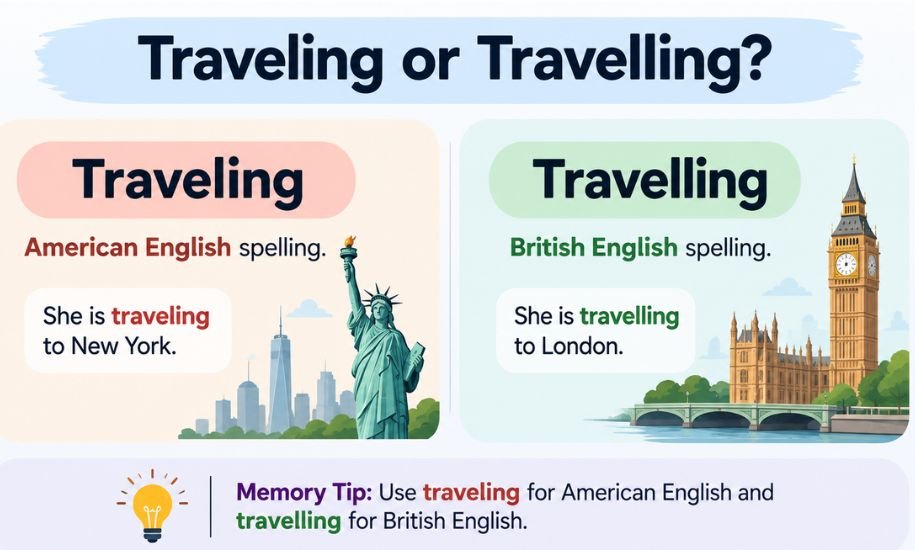
The words traveling and travelling have the same meaning, but their spelling differs depending on the type of English you use. One is standard in American English, while the other is preferred in British English and several other varieties. This difference can be confusing when writing articles, emails, academic assignments or travel-related content. The good news is that both spellings are correct, and choosing the right one is simply a matter of following the appropriate regional convention.
Quick Answer
Both traveling and travelling are correct spellings. Traveling is the standard American English form, while travelling is the standard British English form. Both words have the same meaning and pronunciation, so choose the spelling that matches your audience and remain consistent throughout your writing.
Traveling or Travelling: What Is the Difference?
The main difference between these two words is regional spelling. American English generally uses one l in traveling, whereas British English doubles the l to form travelling.
| Feature | Traveling | Travelling |
|---|---|---|
| Correct spelling | Yes | Yes |
| English variety | American | British |
| Meaning | Moving from one place to another | Moving from one place to another |
| Pronunciation | Same | Same |
| Past tense | Traveled | Travelled |
| Person | Traveler | Traveller |
| Common usage | United States | UK, Australia, New Zealand |
| Grammatical role | Verb form or gerund | Verb form or gerund |
Neither spelling is universally better or more correct. The appropriate choice depends on the regional English convention you are following.
For example:
- American English: My family is traveling to California this summer.
- British English: My family is travelling to Scotland this summer.
Both sentences are grammatically correct. Only the spelling convention changes.
What Does Traveling Mean?
Traveling is the American English form of the present participle and gerund of the verb travel. It refers to the activity of moving from one location to another, whether for leisure, business, education or personal reasons.
The word can describe a journey by car, train, plane, boat or any other means of transportation. It can also refer to the general experience of visiting different places.
Examples of traveling in sentences:
- She enjoys traveling to different countries during her holidays.
- My brother is traveling to New York for a business meeting.
- Traveling by train is one of my favorite ways to explore new places.
- They have been traveling around the United States for three weeks.
In American English, traveling is used when describing an ongoing journey or the general activity of visiting places.
For instance, in the sentence “I love traveling,” the word functions as a gerund because it acts as a noun describing an activity. In “She is traveling abroad,” it forms part of the present continuous verb construction.
What Does Travelling Mean?
Travelling is the British English spelling of the same word. It describes the act of going from one place to another, whether for a short trip, a long journey, work or recreation.
Its meaning, pronunciation and grammatical function are identical to those of traveling. The difference is simply that British English generally doubles the final l when forming this word.
Examples of travelling in sentences:
- We are travelling to London next weekend.
- She loves travelling because it allows her to experience different cultures.
- My parents are travelling across Europe by train.
- Travelling abroad can help students develop independence.
In British English, travelling is the preferred spelling in both formal and informal writing. It is commonly used in British publications, educational materials and everyday communication.
The same spelling convention is generally followed in Australian and New Zealand English.
Why Does Travelling Have Two Ls?
The difference comes from the spelling conventions that developed in American and British English. In British English, the final l is commonly doubled when adding certain suffixes to words such as travel. American English often retains a single l in these forms.
This difference can also be seen in several other words.
| American English | British English |
|---|---|
| Traveling | Travelling |
| Traveled | Travelled |
| Traveler | Traveller |
| Canceling | Cancelling |
| Canceled | Cancelled |
| Modeling | Modelling |
| Modeled | Modelled |
| Labeling | Labelling |
These examples demonstrate a broader spelling pattern, although there are exceptions in both varieties of English.
An easy way to understand the distinction is to remember that American English usually uses traveling, while British English generally uses travelling. The same regional pattern applies to the related forms traveled/travelled and traveler/traveller.
Is Traveling or Travelling Correct in the UK?
Travelling is the standard spelling in the United Kingdom. It is the preferred form in British newspapers, books, educational writing and most other content that follows British English conventions.
For example:
- She is travelling to Manchester to visit her relatives.
- We spent the summer travelling around England.
- Travelling by public transport can be convenient.
Although traveling is the American spelling, it is still understandable to British readers. It is not an inherently incorrect English word; it simply does not follow the usual British spelling convention.
If you are writing for a British audience, use travelling, travelled and traveller consistently.
Traveling or Travelling in IELTS
Both spellings are acceptable in the IELTS examination. Candidates can use British or American English spelling, provided they spell words correctly and maintain consistency.
For example, both of the following sentences are acceptable:
- Travelling to different countries provides opportunities to learn about new cultures.
- Traveling to different countries provides opportunities to learn about new cultures.
If you begin your essay using British English, it is a good idea to continue using British spelling throughout. Similarly, if you choose American English, use its spelling conventions consistently.
For IELTS Writing Task 1 and Task 2, candidates should focus on clarity, grammatical accuracy, vocabulary and coherence rather than worrying about this particular spelling difference.
Traveling Bag or Travelling Bag: Which Is Correct?
Both traveling bag and travelling bag can be used, depending on the English variety.
- Traveling bag: The American English spelling.
- Travelling bag: The British English spelling.
For example:
- American: She packed her traveling bag before leaving for the airport.
- British: She packed her travelling bag before leaving for the airport.
However, travel bag, suitcase and travel backpack may be more natural alternatives in certain contexts. The best choice depends on the type of luggage being described and the sentence in which it appears.
How to Use Traveling and Travelling in Sentences
Both spellings can function as a gerund or as a present participle in a verb construction.
| Context | American English | British English |
|---|---|---|
| Ongoing action | He is traveling abroad. | He is travelling abroad. |
| General activity | Traveling is exciting. | Travelling is exciting. |
| Personal preference | I enjoy traveling alone. | I enjoy travelling alone. |
| Future journey | She will be traveling soon. | She will be travelling soon. |
| Question | Are you traveling today? | Are you travelling today? |
The spelling does not change the grammatical structure of the sentence.
More examples
- American: Traveling alone has helped me become more confident.
- British: Travelling alone has helped me become more confident.
- American: They are traveling by train to visit their grandparents.
- British: They are travelling by train to visit their grandparents.
The sentences have the same meaning, and neither spelling changes how the word functions.
Common Mistakes to Avoid
Although both spellings are correct, writers can make mistakes when mixing regional conventions.
- Mixing spelling styles: Using travelling in one paragraph and traveled in another can create inconsistency if you are following a single regional style.
- Assuming one spelling is always wrong: Traveling is not a misspelling simply because British English generally uses travelling.
- Using the wrong related form: American English normally uses traveler, whereas British English normally uses traveller.
- Changing spelling unnecessarily: There is no need to change a correctly spelled word when quoting a source that uses the other regional convention.
Easy way to remember
Think of the audience you are writing for. If your content is intended for the United States, choose traveling. If it is intended for the United Kingdom, choose travelling. Apply the same approach to the related forms.
Frequently Asked Questions
1. Is traveling or travelling the correct spelling?
Both spellings are correct. Traveling is standard in American English, while travelling is standard in British English. The choice depends on your audience and the spelling style you follow.
2. Is travelling British or American English?
Travelling is the standard British English spelling. It is also commonly used in Australian and New Zealand English, as well as in other varieties that follow British spelling conventions.
3. Is traveling acceptable in formal writing?
Yes. Traveling is completely acceptable in formal American English writing, including academic papers, professional documents and publications. It is also understood internationally.
4. Are traveling and travelling pronounced the same?
Yes. Both spellings have the same pronunciation and meaning. The difference is purely regional and does not affect how the word is spoken.
5. Should I use traveling or travelling in an academic essay?
Use the spelling convention required by your institution, teacher or publication. If no specific style is required, choose either American or British English and use it consistently throughout your essay.
Final Verdict: Traveling or Travelling?
Both traveling and travelling are correct, and neither changes the meaning of the word. The difference is that American English uses traveling, while British English prefers travelling. The same distinction applies to traveled/travelled and traveler/traveller.
The best approach is to choose the spelling that suits your audience and maintain consistency. For more straightforward explanations of confusing English words and spelling differences, Grammarifyr helps readers know the difference and use the right words.
You may also Read : Presume vs Assume: Meaning, Differences and Examples
One Comment