Tased or Tazed? Correct Spelling Explained
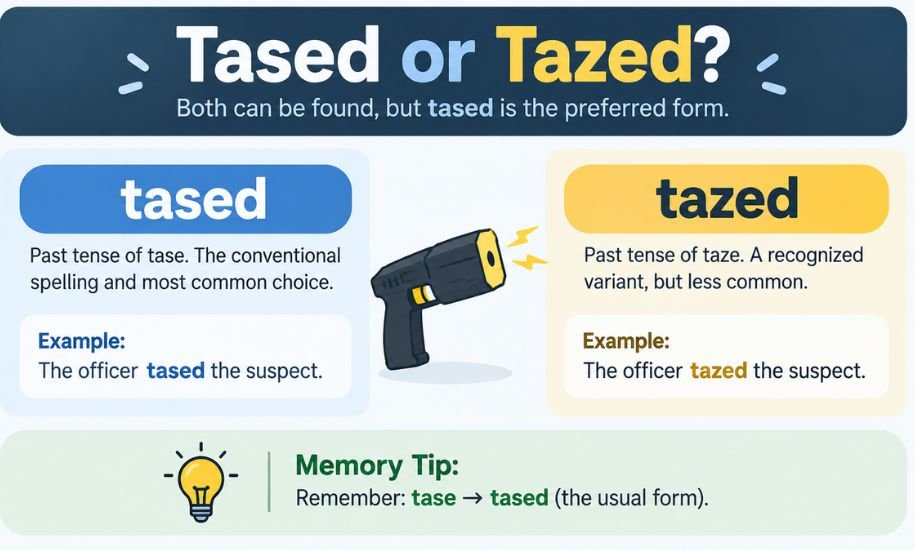
If you are unsure whether the past tense should be tased or tazed, the confusion is understandable. The verb is pronounced with a /z/ sound, which can make the spelling with z look natural. However, English dictionaries recognize both tase and the variant taze, so both tased and tazed can be encountered. The important difference is that tased is the conventional form to prefer in standard edited English, while tazed follows the less common variant spelling taze. The device itself is spelled Taser, not tazer.
Tased is the conventional spelling and the form most writers should use. Tazed is also a documented form because taze is recognized as a variant of tase. For the device, use Taser, not tazer.
Tased vs. Tazed: The Key Difference
The easiest way to understand the forms is to start with their base verbs:
| Form | Word type | Meaning | Recommended usage |
|---|---|---|---|
| tase | Verb | To stun with a Taser | Preferred |
| taze | Verb | Variant of tase | Acceptable variant |
| tased | Past tense/past participle | Past form of tase | Preferred |
| tazed | Past tense/past participle | Past form of taze | Documented variant |
| Taser | Noun | A device used to deliver an electric shock | Correct spelling |
| tazer | Noun | Intended as Taser | Generally treated as a misspelling |
So, if you are writing an article, report, essay, or other formal text, tased is the safest choice.
For example:
The officer tased the suspect.
The alternative:
The officer tazed the suspect.
can also be understood and is supported by the variant verb taze, but it is less conventional.
What Does “Tase” Mean?
Tase is a verb meaning to stun or shock someone with a Taser or similar electroshock device.
Its common grammatical forms include:
- tase — base form
- tases — third-person singular present
- tasing — present participle
- tased — past tense and past participle
Examples:
The officer may tase the suspect if necessary.
The officer tases the suspect during the training demonstration.
The officer is tasing the attacker.
The officer tased the suspect.
The past form tased is the form you will most often want in standard edited English.
Is “Taze” Also a Word?
Yes. Taze is recorded as a variant spelling of tase in dictionaries.
That means it is not accurate to say that taze is simply a meaningless spelling error. It has the same basic meaning as tase.
For example:
The officer decided to taze the suspect.
The spelling follows the alternative base form:
taze → tazed
However, if you are choosing a form for formal or general-purpose writing, tase and tased are the more conventional choices.
Tased or Tazed: Which Should You Use?
If you are deciding between the two forms for your own writing, use tased.
Consider these examples:
Preferred:
The police officer tased the man after he refused to put down the object.
Variant:
The police officer tazed the man after he refused to put down the object.
The first version follows the main dictionary form tase. The second follows the variant taze.
This distinction is similar to other situations in English where a less common spelling is documented but another form is more conventional.
Therefore, the practical rule is:
Use “tased” unless you have a specific reason to follow the variant “taze.”
What About “Tazed or Tased”?
The question tazed or tased has the same answer in reverse.
Both forms can be found, but tased is the preferred conventional form.
The spelling can be explained through the two verb forms:
tase → tased
taze → tazed
The important point is that tazed is not necessarily evidence that someone does not understand English spelling. It can represent the past tense of the documented variant taze.
For polished writing, though, choosing tased avoids unnecessary variation.
Taser or Tazer: Which Is Correct?
This is a different spelling question.
The established spelling of the device is Taser (also styled TASER in some contexts). Tazer is generally treated as a misspelling when it is intended to refer to the device.
The distinction between the noun and verb is useful:
The officer carried a Taser.
Here, Taser is the noun referring to the device.
The officer tased the suspect.
Here, tased is the verb describing the action.
A useful pattern to remember is:
Taser = device
tase = action
tased = action in the past
So, if you are wondering is it taser or tazer, choose Taser when referring to the device.
Why Do People Confuse These Spellings?
The pronunciation is one obvious reason. Tase is pronounced with a final /z/ sound, so it is easy to assume that its spelling should contain a z.
That can lead to a chain of spellings such as:
tase → tased
being replaced with:
taze → tazed
The second pattern is not completely arbitrary because taze itself is a documented variant. The problem is that writers may also extend the z spelling to the device and produce tazer, which is not the standard spelling of the device.
In other words, there are two separate issues:
- Taze/tazed can represent a recognized variant spelling.
- Tazer is generally a misspelling of Taser.
Keeping those distinctions separate makes the whole topic easier.
Tase, Taze, Tased, and Tazed in Sentences
Here are natural examples showing how the forms work.
Tase
The officer was authorized to tase the suspect if the situation became dangerous.
Taze
The report used the alternative spelling taze throughout the document.
Tased
The officer tased the suspect during the confrontation.
Tazed
The article described how the suspect was tazed during the incident.
The last example follows the variant verb taze. It is grammatically consistent with that spelling, although tased is the more conventional form.
A Simple Grammar Table
Because these words are verbs, their forms can be compared directly:
| Tase | Taze |
|---|---|
| tase | taze |
| tases | tazes |
| tasing | tazing |
| tased | tazed |
The pattern is straightforward: the -d past-tense ending attaches to whichever base spelling is being used.
So:
tase + d = tased
and:
taze + d = tazed
This explains why both past forms can exist when both base spellings are recognized.
Common Mistakes to Avoid
1. Writing “tazer” for the device
Incorrect: The officer carried a tazer.
Correct: The officer carried a Taser.
The device name does not normally change to tazer simply because the word is pronounced with a /z/ sound.
2. Assuming “tazed” can never be a word
Because taze is documented as a variant of tase, tazed can occur as its past-tense form.
For standard writing, however, tased remains the more conventional choice.
3. Mixing the forms
Avoid creating inconsistent forms such as using taze as the base verb but then using tased without a reason.
If you choose the variant:
taze → tazed
If you use the conventional form:
tase → tased
4. Treating “Taser” and “tase” as interchangeable
They have different grammatical roles.
The officer held a Taser.
The officer tased the suspect.
The first is a noun; the second is a verb.
Easy Way to Remember the Difference
Use this three-part rule:
Taser = thing
tase = action
tased = action already completed
For the less common variant, remember:
taze → tazed
And when you are unsure which spelling to use in formal writing, choose the s spelling:
tase → tased
That simple pattern will cover most situations.
Is “Tased” Better for Formal Writing?
Yes, tased is generally the better choice when you want the conventional form in edited English.
That does not mean tazed is impossible or inherently meaningless. It reflects the variant verb taze, which is recorded in dictionaries.
The practical distinction is therefore one of standard preference rather than a simple “real word versus fake word” situation.
If you are writing for a general audience and have no reason to use the variant, tased is the clearer choice.
Frequently Asked Questions
Is “tased” or “tazed” correct?
Tased is the conventional form and the one generally recommended for standard writing. Tazed is also documented as the past form of the variant verb taze, so it is not accurate to say that it can never be used.
Is “taze” a real word?
Yes. Taze is recognized as a variant spelling of tase. Both verbs refer to stunning or shocking someone with a Taser or similar device. Tase is the more conventional form.
Is it “taser” or “tazer”?
Use Taser when referring to the device. Tazer is generally considered a misspelling of the established device name.
Is “tazed” the past tense of “taze”?
Yes. If you use taze as the base verb, its past-tense form is tazed. The conventional verb tase has the past form tased.
Should I use “tased” in an essay?
Yes. Tased is the safest and most conventional choice for formal or edited writing. It follows the main dictionary form tase and avoids unnecessary spelling variation.
Why does “tazed” look natural?
The pronunciation of tase ends with a /z/ sound, which makes the spelling taze seem intuitive. In fact, taze is a documented variant, so the spelling has a linguistic basis even though tase/tased is the more conventional choice.
The Bottom Line
When choosing between these forms, tased is the best default for standard English writing. Tazed can also occur because taze is a recognized variant of tase, but it is less conventional. For the device, use Taser, not tazer. Once you separate the noun Taser from the verbs tase/taze, the spelling becomes much easier to remember. Grammarifyr is here to help make these small but confusing English differences easier to use correctly.
You may also Read : Traveled or Travelled: US vs UK Spelling