Spelled or Spelt: UK and US English Explained
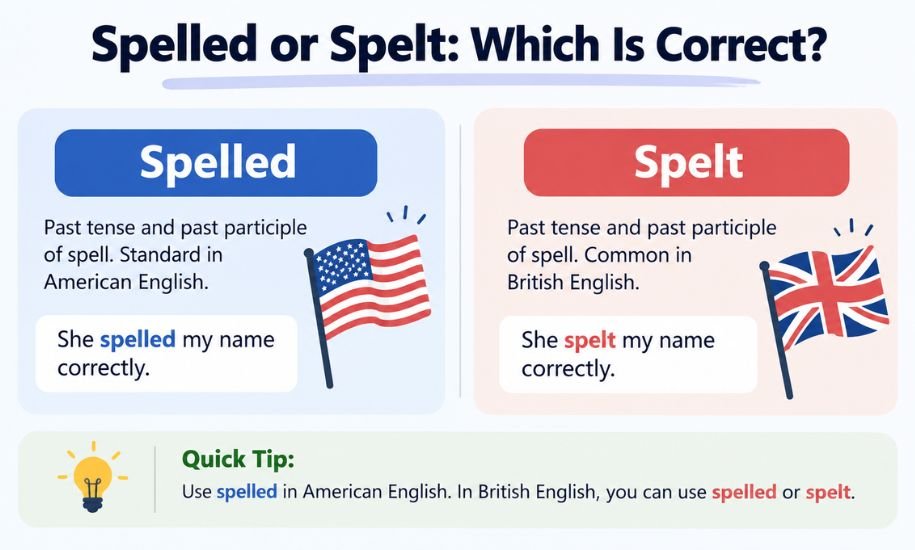
If you have ever wondered whether to write spelled or spelt, you are not alone. Both forms are correct past-tense and past-participle forms of the verb spell, but the form you choose can depend on the variety of English you are using. American English generally prefers spelled, while British English accepts both spelled and spelt, with spelt being especially common. The important point is that spelt is not simply a misspelling of spelled. It is a legitimate English verb form.
Both spelled and spelt are correct forms of the verb spell. Spelled is the standard choice in American English, while British English accepts both forms and commonly uses spelt. Choose the form that matches the variety of English you are writing.
Spelled vs Spelt at a Glance
| Feature | Spelled | Spelt |
|---|---|---|
| Base verb | Spell | Spell |
| Past tense | Yes | Yes |
| Past participle | Yes | Yes |
| American English | Standard | Less usual |
| British English | Correct | Correct and common |
| Meaning | To write or say the letters of a word correctly | Same |
| Example | She spelled my name correctly. | She spelt my name correctly. |
The difference is therefore mainly regional usage, not meaning.
What Does “Spelled” Mean?
Spelled is the past tense and past participle of spell. The verb spell can mean to write or say the letters of a word in the correct order.
For example:
- I spelled the word correctly.
- She spelled my surname incorrectly.
- The teacher spelled the difficult word on the board.
- We have spelled the name the same way throughout the document.
In American English, spelled is the normal form in both everyday and formal writing.
It is also perfectly acceptable in British English. British writers do not have to use spelt.
What Does “Spelt” Mean?
Spelt is another past-tense and past-participle form of spell. It has exactly the same meaning as spelled when it is being used as a verb.
For example:
- She spelt my name correctly.
- I spelt the word incorrectly.
- He spelt out the instructions clearly.
- The surname was spelt differently on the old document.
This form is particularly associated with British English and is widely accepted there.
So if you see someone write, “I spelt your name wrong,” there is no grammatical error simply because they used spelt instead of spelled.
Which Form Is Used in the UK?
In British English, both spelled and spelt are correct.
The shorter form spelt is traditionally associated with British usage, but spelled is also used by British speakers and writers. This means it would be misleading to say that spelled is American and spelt is British in an absolute sense.
A better rule is:
American English usually prefers “spelled,” while British English allows both “spelled” and “spelt.”
For example, a British writer might write:
The word was spelt incorrectly.
Another British writer could write:
The word was spelled incorrectly.
Both sentences are grammatically acceptable.
What About American English?
For American English, spelled is the safest and most natural choice.
Examples include:
I spelled your name correctly.
How is the word spelled?
The student spelled the word incorrectly.
She spelled out exactly what she wanted.
Using spelled is particularly appropriate when writing for an American audience, in American publications, or in documents that otherwise follow US spelling conventions.
Is “Spelt” Wrong?
No. Spelt is not wrong.
It is a standard past-tense and past-participle form of spell, particularly in British English.
The confusion often comes from the fact that American English overwhelmingly favors spelled. Someone accustomed to US English may therefore see spelt and assume it is incorrect.
Compare:
British English:
I spelt the word correctly.
American English:
I spelled the word correctly.
The meaning is identical.
The important distinction is not correct vs incorrect, but rather regional preference and consistency.
“My Name Is Spelled” or “My Name Is Spelt”?
Both versions are correct.
You can write:
My name is spelled Daniel.
or:
My name is spelt Daniel.
However, in natural everyday English, a more common construction would be:
My name is spelled D-A-N-I-E-L.
or:
My name is spelt D-A-N-I-E-L.
The first version fits American English particularly well, while the second is very natural in British English.
The same distinction applies to questions:
How is your name spelled?
How is your name spelt?
Neither question is grammatically wrong.
Examples of “Spelled” and “Spelt”
Seeing the two forms side by side makes the distinction easier to understand.
Example 1
US:
She spelled the word correctly.
UK:
She spelt the word correctly.
Example 2
US:
I accidentally spelled his surname incorrectly.
UK:
I accidentally spelt his surname incorrectly.
Example 3
US:
The teacher spelled out the rules.
UK:
The teacher spelt out the rules.
Example 4
US:
How is this word spelled?
UK:
How is this word spelt?
These examples demonstrate that changing the form does not change the underlying meaning.
Why Are There Two Forms?
The two forms are part of a broader pattern in English. Some verbs have both a regular -ed form and a shorter form ending in -t, particularly in British English.
Examples include:
- learned / learnt
- dreamed / dreamt
- burned / burnt
- spelled / spelt
This does not mean that every verb can freely switch between -ed and -t. These are established forms that have developed through English usage.
For spell, both spelled and spelt have survived, with regional preferences determining which one sounds more natural.
“Spelled or Spelt Wrong”: What Should You Use?
If you are wondering which form to use when saying that a word was written incorrectly, either can work depending on your variety of English.
For American English:
I spelled the word wrong.
For British English:
I spelt the word wrong.
You can also use the more formal construction:
I spelled the word incorrectly.
I spelt the word incorrectly.
Both are grammatically sound.
The important thing is to maintain consistency with the variety of English used throughout your writing.
One More Meaning of “Spelt”
There is one potentially confusing detail: spelt can also be a noun.
In this context, spelt refers to a type of ancient wheat. This is completely unrelated to the past tense of spell.
For example:
The recipe uses spelt flour.
Here, spelt flour means flour made from spelt, a type of wheat.
It does not mean “flour that has been spelled.”
This distinction explains why you may encounter the phrase spelt flour even in contexts that have nothing to do with spelling.
Compare:
She spelt the word correctly.
Here, spelt is a verb form.
The bread contains spelt flour.
Here, spelt is a noun referring to a grain.
Common Mistakes to Avoid
1. Saying that “spelt” is always wrong
This is incorrect. Spelt is a legitimate verb form, especially common in British English.
2. Saying that “spelled” is only American
That is also too broad. British English accepts spelled as well as spelt.
3. Mixing regional conventions unnecessarily
If you are writing an American English document, consistently using spelled will usually sound most natural. If you are following British English, either form can be used, but consistency is helpful.
4. Confusing “spelt” the verb with “spelt” the grain
Context determines the meaning. Spelt flour refers to flour made from the spelt grain, not a special spelling-related expression.
How to Remember the Difference
A simple rule is:
US English → spelled
British English → spelled or spelt
If you are writing for an international audience and want to avoid regional uncertainty, spelled is generally the more widely recognizable choice.
If your writing consistently follows British English conventions, spelt is perfectly acceptable.
The key is not to treat one as universally right and the other as universally wrong.
Frequently Asked Questions
Is “spelled” or “spelt” correct?
Both are correct forms of the verb spell. Spelled is the standard form in American English, while British English accepts both spelled and spelt.
Is “spelt” British or American?
Spelt is particularly associated with British English. American English generally prefers spelled, although spelt may occasionally be encountered.
Can I use “spelled” in British English?
Yes. Spelled is accepted in British English. British writers can use either spelled or spelt, although spelt has a strong traditional association with British usage.
Is “spelt” wrong in American English?
It is not inherently an impossible English form, but spelled is the normal standard choice in American English. If you are writing specifically for a US audience, spelled is the better option.
Is “my name is spelt” correct?
Yes. “My name is spelt…” is grammatically correct, particularly in British English. In American English, “My name is spelled…” is the usual form.
Does “spelt flour” mean something different?
Yes. In spelt flour, spelt refers to a type of wheat. It is a noun rather than the past tense of spell, so the phrase has nothing to do with spelling words.
Final Verdict: Spelled or Spelt?
Spelled and spelt are both correct. Use spelled when following standard American English, while British English allows both spelled and spelt. If you are writing for a particular audience, follow its usual convention and remain consistent.
For more straightforward explanations of confusing English forms and word choices, Grammarifyr helps you know the difference and use the right words.
You may also Read : Vertex vs Vertices: Meaning, Examples and Correct Use

One Comment