Till or Til: Correct Spelling and Usage
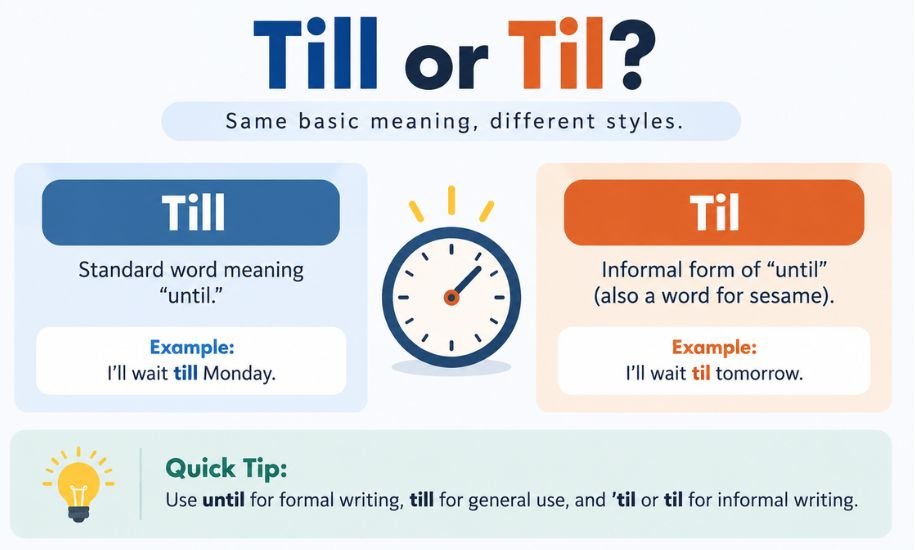
The words till, til, ’til, and until can look almost interchangeable, especially when you mean “up to a particular time.” The confusion becomes even greater because dictionaries do not treat every form in exactly the same way. Till is a standard English word, while ’til is an informal shortened form of until. Some dictionaries also recognize til as an informal form. Knowing when each form is appropriate makes your writing clearer and helps you avoid unnecessary spelling mistakes.
Till is the standard word when you mean “until.” Until is the safest choice for formal writing, while ’til is an informal shortened form. Plain til is also recognized by some dictionaries as an informal form, but it is less conventional in carefully edited writing.
Till or Til: What’s the Difference?
The simplest way to understand these forms is to separate till from ’til and til.
| Form | Correct? | Meaning | Typical use |
|---|---|---|---|
| till | Yes | Until; up to a particular time | Standard English |
| until | Yes | Up to a particular time | Standard and formal writing |
| ’til | Yes | Informal shortening of until | Casual writing |
| til | Recognized informally | Until; also has other meanings | Informal contexts |
| ’till | Generally avoid | Intended to mean until | Usually unnecessary |
Cambridge lists till as both a preposition and conjunction meaning “up to the time that” or “until.” Oxford lists till, til, and ’til as informal forms associated with until.
So, if you are wondering is it til or till, the answer depends on the context. For standard edited writing, till or until is the better choice.
What Does “Till” Mean?
Till can function as a preposition or a conjunction when it refers to time.
It means “until” or “up to a particular time.” Cambridge gives examples such as “We waited till six thirty” and “I’ll keep you company till the train comes.”
Examples
- I will stay till midnight.
- Please wait till I get home.
- We worked till the sun went down.
- She won’t leave till her brother arrives.
- The shop is open till 9 p.m.
In each sentence, till can be replaced by until without changing the basic meaning:
I will stay until midnight.
Please wait until I get home.
This is why till or until is usually a matter of style rather than meaning.
What Does “Until” Mean?
Until is the full, standard form and means “up to the time that” something happens or “up to” a specified point in time.
It can also function as either a preposition or conjunction.
Examples
- We waited until noon.
- She stayed at work until Friday.
- Don’t open the package until I arrive.
- He didn’t understand the problem until the teacher explained it.
- The museum will remain open until six.
If you are writing a formal report, academic paper, business document, or other carefully edited text, until is an easy and uncontroversial choice.
Is “Til” a Correct Word?
This is where the answer requires a little nuance.
Til is not simply a universal misspelling. Oxford lists til as an informal form of until, alongside till and ’til.
Dictionary.com also recognizes til as a separate English word referring to the sesame plant, while ’til is listed as a preposition meaning until or till. It also lists TIL as an abbreviation for “Today I Learned.”
That means context matters.
For example:
I’ll wait til tomorrow.
Here, til is being used informally to mean until.
But:
Til is another name for sesame.
Here, til is a completely different noun.
For polished writing, however, till or until is generally a clearer choice.
Is It “’Til” or “Till”?
Both forms can be used, but they have different backgrounds.
Till is an independent English word. It does not need an apostrophe.
’Til is an informal shortening of until. The apostrophe indicates that part of the original word has been omitted. Cambridge describes till and ’til as more informal than until, while Dictionary.com distinguishes till as a separate word rather than a shortened version of until.
Compare:
I’ll wait till Monday.
I’ll wait ’til Monday.
Both communicate the same basic meaning.
For formal writing:
I’ll wait until Monday.
is the safest option.
What about “’till”?
The spelling ’till is generally unnecessary. If you mean the standard word, simply write till. If you want the informal contraction of until, ’til is the conventional apostrophe form. Dictionary.com describes ’till as an unnecessary or generally misspelled form.
When Should You Use “Till”?
Use till when you want a concise alternative to until in ordinary English.
Examples
Time
We stayed till midnight.
An event
Wait till the rain stops.
A period
The café is open from morning till evening.
A negative construction
She didn’t call till after dinner.
A continuing action
He worked till he finished the project.
Cambridge treats till as a standard preposition and conjunction with the same basic temporal meaning as until.
Although some style guidance prefers until in formal writing, till itself is not simply a spelling mistake.
When Should You Use “’Til”?
’Til is most useful when you deliberately want an informal or conversational tone.
For example:
See you ’til next time!
We danced ’til midnight.
I won’t know ’til tomorrow.
It can also appear in song titles, creative writing, advertising, dialogue, and other contexts where a casual tone is appropriate.
For formal prose, until is usually preferable.
Cambridge specifically notes that till and ’til are more informal than until and says they are not usually used in formal writing.
Till vs. Until: Are They Interchangeable?
For their time-related meaning, yes, they are generally interchangeable.
Compare:
I stayed till 10 p.m.
I stayed until 10 p.m.
Both mean that the person stayed up to that time.
Similarly:
Don’t leave till I return.
Don’t leave until I return.
The meaning remains essentially the same.
Dictionary.com describes till and until as interchangeable in these constructions, while Cambridge lists till as another form of until.
The main difference is style and formality, not the underlying time relationship.
“Till Death” or “Til Death”?
If you mean “until death,” the standard spelling is:
till death
For example:
They promised to remain together till death.
You can also write:
They promised to remain together until death.
In an informal contraction, you may encounter:
’til death
The phrase til death without the apostrophe can also be found in informal writing, and Oxford recognizes til as an informal form.
For formal or carefully edited writing, however, till death or until death is the clearest choice.
A Useful Difference: “Until” vs. “By”
One mistake worth avoiding is treating until and by as interchangeable.
They describe different ideas.
Until indicates that an action or situation continues up to a particular point:
I will work until Friday.
This means the activity continues through the period leading to Friday.
By indicates a deadline:
I will finish the work by Friday.
This means the work must be completed no later than Friday.
Cambridge specifically distinguishes until from by when discussing deadlines and points in time.
Compare
Correct:
She will stay here until Monday.
Correct:
She will finish the report by Monday.
The first sentence focuses on duration. The second focuses on a deadline.
Common Mistakes With These Forms
1. Treating “till” as a misspelling
Incorrect assumption:
Till is just a misspelling of ’til.
This is not accurate. Till is an established English word with its own history and meaning. It can independently mean until.
2. Using “’till” unnecessarily
❌ I’ll wait ’till Monday.
✅ I’ll wait till Monday.
If you mean the established word till, there is no reason to add an apostrophe.
3. Using “til” in formal writing
Informal: I’ll wait til tomorrow.
More polished: I’ll wait until tomorrow.
While dictionaries recognize informal til, until is less likely to raise questions in formal writing.
4. Confusing “til” with “TIL”
TIL in internet and social-media contexts can mean “Today I Learned.” It is an abbreviation rather than a spelling of until.
For example:
TIL that octopuses have three hearts.
That has nothing to do with till or until.
Easy Way to Remember
Use this simple three-part rule:
Until = safest formal choice
Till = standard alternative
’Til = informal shortening
And remember:
Till does not need an apostrophe.
If you’re unsure while proofreading an important piece of writing, choose until. If you’re writing naturally and conversationally, till is perfectly usable.
Examples at a Glance
Here are some practical examples showing how the forms work:
| Meaning | Example |
|---|---|
| Standard | I’ll stay until noon. |
| Standard alternative | I’ll stay till noon. |
| Informal | I’ll stay ’til noon. |
| Informal spelling | I’ll stay til noon. |
| Avoid | I’ll stay ’till noon. |
The first two are the safest choices for general writing. The third is appropriate when an informal tone is intended. The fourth is recognized in some dictionaries as informal but is less conventional in edited prose.
Frequently Asked Questions
Is it til or till?
When you mean “until,” till is the standard standalone word. Til is also recognized as an informal form by Oxford, but until or till is generally a safer choice in carefully edited writing.
Is it ’til or till?
Both can be correct, but they are different forms. Till is an established word, while ’til is an informal shortening of until. In formal writing, until is usually preferable.
Is “till” grammatically correct?
Yes. Till can function as a preposition or conjunction meaning “until” or “up to a particular time.” For example, “Wait till I get there” is grammatically correct.
Is “til” a real word?
Yes, but context matters. Oxford recognizes til as an informal form of until. Dictionary.com also lists til as a noun for sesame and TIL as an abbreviation for “Today I Learned.”
Should I use “until” or “till” in formal writing?
Until is the safest choice for formal writing. Cambridge notes that till and ’til are more informal than until, although till remains a standard English word.
Is “til death” correct?
If you mean “until death,” till death and until death are clear standard choices. ’Til death can be used as an informal contraction, while plain til death is more informal. For polished writing, use till death or until death.
The Bottom Line
When choosing between these forms, till and until are the clearest standard options. ’Til works as an informal shortening, while til is recognized informally by some dictionaries but is less conventional in edited writing. If you want the safest choice for formal English, use until; for ordinary writing, till is perfectly valid. That simple distinction fits the practical approach of Grammarifyr: know the difference and use the right words.
You may also Read : Favorite or Favourite: US vs UK Spelling
One Comment