Is It Pricey or Pricy? The Correct Spelling Explained
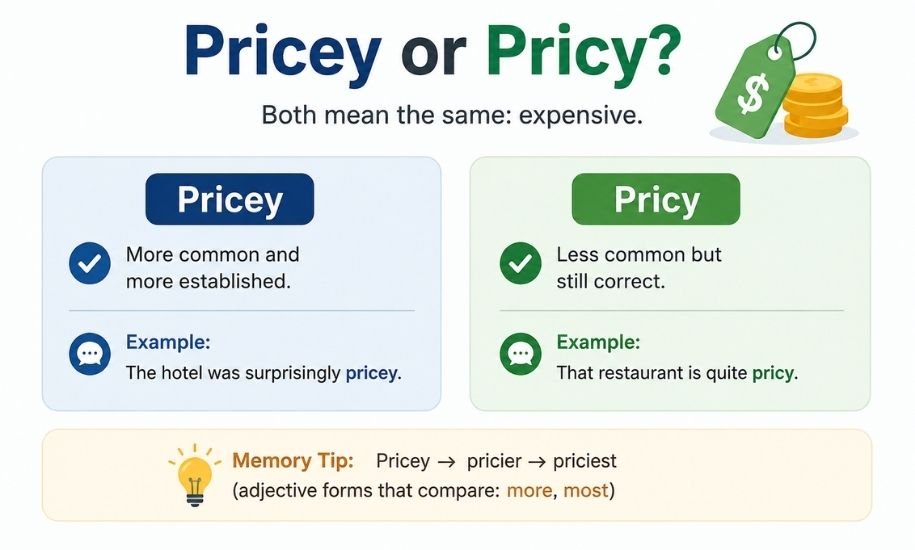
If you have ever hesitated between pricey and pricy, you are not alone. The two spellings look almost identical, sound the same, and refer to the same idea: something that costs a lot of money. The good news is that neither spelling is inherently wrong. Both pricey and pricy are accepted English words, although pricey is the more established form in major dictionaries. The real question is which spelling is the better choice for your writing—and what form you should use when comparing prices.
Pricey and pricy are both correct spellings of the adjective meaning “expensive.” Pricey is the more commonly established form, while pricy is an accepted alternative. For the comparative, use pricier, and for the superlative, use priciest.
Pricey or Pricy: What’s the Difference?
There is no difference in meaning between pricey and pricy. Both are adjectives meaning expensive or, in some contexts, more expensive than someone considers reasonable.
Cambridge lists pricy as an alternative spelling of pricey, while Merriam-Webster describes pricy as a less common variant. Both dictionaries define the word as meaning expensive.
| Feature | Pricey | Pricy |
|---|---|---|
| Correct spelling? | Yes | Yes |
| Meaning | Expensive | Expensive |
| Part of speech | Adjective | Adjective |
| Usage | More established | Less common alternative |
| Comparative | Pricier | Pricier |
| Superlative | Priciest | Priciest |
So if you write:
This restaurant is pricey.
or:
This restaurant is pricy.
both sentences are grammatically correct and mean essentially the same thing.
Which spelling should you choose?
If you want the safest and most familiar option, choose pricey. It is the main form presented by Cambridge and Merriam-Webster, while pricy is treated as an alternative or less common variant.
That does not make pricy incorrect. It simply means that pricey is usually the better default choice.
What Does “Pricey” Mean?
Pricey is an informal adjective meaning expensive. It can describe anything that costs more money than expected or more than the speaker considers reasonable.
For example:
- The hotel was surprisingly pricey.
- That laptop is too pricey for my budget.
- We found a beautiful restaurant, but the menu was quite pricey.
- The tickets are a little pricey, but the seats are excellent.
The word can also be subjective. What seems pricey to one person may seem affordable to another. Dictionary.com notes that the judgment involved in calling something pricey can depend on a person’s budget and expectations.
Is “pricey” formal?
Not usually. Pricey is an informal word, so expensive may be a better choice in highly formal or technical writing. Cambridge specifically labels pricey as informal.
For example:
Conversational:
The new apartment is pretty pricey.
More neutral/formal:
The new apartment is relatively expensive.
This does not mean you should avoid pricey. It is perfectly natural in everyday English, reviews, articles, conversations, and many forms of online writing.
What Does “Pricy” Mean?
Pricy means exactly the same thing as pricey: expensive.
For example:
That designer jacket is rather pricy.
This means:
That designer jacket is rather expensive.
Dictionary.com lists pricy as an adjective and gives pricey as its definition.
The important point is that pricy is not a misspelling. It is a legitimate alternative spelling.
However, because pricey is the more established form, readers are generally more likely to recognize it immediately. If you are choosing one spelling for an article, essay, website, or other piece of general writing, pricey is usually the simplest choice.
Why Are Pricey and Pricy Confused?
The confusion is mainly caused by spelling.
The word is formed from price with the suffix -y. The spelling pricey keeps the original e, while pricy drops it. Both forms have developed as accepted spellings.
Because they have the same pronunciation and meaning, there is no grammatical distinction that tells you when to use one instead of the other.
Compare:
The new car is pricey.
The new car is pricy.
There is no change in meaning. The difference is simply the spelling preference.
More Pricey or Pricier: Which Is Correct?
When you want to compare two things, the standard comparative form is pricier.
The normal progression is:
pricey → pricier → priciest
For example:
This hotel is pricier than the one we stayed at last year.
The newer model is pricier but has better features.
That was the priciest meal we had during the trip.
Both Cambridge and Merriam-Webster list pricier and priciest as the comparative and superlative forms of pricey.
Is “more pricey” wrong?
More pricey can be understood and does occur in English, but pricier is the standard, concise comparative form and is generally the better choice.
Prefer:
The second option is pricier.
Rather than:
The second option is more pricey.
The same principle applies to the superlative. Priciest is the standard form:
It was the priciest restaurant in the area.
Rather than:
It was the most pricey restaurant in the area.
Using pricier and priciest keeps your writing natural and follows the forms given by major dictionaries.
Pricey, Pricier, and Priciest
These three forms express different degrees of the same adjective:
- Pricey — expensive
- Pricier — more expensive than something else
- Priciest — more expensive than all or most of the other options being compared
Consider this example:
This phone is pricey.
You are simply saying that the phone is expensive.
This phone is pricier than the previous model.
You are comparing two phones.
This is the priciest phone in the store.
You are identifying the most expensive option in a group.
This pattern is straightforward and useful to remember:
pricey → pricier → priciest
Examples of Pricey and Pricy in Sentences
Here are some natural examples showing that the two spellings can be used interchangeably.
Pricey
The hotel looked affordable online, but the final bill was quite pricey.
Organic produce can be pricey in some supermarkets.
The headphones are a little pricey, but the sound quality is excellent.
Pricy
That neighborhood has some very pricy apartments.
The restaurant is good, but the portions are small for such a pricy menu.
Some premium cameras are extremely pricy.
In each example, pricey could replace pricy, and vice versa, without changing the meaning.
Pricey vs. Expensive
Although pricey and expensive are close synonyms, they do not always have exactly the same tone.
Expensive is neutral and works comfortably in formal and informal contexts.
The equipment is expensive.
Pricey is more conversational and can suggest that the cost feels high to the speaker.
The equipment is pretty pricey.
There is also a subtle difference in emphasis. Calling something pricey can sound less absolute than simply calling it expensive. For example:
The coffee is a little pricey.
This often suggests that the speaker thinks the price is somewhat high, but not necessarily unreasonable.
That conversational quality is one reason pricey is common when people discuss restaurants, hotels, products, services, travel, and shopping.
Common Mistakes to Avoid
1. Treating “pricy” as a spelling error
Incorrect assumption:
“Pricy” is always wrong.
Better understanding: Both pricy and pricey are accepted. Pricey is simply the more established choice.
2. Using “pricer” when you mean “pricier”
Be careful with the spelling of the comparative.
Correct:
This option is pricier.
Not the intended adjective form:
This option is pricer.
Pricer is actually a separate noun meaning someone or something involved in setting or determining prices, so it should not be used as the comparative of pricey.
3. Forgetting the comparative form
When comparing two things, use pricier:
The blue model is pricier than the black one.
4. Using “most pricey” when “priciest” is available
While most pricey may be understandable, priciest is the established superlative form.
It is the priciest option on the menu.
An Easy Way to Remember
Think of the pattern as:
price → pricey → pricier → priciest
The base adjective is pricey. When you compare two things, change the -y to -ier:
pricey → pricier
For the highest degree, change -y to -iest:
pricey → priciest
You can remember it just like other adjectives ending in -y:
happy → happier → happiest
easy → easier → easiest
pricey → pricier → priciest
Frequently Asked Questions
Is it pricey or pricy?
Both are correct. Pricey is the more established and commonly preferred spelling, while pricy is an accepted alternative. Both mean “expensive.”
Is “pricy” a real word?
Yes. Pricy is a real English adjective and is listed in dictionaries as an alternative spelling of pricey. It means expensive.
Is “pricey” formal English?
Pricey is generally considered informal. It is natural in conversation and casual writing. For formal contexts, expensive or high-priced may be a more neutral choice.
Is it “more pricey” or “pricier”?
Pricier is the standard comparative form. For example: “This model is pricier than the old one.” Major dictionaries list pricier as the comparative form of pricey.
What is the superlative of “pricey”?
The superlative is priciest. For example: “That was the priciest hotel in the city.”
Can I use “pricey” and “pricy” interchangeably?
Yes. Since they have the same meaning, either spelling can be used when you mean “expensive.” For consistency and familiarity, however, pricey is usually the better default.
The Bottom Line
When deciding between pricey or pricy, you do not have to worry about choosing between a correct word and a misspelling. Both are valid, but pricey is the more established form and the safest general choice. When comparing prices, use pricier, and when describing the highest price in a group, use priciest.
For clear, confident word choices and practical grammar guidance, Grammarify helps you know the difference and use the right words.
You may also Read :Gage or Gauge: Meaning, Usage, and Examples
One Comment