Mangos or Mangoes? The Correct Plural Explained
If you have ever wondered whether the plural of mango is mangos or mangoes, you are not alone. The two spellings look different, but the good news is that you do not have to choose between a correct and an incorrect form. Both “mangos” and “mangoes” are accepted plural spellings of “mango.” The main difference is one of spelling preference and style rather than meaning. Understanding when each form is appropriate can help you write confidently and avoid mistakes such as using an apostrophe to make the plural.
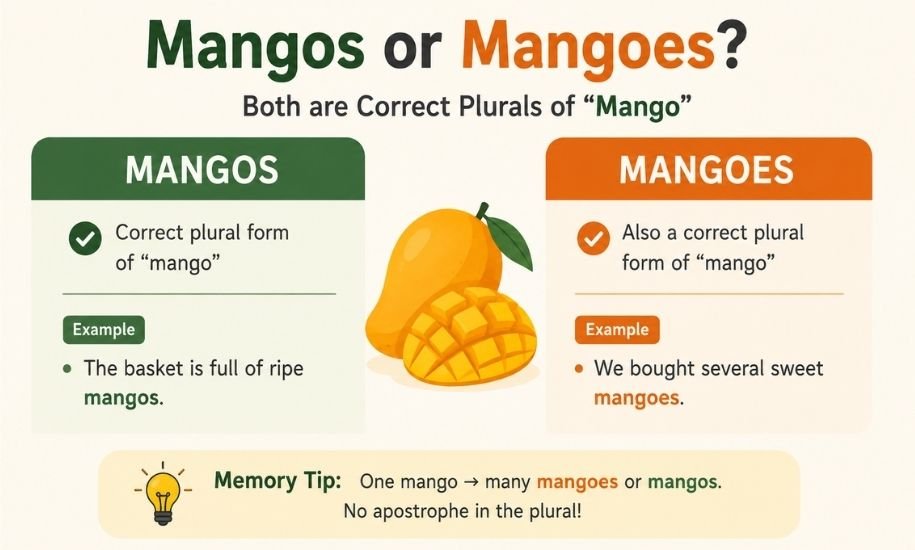
Both “mangos” and “mangoes” are correct. They are two accepted plural forms of mango and have exactly the same meaning. “Mangoes” is a familiar traditional spelling, while “mangos” is also recognized by major dictionaries and is often preferred by some style guides and organizations.
Mangos or Mangoes: Which Is Correct?
The short answer is: both are correct.
Major English dictionaries recognize both forms. Cambridge Dictionary gives mangoes or mangos, Merriam-Webster lists mangoes with mangos as an alternative, and Oxford Advanced Learner’s Dictionary lists both spellings as plurals.
So these sentences are both grammatically correct:
- We bought several mangoes at the market.
- We bought several mangos at the market.
There is no difference in meaning between the two. Both refer to more than one mango.
Quick comparison
| Feature | Mangoes | Mangos |
|---|---|---|
| Correct spelling? | Yes | Yes |
| Singular form | Mango | Mango |
| Plural form | Mangoes | Mangos |
| Meaning | More than one mango | More than one mango |
| Part of speech | Noun | Noun |
| Formal writing | Accepted | Accepted |
| Meaning difference | None | None |
The most important rule is simple: choose one spelling and use it consistently.
What Does “Mangoes” Mean?
Mangoes is the plural form of mango. It refers to two or more mango fruits.
For example:
- She bought five mangoes for the party.
- The mangoes in this basket are ripe.
- We picked fresh mangoes from the tree.
- These mangoes have a sweet, tropical flavor.
Mangoes is particularly familiar to readers because many English speakers naturally form certain nouns ending in -o with -es.
For example:
- tomato → tomatoes
- potato → potatoes
- hero → heroes
- mango → mangoes
However, English does not apply one universal rule to every noun ending in -o. That is one reason the alternative mangos also exists.
What Does “Mangos” Mean?
Mangos is also a correct plural form of mango. It has the same meaning as mangoes.
Examples include:
- The farmer grows hundreds of mangos each year.
- These mangos are ready to eat.
- I bought two ripe mangos for breakfast.
- The store sells fresh mangos throughout the summer.
The shorter spelling is not a typo or an informal mistake. It is an established plural form recognized by dictionaries.
In fact, the National Mango Board uses mangos in its own published material while acknowledging that mangoes is also correct.
Why Are There Two Plural Spellings?
The confusion comes partly from the way English handles nouns ending in -o.
Some words traditionally take -es:
- potato → potatoes
- tomato → tomatoes
- echo → echoes
Others normally take -s:
- photo → photos
- piano → pianos
- radio → radios
Then there are words such as mango that have developed both accepted plural forms.
That means you should not assume that every word ending in -o must take -es. English plural formation contains many exceptions and variations, and mango is one of the nouns where both forms are standard.
Is It “Mangos or Mangoes Plural”?
If you are asking for the plural of mango, either answer is correct:
Singular: mango
Plural: mangoes or mangos
For example:
One mango was sitting on the counter.
becomes:
Three mangoes were sitting on the counter.
or:
Three mangos were sitting on the counter.
Both versions follow standard English usage.
The important thing is not to treat mangos as a misspelling simply because mangoes looks more familiar.
Which Form Should You Use?
If both forms are correct, how do you decide?
For most general writing, mangoes is a safe and familiar choice. It may look more natural to readers who are accustomed to forming the plural with -es.
However, mangos is perfectly acceptable, particularly if it matches the style of the publication, organization, dictionary, or brand you are writing for.
The best practical rule is:
Follow your preferred style guide and remain consistent.
For example, if you begin an article with mangoes, continue using mangoes rather than switching randomly to mangos later.
Example of consistent usage
Good:
The market received a shipment of fresh mangoes. These mangoes were harvested earlier this week.
Also good:
The market received a shipment of fresh mangos. These mangos were harvested earlier this week.
Less consistent:
The market received a shipment of fresh mangoes. These mangos were harvested earlier this week.
The last example is not grammatically wrong, because both forms are valid, but switching spellings without a reason can make your writing look inconsistent.
Is “Mango’s” the Plural?
No. This is an important distinction.
Mango’s with an apostrophe is not the ordinary plural of mango.
Use:
- mangoes — plural
- mangos — plural
- mango’s — possessive singular
For example:
I bought three mangoes.
Here, mangoes means more than one mango.
But:
The mango’s skin was beginning to wrinkle.
Here, mango’s indicates that the skin belongs to or is associated with one mango.
You would not normally write:
I bought three mango’s.
That is an incorrect way to form the plural.
Examples: Mangos vs. Mangoes in Sentences
Because both spellings are valid, you can use either one in ordinary sentences.
Using “mangoes”
- The children shared two ripe mangoes.
- These mangoes are sweeter than the ones we bought yesterday.
- She added fresh mangoes to the fruit salad.
- The tree produced dozens of mangoes this year.
Using “mangos”
- The children shared two ripe mangos.
- These mangos are sweeter than the ones we bought yesterday.
- She added fresh mangos to the fruit salad.
- The tree produced dozens of mangos this year.
Notice that the meaning does not change. Only the spelling of the plural changes.
A Simple Way to Remember the Difference
Think of the word mango as a noun with two accepted plural endings:
mango → mangoes
mango → mangos
You do not need to memorize a complicated rule.
If you prefer the more traditional-looking form, choose mangoes. If your preferred style uses the shorter plural, mangos is correct too.
The one form to avoid for a normal plural is mango’s.
A useful three-part reminder is:
One mango → two mangoes → no apostrophe.
Or, if you prefer the shorter form:
One mango → two mangos → no apostrophe.
Common Mistakes to Avoid
1. Treating “mangos” as automatically wrong
It is not wrong. Major dictionaries recognize it as an accepted plural.
2. Treating “mangoes” as the only possible plural
Mangoes is correct, but it is not the only accepted form. Mangos is also standard.
3. Writing “mango’s” for multiple fruits
An apostrophe does not normally make a noun plural. Use mangoes or mangos instead.
4. Switching between spellings without a reason
Both forms can appear in English, but consistent spelling makes your writing cleaner.
5. Assuming every “-o” word follows the same plural rule
English nouns ending in -o can form plurals in different ways. Some take -es, some take -s, and some, like mango, allow both.
Frequently Asked Questions
Is “mangos” grammatically correct?
Yes. Mangos is a recognized plural of mango. It is not simply a shortened or incorrect version of mangoes. Major dictionaries, including Merriam-Webster and Cambridge, recognize the spelling.
Is “mangoes” correct?
Yes. Mangoes is a standard and widely recognized plural form of mango. It can be used in everyday, academic, professional, and formal writing.
Is it “mangos or mangoes” in formal writing?
Either spelling can be used in formal writing. If you do not have a specific house style, mangoes may be the more familiar choice for many readers. However, mangos is also an accepted standard spelling.
Is “mango’s” ever correct?
Yes, but not as the ordinary plural. Mango’s can be a possessive singular form, as in “The mango’s flavor was excellent.” For more than one fruit, use mangoes or mangos.
What is the plural of mango?
The plural can be mangoes or mangos. Both forms are grammatically correct and have the same meaning.
Final Verdict: Mangos or Mangoes?
Mangos and mangoes are both correct plural forms of “mango.” There is no difference in meaning, and neither spelling should automatically be labeled wrong. Mangoes is a familiar traditional choice, while mangos is also fully accepted.
If you are unsure which one to use, pick the spelling that fits your preferred style and use it consistently. For more clear answers to confusing spelling and word-choice questions, Grammarify helps you know the difference and use the right words.
You may also Read : Pricey or Pricy The Correct Spelling Explained



One Comment