Themself or Themselves: Meaning and Examples
It is easy to hesitate over themself or themselves, especially when they refers to only one person. Traditionally, themselves has been the familiar reflexive form, particularly when they is plural. However, modern English also uses singular they, and themself has developed as a singular reflexive form. So, neither word can simply be dismissed as a spelling mistake. The right choice depends on whether they refers to one person or several people, as well as the style and context of the sentence.
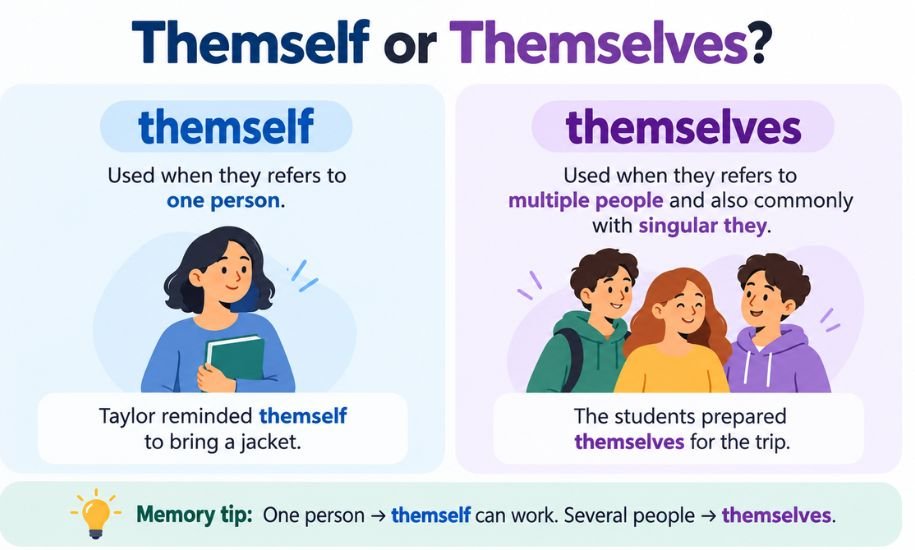
Both themself and themselves are legitimate forms, but they are not used in exactly the same way. Themselves is the standard reflexive form when they refers to multiple people and is also widely used with singular they. Themself is a singular reflexive form used when they refers to one person.
The Key Difference
The simplest way to understand the distinction is to look at what they refers to.
| Form | Typical reference | Example |
|---|---|---|
| themself | One person | Alex reminded themself to bring a jacket. |
| themselves | Two or more people | The children prepared themselves for school. |
| themselves | Also used with singular they | Someone should ask themselves before deciding. |
When they clearly refers to several people, themselves is the appropriate choice:
The players congratulated themselves after the match.
When they refers to one person, themself can make the singular meaning especially clear:
Jordan taught themself how to play the piano.
However, modern English also commonly uses themselves with singular they:
Jordan taught themselves how to play the piano.
That means the choice is not always a simple matter of “one is correct and the other is wrong.”
What Does “Themself” Mean?
Themself is a reflexive pronoun associated with singular they. It can be used when a person is referred to with they/them pronouns or when the gender of an individual is unknown or deliberately unspecified.
For example:
Taylor bought themself a new notebook.
Here, themself refers back to Taylor, who is one person.
Another example is:
Every student should give themself enough time to complete the assignment.
In this sentence, student is singular, and themself emphasizes the singular reference.
The form is especially useful when the writer wants the singular nature of the reference to remain clear.
Examples with “themself”
- Casey reminded themself to lock the door.
- The artist challenged themself to try a new style.
- Someone should ask themself whether the decision is fair.
- The author described themself as a lifelong reader.
These sentences use themself reflexively: the pronoun refers back to the person who is performing the action.
What Does “Themselves” Mean?
Themselves is the traditional reflexive pronoun corresponding to they and is unquestionably standard when they refers to multiple people.
For example:
The students organized themselves into groups.
The two friends bought themselves tickets.
The employees introduced themselves to the new manager.
In each sentence, the subject represents more than one person.
The word can also be used with singular they, which is why the distinction has become more complicated. In contemporary English, sentences such as this are common:
Every employee should introduce themselves.
Although employee is singular, themselves is used because the sentence uses singular they.
Is “Themself” Correct for One Person?
Yes. Themself is an established singular reflexive form, although it is not accepted or preferred equally by every speaker, editor, or style guide.
Its main purpose is to provide a singular reflexive counterpart to singular they.
For example:
Morgan reminded themself about the appointment.
Here, Morgan is one individual.
Using themself can be particularly useful when there is a need to distinguish a singular person from a plural group:
The manager themself approved the proposal.
The form also appears in contexts involving people who use singular they.
However, themselves is also widely accepted with singular they, so the following can also be grammatical:
Morgan reminded themselves about the appointment.
This is one reason that calling themself simply “wrong” would give readers an incomplete picture of modern English.
Can “Themselves” Refer to One Person?
Yes. This is one of the most important points to remember.
Singular they has a long history in English and is widely used when referring to an individual whose gender is unknown, irrelevant, or not specified. In such constructions, themselves is commonly used as the reflexive form.
For example:
If someone leaves a message, they should identify themselves.
The word someone refers to one person, but themselves is used naturally with singular they.
Another example:
Every applicant should ask themselves whether the position is suitable.
Although applicant is singular, themselves works with the singular pronoun they.
This means that “themselves” does not automatically mean that the subject must refer to several people.
Themself or Themselves for Singular “They”
When they refers to one person, both forms can appear.
Compare:
Sam prepared themself for the interview.
Sam prepared themselves for the interview.
Both sentences can be understood as referring to one person.
The difference is largely one of usage and style. Themself explicitly signals the singular reference, while themselves is more familiar to many readers and remains very common with singular they.
For formal writing, it is worth considering the expectations of the publication, institution, or style guide you are following. If a person’s stated pronouns or preferred form are known, respecting that preference is also important.
What About Nonbinary People?
Themself can be used when referring to a nonbinary person who uses singular they pronouns.
For example:
Riley described themself as an experienced designer.
Or:
Riley described themselves as an experienced designer.
The important point is that singular they is not restricted to situations where the person’s gender is unknown. It can also be the pronoun a particular person uses.
When writing about an individual, follow the person’s established pronouns and, where relevant, their preferred style of reflexive wording.
If no preference is known, themselves will often sound more familiar to a broad audience, while themself can make the singular construction more explicit.
Themself or Themselves: Examples
Here are several examples showing how the two forms work in context.
When “themself” refers to one person
Avery taught themself to cook.
The writer pushed themself to finish the novel.
Chris reminded themself to send the email.
The student gave themself another opportunity to improve.
When “themselves” refers to multiple people
The children dressed themselves.
The musicians introduced themselves.
The guests served themselves dinner.
The workers divided themselves into teams.
When “themselves” refers to one person
Every applicant should ask themselves this question.
Someone should remind themselves to check the details.
If a person wants to improve, they must challenge themselves.
In these examples, the subjects are grammatically singular, but singular they makes themselves a natural reflexive choice.
“They Themselves” and “Themself” Are Not the Same
Another source of confusion is the emphatic use of reflexive pronouns.
Consider:
They themselves made the decision.
Here, themselves adds emphasis. It means that they personally made the decision.
With a singular person using they, you may also encounter:
The author themself explained the decision.
Here, themself emphasizes the individual person being discussed.
The choice therefore depends not only on number but also on how the pronoun functions in the sentence.
Common Mistakes to Avoid
1. Using “themself” for a clearly plural subject
Incorrect:
The students taught themself the material.
Better:
The students taught themselves the material.
When the subject refers to multiple people, themselves is the standard form.
2. Assuming “themselves” can never refer to one person
That rule is too strict for modern English.
Correct:
Every customer should ask themselves whether they need the service.
Here, customer is singular, but singular they is being used.
3. Treating “themself” as merely a misspelling
Themself is not simply a typing error for themselves. It is recognized as a singular reflexive form in modern English, although its acceptance varies across dictionaries, style guides, and individual preferences.
4. Ignoring the person’s pronouns
If someone uses they/them pronouns, changing the pronouns simply because a writer finds singular they unfamiliar can make the sentence inaccurate or inappropriate.
An Easy Way to Remember the Difference
A useful rule is:
One person → themself can work.
Several people → themselves.
But remember the second part of the rule:
Singular they can also take themselves.
So, think of themself as the more explicitly singular option rather than assuming that themselves is always plural.
Compare:
Jamie prepared themself.
Jamie prepared themselves.
versus:
Jamie and Alex prepared themselves.
The first two can refer to one person; the last clearly refers to more than one.
Which Form Should You Use in Formal Writing?
If you are writing for a formal audience, themselves is often the safer and more familiar choice when singular they is being used:
Each applicant should introduce themselves.
It is widely understood and accepted in contemporary formal English.
That does not make themself incorrect. It can be an appropriate choice when the singular reference needs to be especially clear or when it matches the preferred usage of the person or publication.
Consistency matters. Once you choose a style for a particular piece of writing, use it consistently unless the context calls for something different.
Frequently Asked Questions
Is “themself” grammatically correct?
Yes. Themself is recognized as a singular reflexive form associated with singular they. It is less universally preferred than themselves, but it is not simply a misspelling.
Is “themselves” correct for one person?
Yes. Themselves is widely used with singular they. For example, “Every student should give themselves enough time” is a standard contemporary construction.
Should I use “themself” or “themselves” for a nonbinary person?
Both can be used with singular they. The best choice may depend on the person’s own preference and the style being followed. If the person has expressed a preferred form, follow it.
Is “themselves” only for plural people?
No. It is the standard reflexive form for plural they, but it is also widely used with singular they. Context determines whether the underlying reference is singular or plural.
Is “themself” more correct than “themselves” for one person?
Not necessarily. Themself specifically highlights the singular reference, but themselves is also widely accepted with singular they. The appropriate choice depends on context, style, and sometimes personal preference.
Final Verdict: Themself or Themselves?
Both themself and themselves have legitimate uses. Use themselves when they refers to multiple people, and remember that it is also commonly used with singular they. Themself is a recognized singular reflexive form and can be useful when they clearly refers to one person.
If you want a simple rule, think “themself” for singular emphasis, “themselves” for plural—and also commonly for singular they. For more clear, practical explanations of confusing English forms, Grammarifyr helps you know the difference and use the right words.
You may also Read : Whoever or Whomever: Difference and Examples
One Comment