Analyze or Analyse: Correct Spelling and Usage
Have you ever wondered whether to write analyze or analyse? Both spellings are correct, but the one you should use depends on the variety of English you are writing in. American English generally uses analyze, while British English prefers analyse. The two words have exactly the same meaning: to examine something carefully to understand it, identify patterns, or draw conclusions. Knowing which spelling fits your audience will help you write consistently in school assignments, professional documents, and everyday communication.
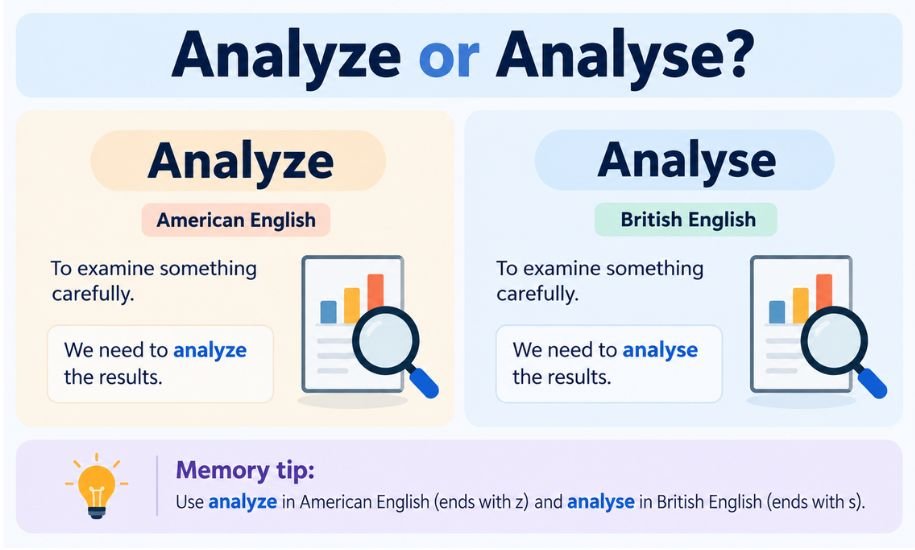
Both analyze and analyse are correct spellings. Use analyze in American English and analyse in British English. Both mean to examine something carefully, and the difference is spelling rather than meaning.
Analyze vs. Analyse: What Is the Difference?
The main difference is regional spelling. American English uses the letter combination -yze, whereas British English generally uses -yse.
| Feature | Analyze | Analyse |
|---|---|---|
| Correct spelling? | Yes | Yes |
| English variety | American English | British English |
| Part of speech | Verb | Verb |
| Meaning | Examine carefully | Examine carefully |
| Past tense | Analyzed | Analysed |
| Present participle | Analyzing | Analysing |
| Related noun | Analysis | Analysis |
Neither spelling is universally better than the other. The right choice depends on your audience and the style guide you follow. If you are writing for an American publication, choose analyze. If your readers are primarily in the UK, analyse is usually the appropriate option.
What Does Analyze Mean?
Analyze is a verb that means to examine something systematically and carefully to understand its components, meaning, or significance. It often involves studying information, identifying patterns, and using evidence to reach a conclusion.
This spelling is standard in American English and appears frequently in academic, scientific, business, and everyday writing.
Examples:
- The researchers will analyze the results before publishing their findings.
- Our team needs to analyze customer feedback to improve the service.
- The teacher asked the students to analyze the poem’s central message.
- We analyzed the sales figures to understand why revenue declined.
In each example, analyze describes the process of examining information rather than simply looking at it.
What Does Analyse Mean?
Analyse has the same meaning as analyze. It is the preferred spelling in British English and is also used in other varieties of English that follow British spelling conventions.
The word can describe examining data, interpreting literature, investigating a problem, or evaluating evidence. Its meaning does not change when the final letters change from -yze to -yse.
Examples:
- The scientists will analyse the samples in the laboratory.
- The committee must analyse the proposal before making a decision.
- She analysed the novel’s characters and themes for her essay.
- The company is analysing its latest customer survey.
These sentences follow the same grammatical patterns as their American English equivalents. Only the spelling differs.
Why Are the Two Spellings Confused?
The confusion comes from the differences between American and British spelling conventions. English has several pairs of words that follow similar regional patterns, including organize/organise, recognize/recognise, and realize/realise.
In these pairs, American English generally uses -ize, while British English commonly uses -ise. The word analyze follows a related but slightly different pattern: American English uses -yze, and British English uses -yse.
Because both versions are accepted, it would be inaccurate to describe analyse as a misspelling in all contexts or to claim that analyze is incorrect everywhere outside the United States.
The most important rule is to use the spelling expected by your audience and remain consistent throughout your writing.
Analyze or Analysed: Understanding the Verb Forms
The spelling difference continues in related verb forms. Learning these variations makes it easier to choose the correct form when writing about past actions or ongoing activities.
| Grammatical form | American English | British English |
|---|---|---|
| Base form | Analyze | Analyse |
| Third-person singular | Analyzes | Analyses |
| Past tense | Analyzed | Analysed |
| Past participle | Analyzed | Analysed |
| Present participle | Analyzing | Analysing |
Consider the following examples:
American English:
- She analyzes every report carefully.
- He analyzed the data yesterday.
- They are analyzing the results now.
British English:
- She analyses every report carefully.
- He analysed the data yesterday.
- They are analysing the results now.
Notice that analyses has two possible grammatical uses. It can be the third-person singular verb, as in “She analyses the figures,” or the plural noun, as in “The analyses were completed.” The surrounding sentence tells you which meaning is intended.
Analysis or Analyse: Which Word Should You Use?
Although analysis and analyse are related, they have different grammatical functions.
- Analyse is a verb in British English. It describes the action of examining something.
- Analyze is the corresponding American English verb.
- Analysis is a noun in both varieties. It refers to the process of examination or the results of that process.
- Analyses is the plural form of the noun analysis and can also be a verb form.
Examples:
- Correct: The researcher will analyse the evidence. (British English)
- Correct: The researcher will analyze the evidence. (American English)
- Correct: The analysis revealed several important patterns.
- Correct: The two analyses reached similar conclusions.
A common mistake is to use analyse when a noun is required. For instance, “The analyse was detailed” is incorrect in standard English. The correct sentence is “The analysis was detailed.”
Analyze or Analyse: Examples in Different Contexts
Seeing both forms in realistic situations makes the distinction easier to remember.
Academic writing
American English: Students must analyze the author’s argument and support their conclusions with evidence.
British English: Students must analyse the author’s argument and support their conclusions with evidence.
Business communication
American English: The management team will analyze quarterly performance before setting new targets.
British English: The management team will analyse quarterly performance before setting new targets.
Science and research
American English: Researchers analyzed the samples to identify possible changes.
British English: Researchers analysed the samples to identify possible changes.
Everyday conversation
American English: I need to analyze the situation before deciding what to do.
British English: I need to analyse the situation before deciding what to do.
These examples show that the regional distinction applies across different subjects and levels of formality. Both spellings are suitable for formal writing when used according to the relevant convention.
Easy Way to Remember the Difference
A simple memory trick is to connect each spelling with its regional audience:
- Analyze = American English. Remember the final z in -yze.
- Analyse = British English. Remember the final s in -yse.
You can also compare related forms:
- American: analyze, analyzed, analyzing.
- British: analyse, analysed, analysing.
When writing a complete article or document, check the spelling of related words as well. For example, if you choose British English, you might also use organise and recognise. If you choose American English, you would normally write organize and recognize.
Frequently Asked Questions
1. Is analyze or analyse correct?
Both spellings are correct. Analyze is the standard American English form, while analyse is the preferred British English form. They have the same meaning and grammatical function, so the choice depends on the variety of English you are using.
2. Is analyse British or American English?
Analyse is primarily associated with British English and other varieties that follow British spelling conventions. American English generally uses analyze. When writing for a specific country or publication, follow its preferred spelling.
3. Is analyze acceptable in British English?
The spelling analyze is understandable and may be accepted by some British publications or style guides. However, analyse is the conventional choice in British English. For formal work, follow the spelling rules required by your publisher, institution, or employer.
4. What is the past tense of analyse?
The past tense is analysed in British English. In American English, the equivalent is analyzed. For example, a British writer might say, “The team analysed the results,” while an American writer would write, “The team analyzed the results.”
5. Is analysis the noun form of analyze and analyse?
Yes. Analysis is the related noun in both American and British English. It describes the process of examining something or the resulting examination. Its plural form is analyses, which is also spelled the same way in both varieties.
6. What is a synonym for analyze or analyse?
Depending on the context, useful synonyms include examine, study, investigate, assess, evaluate, and interpret. These words have related meanings but are not always interchangeable. For example, evaluate emphasizes judging quality or value, while investigate often involves looking into a problem or question.
Final Verdict: Analyze or Analyse?
Both spellings are correct, and neither changes the word’s meaning. Choose analyze for American English and analyse for British English, then apply that choice consistently to related forms such as analyzed/analysed and analyzing/analysing. For more practical explanations of confusing words, spelling choices, and grammar rules, Grammarifyr helps you know the difference and use the right words.
You may also Read : Eery or Eerie: Definition, Synonyms and Examples