Studder or Stutter: Meaning and Examples
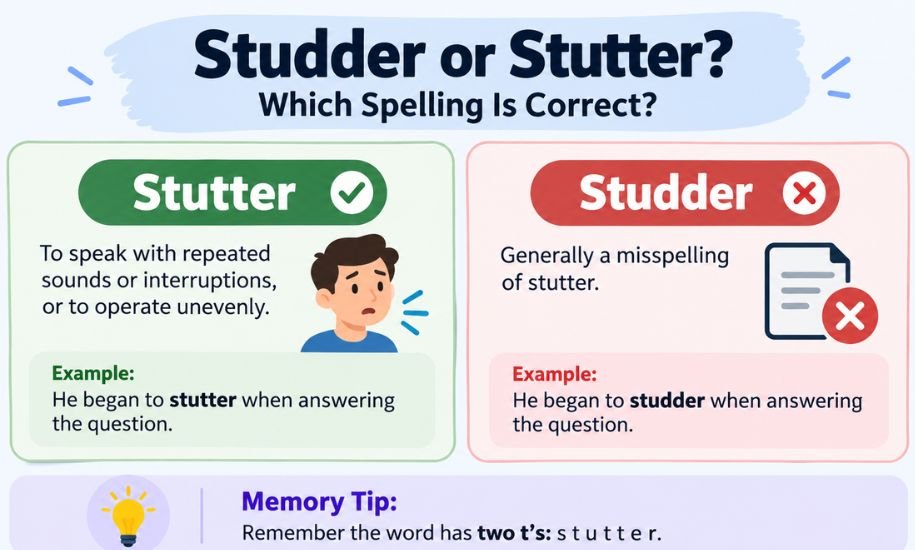
Have you ever wondered whether the correct spelling is studder or stutter? The two forms look and sound similar, which can make it easy to mix them up when writing. However, there is a clear answer for standard English usage. Stutter is the correct spelling when describing interrupted speech, repeated sounds, or something that operates unevenly. Studder is generally a misspelling in these contexts. Understanding the difference will help you write more accurately, choose the right word in sentences, and avoid a common spelling mistake.
Stutter is the standard English spelling. It can mean speaking with repeated sounds or interruptions, or operating irregularly. Studder is generally incorrect when used with these meanings, so choose stutter in formal and everyday writing.
Studder vs. Stutter: A Quick Comparison
| Feature | Stutter | Studder |
|---|---|---|
| Standard spelling | Yes | Generally no |
| Meaning | Interrupted speech or irregular operation | Usually a misspelling of stutter |
| Part of speech | Noun and verb | Not the standard form for these meanings |
| Formal writing | Correct | Avoid |
| Example | He began to stutter. | He began to studder. (Incorrect) |
The important point is that stutter is the form you should use in ordinary English writing. Although you might encounter studder in informal posts or discussions, that does not make it the standard spelling.
What Does Stutter Mean?
Stutter is both a noun and a verb. Its meaning depends on how it is used in a sentence.
Stutter as a verb
As a verb, stutter means to speak with involuntary repetitions, prolonged sounds, or interruptions that affect the smooth flow of speech. It can also describe a machine or process that operates unevenly.
Examples:
- He began to stutter when the interviewer asked an unexpected question.
- I sometimes stutter when I feel nervous speaking in public.
- The engine started to stutter before the car came to a stop.
- Her voice seemed to stutter as she tried to explain what had happened.
In the first two examples, the word refers to speech. In the third, it describes an engine that is not running smoothly.
Stuttering is a speech-fluency condition, not simply a sign of nervousness or a lack of confidence. People who stutter can communicate effectively, and the experience varies from person to person.
Stutter as a noun
As a noun, stutter refers to a pattern of interrupted speech or to the speech difficulty itself.
Examples:
- He has a stutter and sometimes repeats the first sound of a word.
- Her stutter does not prevent her from giving excellent presentations.
- The recording contained a brief stutter in the audio.
The final example uses the word more broadly to describe a brief interruption in a recording.
Related verb forms
The verb follows a regular pattern, so its common forms are straightforward.
| Form | Example |
|---|---|
| Base form | I sometimes stutter. |
| Third-person singular | He stutters when speaking quickly. |
| Past tense | She stuttered during the interview. |
| Present participle | He is stuttering less frequently. |
Notice the doubled t in stuttered and stuttering. These are the standard spellings.
Is Studder a Real Word?
In everyday writing, studder is generally treated as a misspelling of stutter. If you want to describe interrupted speech or an engine that runs unevenly, use stutter.
You may occasionally encounter studder in informal online conversations, personal writing, usernames, or references to unusual or historical word usage. Such appearances do not establish it as an accepted alternative spelling for the ordinary meanings of stutter.
For standard English, the distinction is simple:
- Correct: He tends to stutter when he is under pressure.
- Incorrect: He tends to studder when he is under pressure.
If you are unsure whether an unusual form is accepted, consult a reputable dictionary rather than assuming that a word is correct because it appears online.
Why Do People Confuse the Two Spellings?
There are a few understandable reasons for this mistake.
1. Similar pronunciation
In some varieties of English, the middle consonant in stutter may sound similar to a quick or softened “d” sound. This can lead people to spell the word according to how they hear it.
However, pronunciation does not change the standard written form. The correct spelling remains stutter.
2. Spelling from memory
People often remember the general sound of a word without recalling every letter. Since studder looks plausible at first glance, it may seem correct to someone who has not checked the spelling.
3. Informal online writing
Social media posts, forums, and discussion threads sometimes contain misspellings. Readers may see an incorrect form repeatedly and assume that it is an accepted alternative.
When checking spelling, it is better to rely on established dictionaries than on the frequency of a spelling in informal writing.
Correct and Incorrect Examples
The easiest way to learn the difference is to compare the forms in complete sentences.
| Incorrect usage | Correct usage |
|---|---|
| He started to studder during his speech. | He started to stutter during his speech. |
| The car began to studder on the road. | The car began to stutter on the road. |
| She stuttered when answering the question. | She stuttered when answering the question. |
| My computer seems to studder while playing the video. | My computer seems to stutter while playing the video. |
The third row is already correct. It also illustrates the past-tense form of stutter.
When describing computer performance, stutter can refer to brief interruptions or uneven playback. Depending on the situation, words such as lag, freeze, or skip may be more precise, but stutter is an established way to describe irregular performance.
What Does Stutter Mean in Slang?
The word stutter does not have one universal slang meaning that replaces its ordinary definition. In informal conversation, it may be used figuratively to describe hesitation, repetition, or an interrupted response.
For example:
- “The speaker seemed to stutter over his words” describes difficulty speaking smoothly.
- “The video stuttered for a moment” describes interrupted playback.
- “The engine gave a little stutter” describes irregular operation.
People may also use studder informally when they mean stutter. In that case, it is usually a spelling error rather than a separate slang word with a consistent meaning.
Context matters when interpreting unusual expressions online. Avoid assuming that every informal use has a recognized dictionary definition.
What Is a Stutter Step?
A stutter step is a movement technique involving quick, short, or hesitant-looking steps. It is often discussed in sports, particularly basketball and football, where a player may use rapid foot movements to confuse a defender or change direction.
For example:
- The basketball player used a stutter step before driving toward the basket.
- The runner used a quick stutter step to adjust his position.
- The football player’s stutter step made it harder for the defender to predict his next move.
The expression uses the standard spelling stutter. It does not use studder.
Although the phrase shares a word with the speech-related meaning, its sporting use concerns movement rather than a speech difficulty.
How Do You Say Stutter in Spanish?
The English word stutter has Spanish equivalents that depend on whether it is being used as a verb or a noun.
| English | Spanish | Usage |
|---|---|---|
| To stutter | Tartamudear | Verb |
| A stutter | Tartamudez | Noun describing the speech difficulty |
| He stutters | Él tartamudea | Example sentence |
| She has a stutter | Ella tiene tartamudez | Example sentence |
For example, “He began to stutter” can be translated as Él empezó a tartamudear.
These translations are useful when learning vocabulary, but the main spelling distinction in English remains the same: stutter is the standard form.
Frequently Asked Questions
1. Is it spelled studder or stutter?
The correct standard spelling is stutter. Use it when describing interrupted speech, repeated sounds, or irregular operation. Studder is generally a misspelling in these contexts and should be avoided in formal writing.
2. Is studder ever correct?
You may encounter the spelling in informal writing or unusual historical references, but it is not the standard alternative to stutter. For ordinary English usage, choose stutter.
3. Is stutter an American or British spelling?
Stutter is used in both American and British English. It is not a case of two different regional spellings, so you do not need to choose between an American and a British version.
4. What is the past tense of stutter?
The past tense is stuttered. For example, “He stuttered while answering the question.” The present participle is stuttering, as in “She is stuttering less during the presentation.”
5. What is the difference between stuttering and stammering?
Stuttering and stammering are often used to describe similar speech-fluency difficulties. Usage varies by region and context, but both can refer to repetitions, prolonged sounds, or interruptions in speech. Neither term should be confused with the misspelling studder.
Final Verdict: Studder or Stutter?
Stutter is the correct standard spelling. Use it for speech interruptions, irregular engine operation, uneven video playback, and expressions such as stutter step. Although studder occasionally appears in informal writing, it is generally not an accepted substitute in these contexts.
Remembering this simple distinction will help you avoid the error in everyday messages and formal writing. At Grammarifyr, the goal is to make confusing English words easier to understand so you can know the difference and use the right words.
You may also Read : Neice or Niece: Meaning, Spelling and Examples