Former or Latter: Meaning and Examples
Choosing between former and latter can be confusing because both words are used to refer back to things that have already been mentioned. The key is their position in a pair: former refers to the first of two items, while latter refers to the second. Both are correct words, but they serve different purposes. Once you connect former with “first” and latter with “last,” the distinction becomes much easier to remember and use accurately.
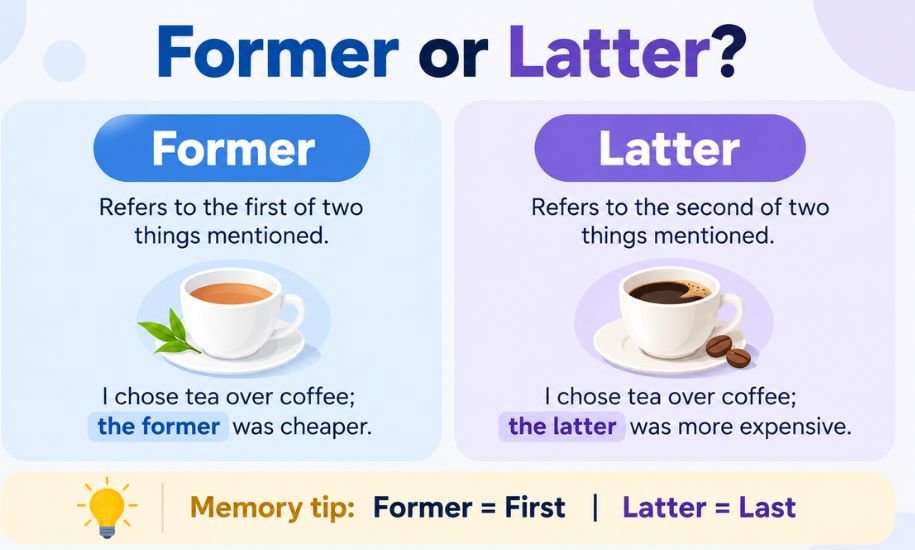
Both former and latter are correct. When two things are mentioned, former refers to the first one and latter refers to the second. For example, in “I chose tea over coffee; the former was cheaper,” former means tea.
Former vs. Latter: The Basic Difference
The easiest way to understand the pair is to focus on order.
- Former = the first of two things mentioned
- Latter = the second of two things mentioned
Consider this sentence:
I enjoy reading novels and watching films, but I prefer the former.
The two activities are reading novels and watching films. Because reading novels appears first, the former refers to reading novels.
Now change the sentence:
I enjoy reading novels and watching films, but I prefer the latter.
Here, the latter refers to watching films because it was mentioned second.
| Feature | Former | Latter |
|---|---|---|
| Basic meaning | First-mentioned | Second-mentioned |
| Usually refers to | The first of two | The second of two |
| Memory clue | F = First | L = Last |
| Example | “Tea and coffee; the former” = tea | “Tea and coffee; the latter” = coffee |
In this usage, both words usually work as substitutes for nouns that have already appeared in the sentence or preceding sentence.
What Does “Former” Mean?
When used to distinguish between two previously mentioned things, former means the first of the two.
For example:
We could take the train or the bus. I prefer the former.
The train is the former because it was mentioned first.
Here are a few more examples:
Maria and Elena both applied for the position, but the former had more experience.
The former refers to Maria.
You can study mathematics or history. I recommend the former.
The former refers to mathematics.
The company considered a local supplier and an international supplier. The former offered a lower price.
The former refers to the local supplier.
The word does not indicate that the first option is better, more important, or older. It simply identifies its position in the pair.
Another Meaning of “Former”
Former has another very common meaning: previous or no longer in a particular role or condition.
For example:
He is a former employee of the company.
This means he used to be an employee but is not one now.
Other examples include:
- a former president
- a former teacher
- her former employer
- his former home
- my former colleague
This meaning is different from the “first of two” meaning.
What Does “Latter” Mean?
When referring to two previously mentioned things, latter means the second of the two.
For example:
The restaurant offers indoor and outdoor seating. I prefer the latter.
The latter means outdoor seating because it was mentioned second.
More examples:
Sarah and James attended the meeting. The latter arrived early.
The latter refers to James.
You can pay by card or cash. The latter is preferred at this location.
The latter refers to cash.
The course covers grammar and vocabulary. The latter receives more attention in the final section.
The latter refers to vocabulary.
As with former, the word describes position, not quality. The latter choice is not necessarily worse, better, newer, or more important. It is simply the one mentioned second.
“The Former and the Latter” Examples
The expressions the former and the latter are particularly useful when a writer wants to avoid repeating two nouns.
Example 1
I have two pets, a dog and a cat. The former loves running, while the latter prefers sleeping.
- The former = the dog
- The latter = the cat
Example 2
The company considered hiring an experienced manager or training a new employee. The former would be more expensive.
- The former = hiring an experienced manager
- The latter = training a new employee
Example 3
Jane enjoys both painting and photography, but she spends more time on the latter.
- The former = painting
- The latter = photography
Example 4
We could meet on Tuesday or Thursday. The latter works better for me.
- The former = Tuesday
- The latter = Thursday
These examples all follow the same principle: first = former, second = latter.
Why Are These Words Often Confused?
The confusion usually comes from the fact that both words point backward to information already mentioned. Unlike ordinary nouns, they require the reader to remember the order of the earlier items.
For example:
The museum offers guided tours and self-guided visits. The latter is cheaper.
A reader has to look back and identify the two options before understanding latter.
The words can therefore become difficult when a sentence contains several possible references or when too much information separates the original nouns from former or latter.
For clear writing, make sure the pair is obvious.
Should You Use Former and Latter for More Than Two Items?
Generally, it is best to use former and latter when you are referring to two items.
For example:
We discussed London and Manchester. The former is larger.
This is perfectly clear.
But consider:
We discussed London, Manchester, Birmingham, and Leeds. The former is larger.
Which city does the former mean? The sentence leaves room for confusion.
When there are three or more items, use a more precise expression:
We discussed London, Manchester, Birmingham, and Leeds. London is larger than the others.
Or:
Of the four cities, the first is the largest.
Repeating the noun is often better than making readers guess what a reference means.
Is “Former and Latter” Formal?
Yes, former and latter can sound more formal than simply repeating the nouns. They are especially common in formal writing, academic prose, reports, essays, and other contexts where concise reference is useful.
For example:
The study compares online and classroom learning. The former offers greater flexibility, while the latter provides more direct interaction.
This sounds natural in formal written English.
In casual conversation, however, repeating the noun can sometimes be clearer:
I prefer online learning because it is more flexible.
There is nothing wrong with using former or latter in everyday English, but they can have a somewhat formal tone.
Common Mistakes to Avoid
1. Reversing the meanings
A frequent mistake is assuming latter refers to the first item.
Incorrect interpretation:
Coffee and tea are available. The latter means coffee.
It does not. Coffee is the former, while tea is the latter.
2. Assuming “former” means better
Former only identifies the first item.
I considered a laptop and a tablet. I chose the former.
This tells us that the laptop was mentioned first. It does not tell us that laptops are objectively better than tablets.
3. Assuming “latter” means worse
Likewise, latter does not mean inferior.
She considered two universities and chose the latter.
This simply means she chose the second university mentioned.
4. Using the words when the reference is unclear
Avoid:
I compared four models, and the latter was the cheapest.
With four models, the reader may not know what latter refers to.
Be specific instead:
I compared four models, and the fourth model was the cheapest.
5. Confusing “former” with “first” in every context
Although former can mean the first of two things, it can also mean previous.
He is a former manager.
This does not mean he was the first manager. It means he was a manager in the past.
An Easy Way to Remember the Difference
The simplest memory trick is:
Former = First
Both begin with F.
And:
Latter = Last
Both begin with L.
So when you see two things in a sentence, think:
First → former
Second → latter
For example:
Apples and oranges were available. I chose the latter.
Oranges come second, so latter = oranges.
This quick association can prevent one of the most common mistakes with these words.
Former and Latter in Everyday Sentences
Here are some natural examples to reinforce the difference:
I prefer tea and coffee, but I usually drink the former in the morning.
Former = tea.
We can travel by car or train; the latter is more comfortable.
Latter = train.
Both the old and new systems have advantages, but the latter is easier to maintain.
Latter = new system.
The manager compared two proposals and recommended the former.
Former = the first proposal.
The restaurant offers vegetarian and seafood dishes. The latter are especially popular.
Latter = seafood dishes.
Notice that the reference always depends on the order of mention.
What Does “Latter” Mean in “The Latter Half”?
There is another useful meaning of latter that does not involve two things.
In expressions such as the latter half, the latter part, and the latter stages, latter means the later part of a period or sequence.
For example:
Sales improved during the latter half of the year.
Here, latter half means the second or later half of the year.
Similarly:
The team struggled during the latter stages of the competition.
This refers to the later part of the competition.
This usage is related to the basic idea of something being later in a sequence, but it is different from using the latter to identify the second of two previously mentioned choices.
Former or Latter: Which One Should You Use?
Choosing between them is straightforward once you identify the order of the two items.
Suppose your sentence mentions:
A → B
Then:
A = the former
B = the latter
For example:
I can work from home or from the office. The former is more convenient.
Home is first, so it is the former.
I can work from home or from the office. The latter is better for collaboration.
The office is second, so it is the latter.
If there are several items or the reference could be misunderstood, simply repeat the noun or use first and second. Clear writing is more important than avoiding repetition at all costs.
FAQs
Is “former or latter” grammatically correct?
Yes. Both former and latter are standard English words. When used together as a pair, former normally identifies the first of two mentioned items, while latter identifies the second.
Does former mean first?
It can. When referring to two previously mentioned things, former means the first one. However, former can also mean previous, as in “a former employee.”
Does latter mean last?
Usually, latter refers to the second of two things. It can also describe something occurring later in a period, as in “the latter half of the year.” It should not automatically be interpreted as “last” in every context.
Can I use former and latter for three or more things?
It is best to avoid doing so when the reference could be unclear. These terms work most clearly with two items. For larger lists, use specific nouns or expressions such as the first, the second, or the final item.
Are former and latter formal words?
They are standard English but can sound relatively formal, particularly in everyday conversation. They are especially useful in academic, professional, and other forms of formal writing.
How can I remember which is which?
Remember F = First for former and L = Last for latter. When two items are mentioned, the first is the former and the second is the latter.
Final Verdict: Former or Latter?
Both words are correct, but they point to different positions. Former refers to the first of two previously mentioned items, while latter refers to the second. Remember “former = first” and “latter = last”, and the distinction becomes much easier. When clarity might suffer, especially with longer lists, simply name the item instead. For more clear explanations of confusing English words and usage, Grammarifyr helps you know the difference and use the right words.
You may also Read : Fiancé or Fiancée: Spelling, Meaning and Examples
One Comment