VTI or VOO: Key Differences Explained
Choosing between VTI or VOO can seem surprisingly difficult. Both are popular Vanguard ETFs, both offer diversified exposure to U.S. stocks, and both are designed for long-term investors. The main difference is what they include: VTI covers the broader U.S. stock market, while VOO focuses on the S&P 500 and its large-cap companies.
That distinction matters, but the two funds also overlap substantially. So, rather than assuming one is automatically better, it makes more sense to understand how each fund works, what type of exposure it provides, and which approach fits your investing goals.
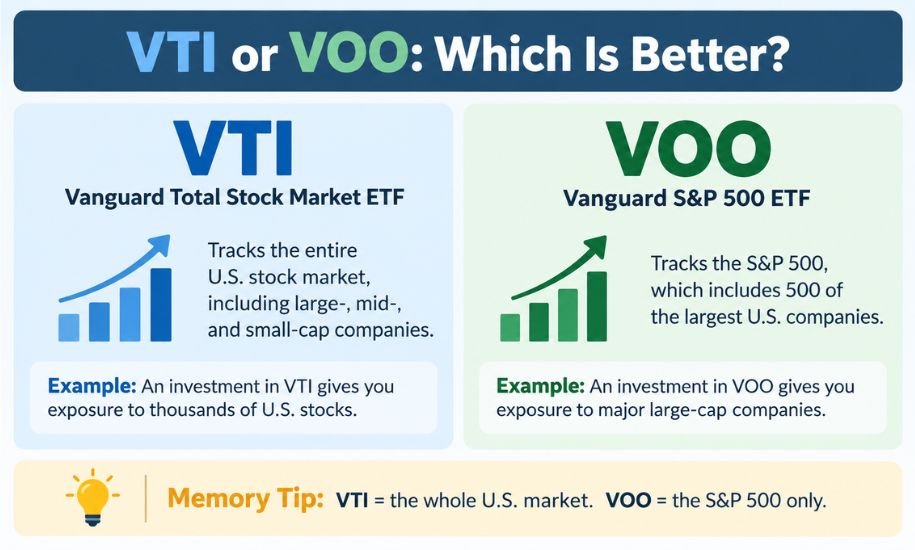
Both VTI and VOO are strong, low-cost choices for U.S. stock exposure. VTI tracks the broader U.S. stock market and includes large-, mid-, and small-cap companies, while VOO tracks the S&P 500 and emphasizes large-cap stocks. If you want broader market coverage, VTI has the edge; if you specifically want S&P 500 exposure, VOO may be the better fit.
VTI vs VOO: What’s the Difference?
The simplest way to understand the difference is to look at the indexes they track.
VTI is the Vanguard Total Stock Market ETF. Vanguard says it holds more than 3,500 domestic stocks, giving investors exposure across the U.S. equity market.
VOO is the Vanguard S&P 500 ETF. It tracks the S&P 500, an index representing large U.S. companies.
| Feature | VTI | VOO |
|---|---|---|
| Fund | Vanguard Total Stock Market ETF | Vanguard S&P 500 ETF |
| Main exposure | Broad U.S. stock market | S&P 500 |
| Company size | Large, mid, and small companies | Primarily large-cap companies |
| Diversification | Broader | More concentrated |
| Expense | Very low | Very low |
| Best fit | Investors seeking total U.S. market exposure | Investors seeking S&P 500 exposure |
The difference is therefore not that one fund is “good” and the other is “bad.” They simply take slightly different approaches to investing in U.S. equities.
What Is VTI?
VTI stands for Vanguard Total Stock Market ETF.
Its objective is to provide broad exposure to the U.S. stock market. Instead of limiting its portfolio to the largest companies, it includes stocks across different market-cap categories.
That means an investor in VTI owns shares of many of the familiar mega-cap companies found in the S&P 500 while also gaining exposure to smaller businesses.
Vanguard describes VTI as holding more than 3,500 domestic stocks.
Why investors choose VTI
VTI can appeal to someone who wants:
- Broad U.S. stock-market exposure
- Large-, mid-, and small-cap companies in one fund
- A simple core holding
- Diversification without selecting individual companies
- A passive, low-cost investment approach
One important point is that VTI does not give every company an equal weighting. Larger companies still make up much of the fund because the underlying market is weighted by company size.
So choosing VTI does not mean making a large bet on small companies. It means including them alongside the largest businesses.
What Is VOO?
VOO stands for Vanguard S&P 500 ETF.
Rather than tracking the entire U.S. equity market, VOO tracks the S&P 500. This gives investors exposure to many of America’s largest publicly traded companies.
The S&P 500 is widely followed as a benchmark for U.S. large-cap stocks, which helps explain why VOO is so widely used as a core equity holding.
VOO may be attractive to investors who specifically want the performance and composition of the S&P 500 rather than the broader U.S. market.
Why investors choose VOO
VOO can make sense for someone who wants:
- S&P 500 exposure
- A large-cap-focused portfolio
- A straightforward investment strategy
- Exposure to established U.S. businesses
- A low-cost index ETF
Its narrower index does not necessarily mean poor diversification. The S&P 500 still contains companies from many sectors of the U.S. economy.
Why Are VTI and VOO So Similar?
This is one of the most important things to understand when comparing VOO or VTI.
Although VTI contains far more stocks, a large portion of its value is invested in the biggest U.S. companies. Those same companies are heavily represented in VOO.
As a result, the two ETFs can behave very similarly.
Recent investor discussions on Reddit repeatedly make this point. Some investors describe the funds as close substitutes because of their substantial overlap, while others prefer VTI because it adds exposure to mid- and small-cap stocks.
This overlap is why someone shouldn’t expect VTI and VOO to produce dramatically different results every year.
Their differences become more noticeable when smaller companies perform very differently from large-cap companies.
VTI or VOO: Which Has Better Performance?
This is where the answer becomes less straightforward.
VOO has performed better than VTI during some recent periods, particularly during periods when the largest U.S. companies have driven market returns. Recent Reddit discussions from investors have highlighted VOO’s stronger performance over certain five- and longer-term periods.
But that does not establish that VOO will always outperform VTI.
VTI includes smaller companies, so its relative performance can improve when mid- and small-cap stocks perform strongly. VOO can have an advantage when large-cap stocks dominate.
The key lesson is that recent performance alone is not a reliable reason to switch from one ETF to the other.
An investor choosing between them is primarily choosing between broader market exposure and S&P 500 exposure, not between a guaranteed winner and loser.
VTI Stock or VOO: Which Offers More Diversification?
If by diversification you mean the number and range of U.S. companies represented, VTI has the advantage.
VTI reaches beyond the S&P 500 and includes smaller businesses. Vanguard specifically describes it as providing broad coverage of the domestic stock market.
VOO is more concentrated because it focuses on the S&P 500.
However, there is an important distinction between number of holdings and portfolio impact.
The additional companies in VTI represent a relatively smaller portion of the overall portfolio because the fund is market-cap weighted. The biggest U.S. companies still have substantial influence on its performance.
Therefore, VTI is more diversified, but it is not completely different from VOO.
Is VTI or VOO Better for Long-Term Investing?
For long-term investors, either can be a reasonable choice depending on the desired exposure.
VTI may be preferable when:
You want to own a broad slice of the U.S. market and don’t want to decide whether large-, mid-, or small-cap stocks will perform best.
VTI essentially says: own the market broadly.
VOO may be preferable when:
You specifically want exposure to the S&P 500 and are comfortable concentrating more heavily on large U.S. companies.
VOO essentially says: focus on America’s largest companies.
Neither approach guarantees better future returns.
The more important question is whether the fund’s investment strategy matches your goals and whether you can stick with that strategy through periods of market volatility.
What Does “VTI or VOO Reddit” Tell Us?
Reddit discussions can be useful for understanding how investors think about the choice, but individual comments should not be treated as financial advice.
Recent discussions show a recurring theme: the difference between the two funds is relatively small for many long-term investors.
For example, one recent Bogleheads discussion argues that choosing between a total-market fund and an S&P 500 fund is unlikely to make a meaningful difference to long-term results.
Other investors favor VTI because they prefer having small- and mid-cap exposure included automatically.
Meanwhile, some VOO investors point to its recent performance and the strength of large-cap companies.
The useful takeaway isn’t that Reddit has selected a universal winner. It’s that reasonable investors can prefer either strategy.
Should I Invest in VOO or VTI?
If you’re asking “should I invest in VOO or VTI?”, start with the type of exposure you want.
Choose VTI if your priority is broad U.S. market exposure, including smaller companies.
Choose VOO if your priority is specifically owning the S&P 500 and emphasizing large-cap U.S. businesses.
If you already own one, there may be little reason to change simply because the other has recently performed better.
Switching investments can also have tax consequences in a taxable account, so performance chasing can create costs without necessarily improving the portfolio.
Should You Own Both?
You can own both, but it is important to understand what that accomplishes.
Because VTI already contains the major companies represented in VOO, buying both does not create two completely independent sources of diversification.
Instead, owning both can increase your exposure to the large-cap companies that dominate the S&P 500.
For an investor who wants broad U.S. exposure, choosing one may be simpler.
For someone who intentionally wants additional large-cap emphasis, owning both can be reasonable—but that should be a deliberate decision rather than an assumption that two ETFs automatically mean twice the diversification.
How to Choose Between Them
A simple decision rule can make the choice easier:
Pick VTI if:
You want broad exposure to the U.S. stock market and like the idea of including smaller companies.
Pick VOO if:
You specifically want an S&P 500 ETF and prefer greater emphasis on large-cap businesses.
Don’t choose solely because:
One has recently produced a higher return.
Don’t buy both solely because:
You think they provide completely separate diversification.
The best choice is the one whose strategy you understand and can comfortably maintain for your intended investment horizon.
Common Mistakes When Comparing VTI and VOO
1. Assuming VTI means mostly small-cap stocks
It doesn’t. VTI includes smaller companies, but large companies still account for much of its portfolio.
2. Assuming VOO is not diversified
VOO is concentrated relative to VTI, but the S&P 500 contains hundreds of companies across numerous industries.
3. Choosing based entirely on recent returns
Recent outperformance can change. Market leadership moves between company sizes and sectors over time.
4. Assuming owning both automatically improves diversification
Because the funds overlap significantly, owning both can simply increase your exposure to the same large companies.
5. Treating Reddit opinions as personalized financial advice
Investor discussions can reveal useful perspectives, but your financial circumstances, time horizon, taxes, risk tolerance, and overall portfolio matter more than a stranger’s preferred ETF.
Frequently Asked Questions
Is VTI or VOO better for beginners?
Both can be suitable for investors seeking broad U.S. equity exposure. VTI is broader, while VOO focuses on the S&P 500. A beginner should generally focus first on understanding the fund, investment horizon, diversification, and risk rather than trying to predict which ETF will outperform next.
Is VOO or VTI better for long-term investing?
Neither is universally better. VTI provides broader U.S. market exposure, while VOO concentrates on large-cap companies in the S&P 500. Their performance can be quite similar because the largest companies make up a substantial portion of both portfolios.
Does VTI include the S&P 500?
VTI is not an S&P 500 fund, but it includes the large U.S. companies represented in the S&P 500 along with many additional mid- and small-cap companies.
Is VTI more diversified than VOO?
Yes, in terms of the breadth of U.S. stocks represented. VTI includes thousands of companies across market-cap ranges, while VOO focuses on the S&P 500. However, the largest companies still have significant weight in VTI.
Why does VOO sometimes outperform VTI?
VOO can outperform when large-cap U.S. companies outperform smaller companies. Since VTI includes mid- and small-cap stocks in addition to large companies, its performance can differ depending on market conditions.
Should I switch from VOO to VTI?
Not necessarily. If your goal is broader U.S. market exposure, VTI may better match that objective. But switching solely because VTI or VOO has recently performed better can be counterproductive. Consider taxes and your overall investment strategy before making a change.
Final Verdict: VTI or VOO?
VTI is the better fit for investors who want broader U.S. stock-market exposure, while VOO is the better fit for those who specifically want the S&P 500 and large-cap companies. Because the funds overlap substantially, the long-term difference may be smaller than many investors expect. The right choice is less about finding a guaranteed winner and more about choosing an investment approach you understand and can stick with. For clear explanations of confusing choices and terms, Grammarifyr helps readers understand the difference and use the right information with confidence.
You may also Read : Loses or Looses: Meaning and Correct Usage


One Comment