Loses or Looses: Meaning and Correct Usage
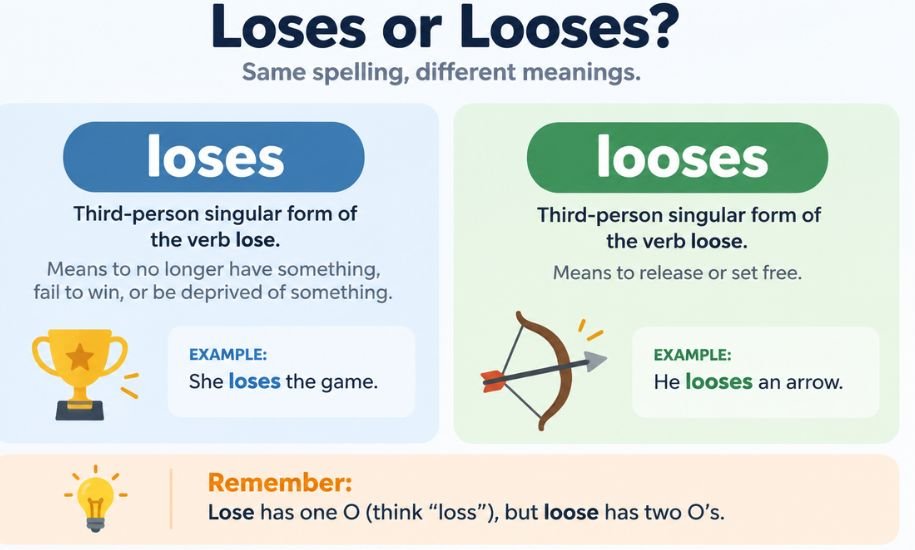
The words loses and looses look almost identical, but they do not have the same meaning or grammatical use. In everyday English, the form you usually need is loses, the third-person singular form of the verb lose. Looses is also a legitimate word, but it comes from the verb loose, meaning to release or set free, and it is much less common. Understanding the difference also makes it easier to distinguish related pairs such as lose or loose and looser or loser.
Loses is the correct form when you mean “fails to keep,” “misplaces,” or “is defeated.” Looses is a real but uncommon verb form meaning “releases” or “sets free.” For most everyday sentences, if you are talking about losing something or losing a game, use loses.
Loses or Looses: What’s the Difference?
The simplest way to distinguish these words is to look at the verbs they come from:
| Word | Comes from | Meaning | Common use |
|---|---|---|---|
| loses | lose | Fails to keep, misplaces, or fails to win | Very common |
| looses | loose | Releases or sets free | Rare/uncommon |
Loses is the normal choice in sentences such as:
- She loses her keys all the time.
- The team loses another important match.
- He loses interest quickly.
- The company loses money when sales decline.
Looses has a different meaning:
- The hunter looses an arrow.
- The action looses the animal from its restraints.
In modern everyday English, alternatives such as releases, sets free, or lets loose are often more natural than looses when expressing the idea of freeing something.
What Does “Loses” Mean?
Loses is the third-person singular present-tense form of lose.
The verb lose has several related meanings. It can mean to no longer have something, fail to find something, fail to win, or be deprived of something.
For example:
- She loses her phone frequently.
- Our team loses when it fails to defend properly.
- He loses his patience when people are late.
- The business loses customers after the price increase.
The basic verb forms are:
| Verb form | Example |
|---|---|
| Base form | lose |
| Third-person singular | loses |
| Past tense | lost |
| Past participle | lost |
| -ing form | losing |
Notice that loses is formed by adding -es to lose. It is not spelled looses.
Why Is “Loses” Spelled With One O?
The spelling follows the normal spelling of the verb lose:
lose → loses
Adding the third-person singular ending -s produces loses, rather than doubling the vowel.
Examples:
- I lose my keys.
- She loses her keys.
- They lose the game.
- He loses the game.
This is why writing looses when you mean loses is a spelling and word-choice error.
Is “Looses” a Real Word?
Yes. Looses is not simply a misspelling in every situation. It can be the third-person singular form of the verb loose.
As a verb, loose can mean to release, set free, or let something go. This use is much less frequent than the adjective loose, which means “not tight” or “not firmly attached.”
For example:
The archer looses an arrow.
Here, looses means releases or shoots the arrow.
Another example is:
The movement looses the rope from its fastening.
However, because this verb usage is uncommon, readers may initially assume that looses is a mistake. In ordinary writing, releases or another more familiar expression may be clearer.
So the important point is not that looses is always wrong. It is that looses and loses belong to different verbs and have different meanings.
Lose or Loose: Understanding the Basic Difference
The confusion becomes easier to solve when you understand lose vs. loose.
Lose is primarily a verb. It can mean to misplace something, no longer possess something, or fail to win.
Examples:
- Don’t lose your wallet.
- We might lose the match.
- She doesn’t want to lose her job.
Loose is most commonly an adjective. It describes something that is not tight, firmly fixed, or securely attached.
Examples:
- My shirt is loose.
- This screw is loose.
- The dog’s collar is loose.
- One of the wires has become loose.
There is also a verb loose, meaning to release or set free, which gives us the less common form looses.
Lose or Loose Definition at a Glance
A simple definition can help:
Lose: to no longer have something, fail to find something, or fail to win.
Loose: not tight or securely fixed; as a verb, to release or set free.
Compare:
I don’t want to lose my jacket.
with:
My jacket is loose around the waist.
The first describes what happens to the jacket; the second describes how the jacket fits.
Is It Loose or Lose?
If you are wondering is it loose or lose, check what you are trying to say.
Use lose when someone:
- misplaces something
- fails to win
- no longer has something
- fails to maintain something
- experiences a reduction or loss
Examples:
Try not to lose your passport.
The team could lose the final.
Use loose when something:
- is not tight
- is not securely attached
- is free rather than restrained
Examples:
This belt is too loose.
The handle is loose.
A useful test is to replace the word with misplace or not tight. If misplace works, choose lose. If not tight works, choose loose.
Is It Lose or Loose in Common Sentences?
Here are some common situations that make the distinction clearer:
Correct: She doesn’t want to lose her necklace.
The meaning is “misplace or no longer have.”
Correct: Her necklace is loose.
The meaning is “not tight or securely fitted.”
Correct: The player loses the match.
The meaning is “fails to win.”
Correct: The player wears a loose shirt.
The meaning is “not tight.”
Correct: The archer looses an arrow.
Here, looses is the verb meaning “releases.” It is grammatically possible but uncommon in everyday conversation.
How Do You Spell Lose or Loose?
If you’re asking how do you spell lose or loose, the answer depends on the meaning.
Remember:
- LOSE = misplace or fail to win
- LOOSE = not tight
For example:
I don’t want to lose my keys.
but:
These shoes are loose.
The pronunciation can also help. Lose ends with a z sound, while loose ends with an s sound.
- lose → sounds like “looz”
- loose → sounds like “loos”
The spelling difference is small, but the meanings are clearly different.
Looser or Loser: Another Common Mix-Up
The same spelling problem appears in looser or loser.
Looser is the comparative form of loose. It means “less tight” or “less firmly held.”
These trousers are looser than my old pair.
Loser is a noun derived from lose. It refers to someone or something that loses.
The loser of the final received a medal.
Compare the forms:
loose → looser
lose → loser
The extra o in looser belongs to loose, while loser comes from lose.
This is why it is incorrect to use looser when you mean someone who loses.
Correct and Incorrect Examples
Seeing the words side by side is one of the easiest ways to learn the difference.
When “loses” is correct
Correct: He loses his keys every week.
Incorrect: He looses his keys every week.
The intended meaning is that he misplaces his keys.
When “loses” describes a competition
Correct: Our team loses the game by two points.
Incorrect: Our team looses the game by two points.
The verb lose is used for failing to win.
When “loose” is correct
Correct: The screw is loose.
Incorrect: The screw is lose.
The intended meaning is that the screw is not securely fastened.
When “looses” can be correct
Correct: The archer looses an arrow.
Here, looses means releases or shoots an arrow.
However, this is a specialized or literary use. In ordinary writing, releases an arrow or shoots an arrow may be more immediately understandable.
An Easy Way to Remember the Difference
A simple memory trick works for most situations:
Lose = loss
Both words are connected with the idea of something being lost:
- lose a game
- lose your keys
- lose money
- loses a match
For loose, think about something that has extra space:
- loose shoes
- loose clothing
- loose screws
- looser trousers
You can also remember:
Lose one O, but loose has two.
If you mean “not tight,” choose loose with two O’s. If you mean “misplace” or “fail to win,” choose lose with one O.
Common Mistakes to Avoid
1. Writing “looses” instead of “loses”
Incorrect:
She looses her phone every morning.
Correct:
She loses her phone every morning.
2. Writing “lose” when you mean “loose”
Incorrect:
My shoes are too lose.
Correct:
My shoes are too loose.
3. Confusing “loser” with “looser”
Incorrect:
The looser of the competition went home.
Correct:
The loser of the competition went home.
4. Assuming “looses” is always a spelling mistake
In most everyday sentences, looses is probably an error for loses. But looses can be a legitimate verb form when it means releases or sets free.
Context determines whether it is appropriate.
Frequently Asked Questions
Is “loses” the correct spelling?
Yes, when you need the third-person singular form of lose. For example, “She loses her keys” and “The team loses the match” are correct.
Is “looses” ever correct?
Yes. Looses can be the third-person singular form of the verb loose, meaning to release or set free. This use is uncommon compared with loses.
How do you spell loose or lose?
Use loose when something is not tight, such as “a loose shirt.” Use lose when something is misplaced or someone fails to win, such as “lose your keys” or “lose the game.”
What is the difference between looser and loser?
Looser means less tight and comes from loose. Loser means a person or thing that loses and comes from lose.
Is “lose” or “loose” correct for a competition?
Use lose. For example, “Our team might lose the competition.” The word loose does not mean fail to win.
What is an easy way to remember lose and loose?
Think of lose as being connected with a loss, while loose describes something that is not tight. Also remember: lose has one O; loose has two.
Final Verdict: Loses or Looses?
For normal sentences about misplacing something, failing to win, or no longer having something, loses is the word you want. Looses is a genuine but uncommon form of loose meaning “releases” or “sets free.” The broader lose vs. loose distinction is simple: lose relates to losing or failing to keep something, while loose usually describes something that is not tight. If you want more straightforward explanations of confusing English words and word forms, Grammarifyr is built around helping readers know the difference and use the right words.
You may also Read : Journeys or Journies: The Correct Spelling Explained
One Comment