Realised or Realized: British and American English
If you have ever paused over realised or realized, you are not alone. Both spellings appear in polished English writing, but they are associated with different regional conventions. The good news is that neither spelling is inherently wrong. The main distinction is whether you are following a British-style spelling convention, an American one, or a particular style guide. The same difference also appears in realise/realize, realising/realizing, and realisation/realization.
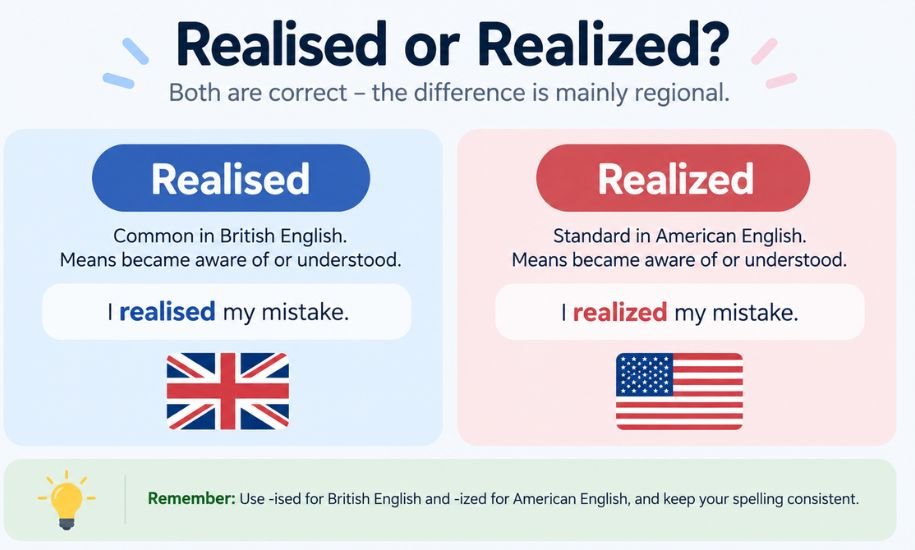
Realised and realized are both correct spellings. “Realised” is commonly used in British English, while “realized” is the standard American English spelling. Both mean the same thing, so choose the form that matches your audience and keep your spelling consistent.
Realised or Realized: What’s the Difference?
The difference is primarily regional spelling, not meaning.
| Feature | Realised | Realized |
|---|---|---|
| Correct spelling? | Yes | Yes |
| Common association | British English | American English |
| Meaning | Became aware; understood; achieved | Became aware; understood; achieved |
| Verb | Past tense/past participle of realise | Past tense/past participle of realize |
| Example | I realised my mistake. | I realized my mistake. |
For example:
I realised that I had left my phone at home.
and
I realized that I had left my phone at home.
These sentences communicate exactly the same idea.
The difference is similar to other British and American spelling pairs such as organised/organized, recognised/recognized, and apologised/apologized.
What Does “Realised” Mean?
Realised is the past tense and past participle of realise in spelling conventions that use -ise. It most commonly means became aware of something, understood something, or recognized something.
For example:
- I realised that I had forgotten my keys.
- She realised what the teacher meant.
- We realised that the meeting had already started.
- He suddenly realised his mistake.
The verb can also mean to achieve something, especially a goal, ambition, or dream.
She finally realised her dream of becoming a published author.
So, depending on context, realised can describe either a mental understanding or the achievement of something.
What Does “Realized” Mean?
Realized has the same meanings as realised. It is the spelling normally associated with American English.
Consider:
I realized that the door was unlocked.
The meaning is the same as:
I realised that the door was unlocked.
The spelling changes, but the pronunciation and meaning remain essentially the same.
Realized can likewise mean becoming aware of something:
She realized that she had misunderstood the instructions.
It can also refer to achieving something:
He realized his ambition of opening his own business.
Therefore, there is no difference in definition between the two forms simply because one uses s and the other uses z.
“I Just Realised” or “I Just Realized”?
Both “I just realised” and “I just realized” are grammatically correct.
The word just usually indicates that the realization happened recently.
British-style spelling
I just realised that I left my notebook at home.
American spelling
I just realized that I left my notebook at home.
You can also use the expression in a variety of situations:
I just realised what you were trying to tell me.
I just realized that tomorrow is a holiday.
I just realised I had the wrong address.
I just realized why the machine wasn’t working.
There is no grammatical difference between the two versions. The choice is a matter of spelling convention.
Is “Realised” or “Realized” Used in the UK?
This question needs a little nuance.
Realised is a very common British English spelling, and it is the form many readers expect when a text follows the -ise convention.
For example:
I realised that I had made an error.
However, realized is not automatically unacceptable in British English. Some British publishers and style systems use -ize spellings. Oxford style, for example, traditionally favors the -ize form in many words.
So the simple rule “realised is British and realized is American” is useful for beginners, but it is not the complete picture.
A more accurate rule is:
- realised is widely used in British English.
- realized is standard in American English.
- realized can also occur in British English depending on the publication’s spelling convention or style guide.
If you are writing specifically for a UK audience, check the style requirements of the publication. If there is no specific requirement, consistency matters more than switching randomly between the two systems.
Why Are These Spellings Different?
The difference comes from a broader spelling pattern involving verbs ending in -ise and -ize.
Compare these forms:
| British-style form | American form |
|---|---|
| realise | realize |
| realised | realized |
| realising | realizing |
| realisation | realization |
The important point is that the spelling variation affects the whole word family.
For example, if your chosen style uses realise, you would normally write:
realise → realised → realising → realisation
If your style uses realize, you would write:
realize → realized → realizing → realization
This makes it easier to maintain consistency throughout an article or document.
Examples in Everyday Sentences
Here are some natural examples showing how either spelling can work.
Using “realised”
I realised I had left my wallet in the car.
Maria realised that the instructions were different from what she expected.
We realised there was not enough time to finish the project.
He realised how important the opportunity was.
She realised her ambition after years of hard work.
Using “realized”
I realized I had left my wallet in the car.
Maria realized that the instructions were different from what she expected.
We realized there was not enough time to finish the project.
He realized how important the opportunity was.
She realized her ambition after years of hard work.
The meanings remain unchanged.
Which Spelling Should You Choose?
Your intended audience should usually determine your choice.
Choose “realised” if:
- You are following conventional British spelling.
- Your publication uses -ise forms.
- Your other spelling choices include forms such as organised and recognised.
- You are writing for an audience that expects this convention.
Choose “realized” if:
- You are writing in American English.
- Your style guide specifies -ize spellings.
- Your other words use forms such as organized and recognized.
- Your publication follows American spelling conventions.
The most important thing is consistency.
It would be better to consistently follow one spelling system than to use realised in one paragraph and realized in another without a reason.
Common Mistakes to Avoid
1. Assuming one spelling is always wrong
Neither spelling should automatically be treated as incorrect. They represent different spelling conventions.
2. Mixing spelling systems unnecessarily
If an article is written in a consistent British style, using realised alongside organized may create an inconsistent appearance.
Likewise, American-style writing would normally use realized rather than switching to realised.
3. Confusing the verb with the noun
The verb is:
She realised the truth.
The noun is:
Her realisation came later.
In American spelling:
She realized the truth.
Her realization came later.
The same regional spelling pattern applies to the related noun.
4. Thinking the spelling changes the pronunciation
For most standard uses, realised and realized are pronounced the same way. The difference is primarily visible in writing.
An Easy Way to Remember the Difference
A simple memory rule is:
British-style English → often -ise / -ised
American English → -ize / -ized
So:
realise → realised
but:
realize → realized
You can apply the same pattern to related words:
recognise → recognised
recognize → recognized
and:
organise → organised
organize → organized
Just remember that some British style guides also use -ize, so this is a practical convention rather than an absolute rule for every British publication.
Realised or Realized: Which Is Correct?
The answer depends on the spelling convention you are using.
If you are writing standard American English, realized is the expected form.
If you are following a British spelling convention that uses -ise, realised is the expected form.
Neither one changes the underlying meaning of the verb. For example, both of these are correct:
I realised that I was late.
I realized that I was late.
The best choice is therefore the one that fits the English variety and style guide of your writing.
Frequently Asked Questions
Is “realised” or “realized” correct?
Both are correct. Realised is widely used in British English, while realized is standard in American English. Some British style systems also use the -ize spelling, so the choice should follow the style guide and remain consistent.
Is “I just realised” grammatically correct?
Yes. “I just realised” is grammatically correct and is particularly common in British-style English. In American English, the equivalent is “I just realized.” Both sentences mean that the speaker has recently become aware of something.
Can I use “realized” in UK English?
Yes. Although realised is a common British spelling, realized is also used in some British publications and style systems. If you are writing for a particular UK publication, follow its stated spelling preferences.
What is the meaning of “realised” or “realized”?
The word usually means became aware of, understood, or recognized something. It can also mean achieving or fulfilling something, such as a goal, ambition, or dream.
Are “realise” and “realize” different words?
They are spelling variants of the same verb. Realise is widely associated with British-style spelling, while realize is standard in American English. Their meanings and grammatical functions are the same.
Which should I use in formal writing?
Use the form required by your audience, publisher, school, employer, or style guide. If no specific requirement exists, choose one spelling convention and use it consistently throughout the document.
Final Verdict: Realised or Realized?
Realised and realized are both correct. The main difference is regional and stylistic: realised is widely used in British English, while realized is standard in American English and also appears in some British styles. When choosing between them, consider your audience and keep related spellings consistent. For more clear explanations of confusing English words and spelling differences, Grammarifyr helps you know the difference and use the right words.
You may also Read : Cloths or Clothes? The Simple Difference Explained
One Comment