Began or Begun: Meaning and Grammar Explained
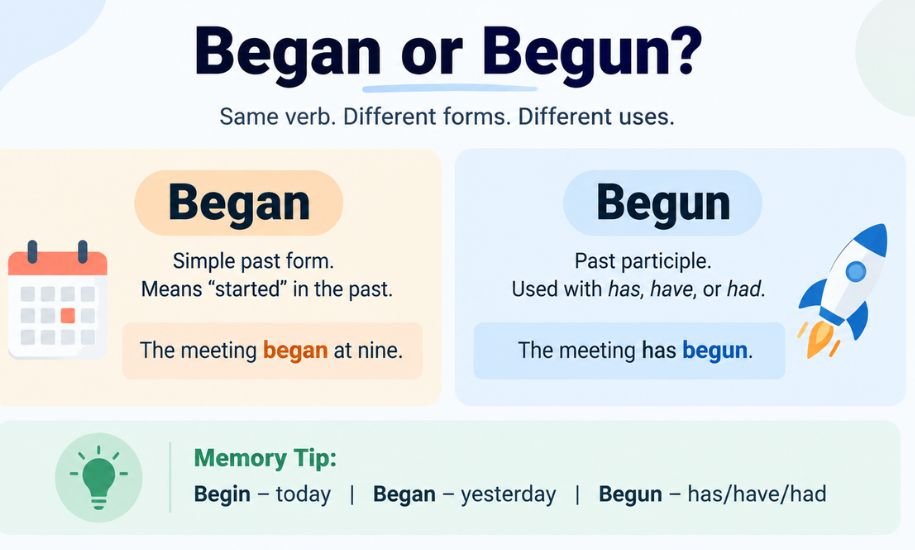
It is easy to confuse began and begun because both forms come from the same irregular verb, begin. The difference is grammatical rather than a matter of spelling preference. Began is the simple past form, while begun is the past participle. Choosing the right one depends on the tense and whether a helping verb such as has, have, or had is present. Once you learn the pattern begin → began → begun, the distinction becomes much easier to remember.
Began and begun are both correct forms of the verb begin, but they are used differently. Began is the simple past form: “The class began at nine.” Begun is the past participle and is normally used with a helping verb: “The class has begun.”
Began vs Begun: The Key Difference
The easiest way to understand these forms is to look at all three principal forms of the verb:
| Verb form | Grammatical name | Example |
|---|---|---|
| begin | Base form | We begin work at eight. |
| began | Simple past | We began work at eight yesterday. |
| begun | Past participle | We have begun work. |
So, began describes something that started in the past, while begun is used as part of perfect constructions and some passive constructions.
Compare these sentences:
- The concert began at 7 p.m.
- The concert has begun.
- The concert had begun before we arrived.
The first sentence uses the simple past. The second and third use the past participle with has and had.
What Does “Began” Mean?
Began is the simple past tense of begin, meaning “started” or “commenced.”
You use it when talking about an action or event that started at a point in the past.
Examples
- The meeting began at noon.
- She began learning Spanish last year.
- The rain began after sunset.
- We began the journey early in the morning.
Notice that began does not normally need has, have, or had before it.
Correct:
The movie began at eight.
Incorrect:
The movie has began at eight.
The second sentence uses the wrong verb form after has.
What Does “Begun” Mean?
Begun is the past participle of begin. It carries the same basic idea of starting, but its grammatical function is different.
It commonly appears with auxiliary verbs such as:
- has begun
- have begun
- had begun
- will have begun
Examples
- The ceremony has begun.
- We have begun our research.
- She had begun preparing dinner before the guests arrived.
- By next week, construction will have begun.
The important point is that begun generally needs another verb to form these perfect constructions.
When to Use Began or Begun
A simple rule can help you choose between them.
Use “began” for the simple past
Choose began when you are simply describing something that started in the past.
The lesson began at 10 a.m.
He began his new job on Monday.
The discussion began unexpectedly.
They began walking toward the station.
A past-time reference often makes this especially clear:
- yesterday
- last week
- two hours ago
- in 2020
- this morning, when referring to a completed past event
For example:
The project began last January.
Use “begun” with perfect tenses
Use begun after has, have, or had when forming a perfect tense.
Present perfect:
The show has begun.
Present perfect:
We have begun the next stage.
Past perfect:
The meeting had begun before I arrived.
Future perfect:
By Friday, the work will have begun.
This gives you a useful formula:
has/have/had + begun
rather than:
has/have/had + began
Is It “I Have Began” or “I Have Begun”?
The correct form is:
I have begun. ✅
Not:
I have began. ❌
The reason is straightforward: have is being used as an auxiliary verb to form the present perfect, so the past participle is required.
Examples
- I have begun reading the book.
- I have begun working on the assignment.
- I have begun to understand the problem.
- I have begun preparing for the examination.
However, if you are talking about a completed action in the simple past, use began:
I began reading the book yesterday.
The difference is therefore not about the subject I. It is about the tense.
“It Has Began or Begun”?
The correct construction is:
It has begun. ✅
Not:
It has began. ❌
For example:
The meeting has begun.
The winter season has begun.
The new semester has begun.
Compare this with the simple past:
The meeting began at nine.
The two sentences are both grammatical because they use different constructions:
Simple past:
The meeting began at nine.
Present perfect:
The meeting has begun.
This is why “has began or begun” has a clear answer: after has, use begun.
“We Have Began or Begun”?
The correct expression is:
We have begun. ✅
Not:
We have began. ❌
Examples:
- We have begun the project.
- We have begun making changes.
- We have begun preparing for the event.
- We have begun to see improvements.
But when describing a specific completed event in the past, use began:
We began the project last Monday.
A useful comparison is:
| Sentence | Correct? | Why |
|---|---|---|
| We began the project yesterday. | ✅ | Simple past |
| We have begun the project. | ✅ | Present perfect |
| We have began the project. | ❌ | Have requires the past participle |
| We had begun the project earlier. | ✅ | Past perfect |
“I’ve Began” or “I’ve Begun”?
I’ve is a contraction of I have, so the same rule applies.
Correct:
I’ve begun the assignment. ✅
Incorrect:
I’ve began the assignment. ❌
More examples:
- I’ve begun studying for my exam.
- I’ve begun writing the report.
- I’ve begun to notice a difference.
- I’ve begun planning the trip.
If you expand I’ve to I have, the correct form becomes obvious:
I have begun → I’ve begun
Can “Begun” Ever Appear Without Has, Have, or Had?
Yes. The simple rule that “begun always follows has, have, or had” is useful for learners, but it is not a complete description of English grammar.
Begun can also appear in passive constructions.
For example:
Construction was begun in April.
Here, begun is still a past participle, but it follows was as part of a passive construction.
Another example is:
The work was begun by a previous team.
So the more accurate rule is:
Began is the simple past form. Begun is the past participle and needs an appropriate auxiliary or passive construction.
Correct and Incorrect Examples
Seeing the forms side by side makes the pattern easier to recognize.
Correct uses of “began”
The film began at 8 p.m.
She began her career in journalism.
We began the meeting after lunch.
It began to snow during the night.
Correct uses of “begun”
The film has begun.
They have begun the investigation.
The team had begun preparing before we arrived.
Work will have begun by Monday.
Common errors
I have began my work. ❌
I have begun my work. ✅
She has began studying. ❌
She has begun studying. ✅
We begun the project yesterday. ❌
We began the project yesterday. ✅
They had began before noon. ❌
They had begun before noon. ✅
I’ve began reading the article. ❌
I’ve begun reading the article. ✅
Why Are These Two Forms So Often Confused?
The confusion comes largely from the fact that begin is an irregular verb. Unlike regular verbs such as walk → walked → walked, its three principal forms change:
begin → began → begun
There is no -ed ending to signal the past forms. Learners therefore have to remember which form belongs to which grammatical construction.
The vowel changes can also make the pattern less intuitive:
- begin
- began
- begun
Similar patterns occur with other irregular verbs:
- sing → sang → sung
- ring → rang → rung
- drink → drank → drunk
Learning irregular verbs as a three-form sequence can make them easier to use accurately.
An Easy Way to Remember the Difference
Try this simple pattern:
Begin — today
Began — yesterday
Begun — has/have/had
For example:
- I begin work at nine.
- I began work at nine yesterday.
- I have begun work already.
Another useful question is: Is there a helping verb before the blank?
If the sentence says:
She has ___ the process.
Choose begun.
If it says:
She ___ the process yesterday.
Choose began.
This quick check will solve most everyday cases.
Common Mistakes to Avoid
1. Using “began” after “has”
The show has began. ❌
Use:
The show has begun. ✅
2. Using “begun” as the simple past
They begun the work yesterday. ❌
Use:
They began the work yesterday. ✅
3. Treating “begun” as an alternative spelling
Begun is not simply another spelling of began. Both are legitimate verb forms, but they have different grammatical functions.
4. Forgetting that contractions still follow the same rule
Because I’ve means I have, write:
I’ve begun.
Not:
I’ve began.
Frequently Asked Questions
Is “began or begun” correct?
Both began and begun are correct. Began is the simple past form of begin, while begun is the past participle. The sentence structure determines which one you need.
Is it “I have began” or “I have begun”?
I have begun is correct. The auxiliary verb have requires the past participle, and begun is the past participle of begin.
Is it “has began” or “has begun”?
The correct form is has begun. For example, “The meeting has begun.” Has began is not standard English because began is the simple past rather than the past participle.
Is “we have began” grammatically correct?
No. In standard English, use we have begun. If you are describing a completed event in the simple past, use we began, as in “We began the project yesterday.”
What is the difference between “began” and “begun” in meaning?
Their basic meaning is the same because both come from begin, meaning “to start.” The difference is grammatical: began is simple past, while begun is the past participle.
How can I remember which form to use?
Remember the sequence begin → began → begun. Use began for simple past actions and begun in constructions such as has begun, have begun, and had begun.
Final Verdict: Began or Begun?
Began and begun are both correct, but they cannot normally be swapped. Use began when describing something that started in the simple past: “The class began at nine.” Use begun as the past participle: “The class has begun.” Remembering begin → began → begun is the easiest way to keep the forms straight. For more clear explanations of confusing English forms, Grammarifyr follows the same goal: Know the Difference. Use the Right Words.
You may also Read : Realised or Realized: British and American English
One Comment