Laid or Layed: The Correct Grammar Explained
If you have ever written a sentence such as “She layed the book on the table,” you may have wondered whether laid or layed is correct. The confusion is understandable because many English verbs form their past tense by adding -ed. However, lay is an irregular verb, so its past forms do not follow that pattern.
There is also another source of confusion: lay and lie are different verbs, but some of their forms overlap. Once you understand which verb you mean, choosing the correct form becomes much easier.
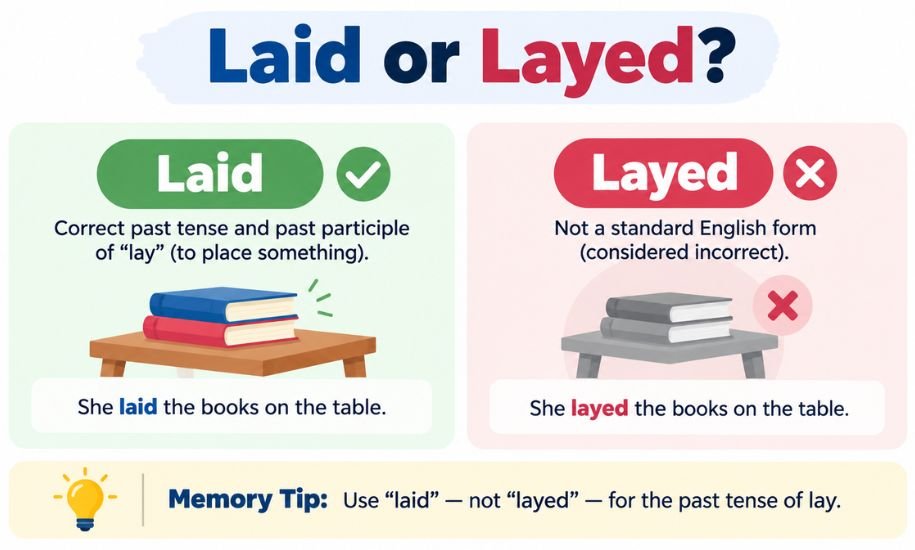
Laid is the standard correct form when it is the past tense or past participle of lay, meaning “to put” or “to place” something. Layed is not the standard past form of lay. However, when you mean that someone rested or reclined, the past tense of lie is lay, not laid.
Laid or Layed: Which Is Correct?
When you mean put, place, or set something down, the correct past tense is laid.
- Present: I lay the book on the desk.
- Past: I laid the book on the desk.
- Past participle: I have laid the book on the desk.
- Present participle: I am laying the book on the desk.
The form layed is not the standard spelling for the past tense or past participle of lay. Cambridge specifically identifies laid, not layed, as the correct past form.
| Form | Correct? | Use |
|---|---|---|
| lay | Yes | Present form of lay |
| laid | Yes | Past tense and past participle of lay |
| laying | Yes | -ing form of lay |
| layed | No | Not the standard past form of lay |
So:
Correct: She laid the keys on the table.
Incorrect: She layed the keys on the table.
Why Is “Layed” So Easy to Write?
The mistake comes from a perfectly understandable pattern in English.
Many regular verbs form their past tense by adding -ed:
- walk → walked
- clean → cleaned
- open → opened
- play → played
It can therefore seem logical to write:
lay → layed
But lay is an irregular verb. Its forms have to be learned separately:
lay → laid → laid
The same pattern applies whether you are talking about putting down an object, placing something somewhere, producing an egg, or using a related expression such as laid out or laid off.
The CDC’s writing guidance likewise identifies laid as both the past form and past participle of lay, while noting that layed is not the standard word.
What Does “Laid” Mean?
Laid is the past tense and past participle of lay when the verb means to put, place, or set something somewhere.
For example:
- She laid the phone beside her laptop.
- He laid the baby gently in the crib.
- They laid the documents on the desk.
- The workers laid the tiles carefully.
- The contractor laid the foundation last year.
The verb lay normally takes an object. In “She laid the book on the table,” the book is the thing being placed.
This gives you a useful basic pattern:
Someone lays something.
In the past:
Someone laid something.
And with a perfect construction:
Someone has laid something.
What About “Layed”?
In ordinary standard English, layed should not be used as the past tense or past participle of lay.
For example:
❌ She layed the blanket on the bed.
✅ She laid the blanket on the bed.
❌ The workers layed the bricks.
✅ The workers laid the bricks.
❌ He had layed the papers on my desk.
✅ He had laid the papers on my desk.
The incorrect form usually results from treating lay as though it were a regular verb. For normal essays, articles, emails, schoolwork, and professional writing, laid is the form to choose.
Laid or Lay in Bed?
This is where the distinction between lay and lie becomes especially important.
If you mean that someone rested or reclined on a bed, you are dealing with the verb lie, not lay.
The forms are:
lie → lay → lain
For example:
I lie on the bed when I need to rest.
Past tense:
Yesterday, I lay on the bed for an hour.
Past participle:
I have lain on the bed for an hour.
Cambridge explains that lie means to be or put yourself in a flat position and does not take a direct object. Its past tense is lay, while its past participle is lain.
So compare these sentences:
Putting something on the bed:
She laid the book on the bed.
Resting on the bed:
She lay on the bed.
The first sentence uses lay → laid because an object is being placed.
The second uses lie → lay because the person is reclining.
“Laid in Bed” vs “Lay in Bed”
Consider these examples:
She laid the baby in bed.
Here, she placed the baby in the bed.
She lay in bed all morning.
Here, she was resting in bed.
Both sentences can be correct, but they use different verbs.
A useful question is:
Is someone placing something, or is someone resting?
If something is being placed, use laid for the past tense.
If someone is resting, the past tense is lay.
Lay, Laid, Lie, and Lain: The Full Picture
These forms are easier to understand when they are placed side by side.
| Verb | Meaning | Past | Past Participle |
|---|---|---|---|
| lay | Put or place something | laid | laid |
| lie | Recline or rest | lay | lain |
| lie | Tell something untrue | lied | lied |
Examples:
I lay the clothes on the chair every evening.
I laid the clothes on the chair yesterday.
I lie on the sofa after work.
I lay on the sofa yesterday.
I have lain on the sofa for an hour.
There is one more lie worth knowing. When lie means “to say something untrue,” its forms are regular:
lie → lied → lied
For example:
He lied about where he had been.
That is completely different from:
He lay on the sofa.
Cambridge’s comparison of these three verbs shows why the forms are so easily confused.
Is It “Laid Down” or “Layed Down”?
The standard form is laid down when lay means putting something down.
For example:
She laid down the book.
He laid down the tools.
They laid down the rules.
Never use layed down for this meaning in standard English.
However, there is another construction:
I lay down for a nap yesterday.
Here, lay is the past tense of lie. The person is reclining rather than putting an object down.
Compare:
Placing something:
He laid down the newspaper.
Reclining:
He lay down for a nap.
This small difference explains many sentences that initially seem confusing.
What About “Laid Off”?
The standard expression is laid off, not layed off.
For example:
The company laid off several employees.
She was laid off last month.
Here, laid is the past form of lay in the established expression lay off. The spelling layed off is not standard.
The same applies in other fixed expressions involving the past form:
- laid out
- laid down
- laid back
- laid aside
- laid away
- laid off
For example:
She laid out the materials before the meeting.
The designer laid out the page carefully.
They laid down new guidelines.
What About “Laid Out”?
Again, laid out is the correct form.
She laid out the clothes for the next morning.
The architect laid out the plans on the table.
The information was clearly laid out in the report.
Writing layed out is a common spelling error, but it does not represent the standard past form of lay.
The same pattern applies because laid is both the simple past and past participle of lay.
Correct Usage Examples
Here are several examples that show how the forms work in real sentences.
Using “laid”
Maria laid her keys on the kitchen counter.
The workers laid the carpet yesterday.
He laid the documents beside the printer.
The hen has laid three eggs.
We had laid the groundwork before the project began.
Using “lay”
When lay is the present form of the verb meaning “put”:
I lay the newspaper here every morning.
When lay is the past tense of lie:
I lay on the couch yesterday afternoon.
Using “lain”
She has lain in bed all morning.
The dog had lain quietly beside the fire.
Incorrect “layed”
❌ She layed the book on the desk.
❌ They layed the foundation last summer.
❌ He layed out the documents.
The standard versions are laid the book, laid the foundation, and laid out the documents.
A Simple Way to Remember the Difference
Try remembering this pair:
Lay → Laid
You can also compare it with another irregular verb:
Pay → Paid
Although the verbs are unrelated in meaning, the spelling pattern can serve as a quick memory aid:
pay → paid
lay → laid
The more important memory rule, however, is to remember what you mean.
Putting something somewhere?
lay → laid → laid
Resting or reclining?
lie → lay → lain
That distinction is much more useful than simply memorizing “laid is correct.”
Common Mistakes to Avoid
Mistake 1: Treating “lay” like a regular verb
❌ I layed the package on the table.
✅ I laid the package on the table.
Mistake 2: Using “laid” when someone is reclining
❌ I laid on the bed yesterday.
✅ I lay on the bed yesterday.
The second sentence uses lay as the past tense of lie.
Mistake 3: Using “lay” when an object is being placed in the past
❌ She lay the phone on the desk yesterday.
✅ She laid the phone on the desk yesterday.
Mistake 4: Confusing “lain” and “laid”
❌ He has lain the book on the table.
✅ He has laid the book on the table.
But:
He has lain on the bed all afternoon.
The difference is whether lay means placing something or lie means reclining.
FAQ
Is “layed” a correct word?
Not as the standard past tense or past participle of lay. In ordinary modern English, use laid when you mean that something was put or placed somewhere. Major grammar references such as Cambridge identify laid, not layed, as the correct form.
Is it “laid in bed” or “layed in bed”?
If you mean someone rested in bed, the correct past-tense expression is usually lay in bed: “She lay in bed all morning.” If you mean someone placed another person or object in bed, use laid: “She laid the baby in bed.”
What is the past tense of “lay”?
The past tense of lay, meaning “to put or place,” is laid. Its past participle is also laid. The basic pattern is lay → laid → laid.
Is “layed down” ever correct?
Not as the standard past form of lay. Use laid down when something was put down: “He laid down the book.” But use lay down when someone reclined in the past: “He lay down for a nap.”
What is the difference between “laid” and “lay”?
Laid is the past tense and past participle of lay. Lay can be the present form of lay (“I lay the book here”) or the past tense of lie (“I lay on the sofa yesterday”). The surrounding context determines which verb is being used.
The Bottom Line
When lay means “put” or “place,” its past tense and past participle are laid, not layed. Remember the pattern lay → laid → laid. The main complication is lie: when someone rests or reclines, its past tense is lay, as in “She lay in bed.” Once this distinction is clear, forms such as laid down, laid off, and laid out become much easier to use correctly. Grammarifyr is here to help make these easily confused English forms clearer and easier to use.
You may also Read : Blond or Blonde: A Simple English Usage Guide

One Comment