Afterward or Afterwards: Difference Explained
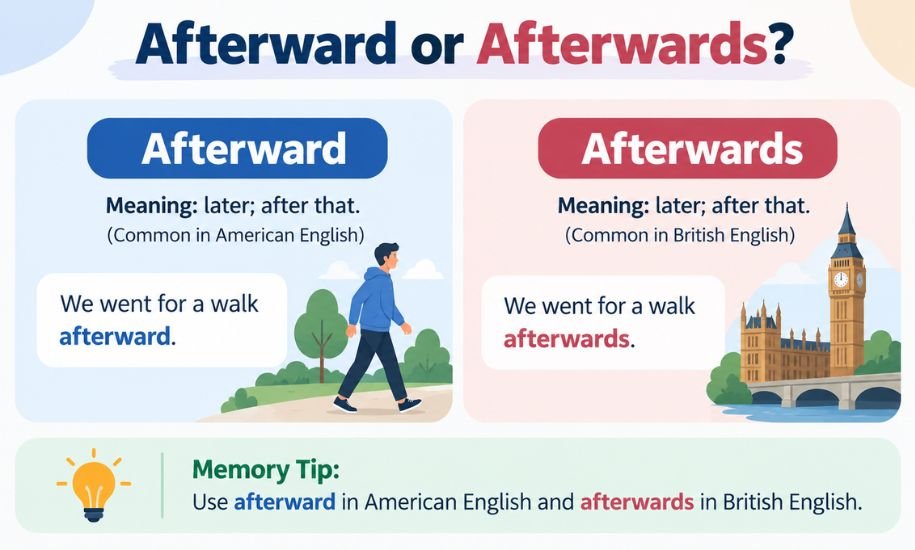
If you have ever hesitated between afterward and afterwards, you are not alone. The two forms look almost identical, have the same basic meaning, and are both standard English words. The difference is mainly one of regional preference rather than grammar: afterward is particularly common in American English, while afterwards is mainly associated with British English. Both mean that something happens at a later time or after an earlier event.
Afterward and afterwards are both correct. They mean “later” or “after that.” Afterward is especially common in American English, while afterwards is mainly used in British English.
Afterward or Afterwards: What’s the Difference?
There is no important difference in meaning between the two forms. Both are adverbs used to refer to a time following an event, action, or period that has already been mentioned.
| Feature | Afterward | Afterwards |
|---|---|---|
| Correct word? | Yes | Yes |
| Part of speech | Adverb | Adverb |
| Basic meaning | Later; after that | Later; after that |
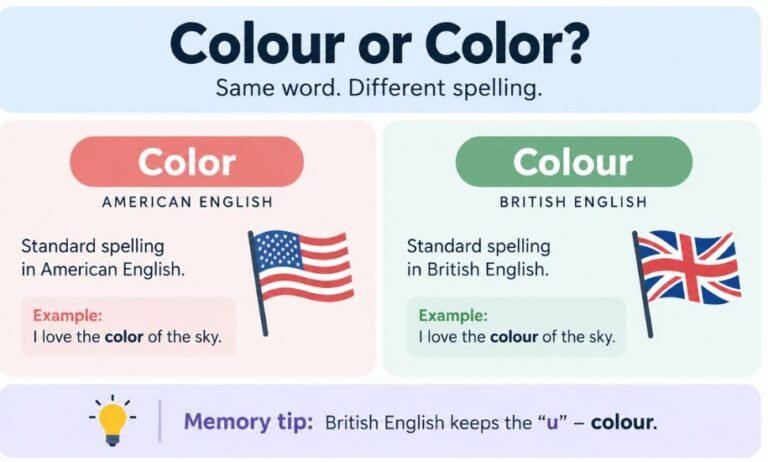
| Main regional association | American English | British English |
| Example | We went home afterward. | We went home afterwards. |
Cambridge identifies afterward as a US form and notes that afterwards is mainly UK usage. Collins similarly explains that afterward is mainly American, while afterwards is the British form.
So, if you are writing for an American audience, afterward may sound more natural. For a British audience, afterwards is often the more familiar choice.
Neither should be treated as a spelling mistake.
What Does “Afterward” Mean?
Afterward is an adverb meaning at a later time, after something else has happened, or subsequently.
For example:
- We finished dinner and went for a walk afterward.
- She apologized afterward.
- I didn’t understand what had happened until afterward.
- He felt tired afterward.
The word usually refers back to something that has already happened. Cambridge defines it as meaning “after the time mentioned” and gives examples such as soon afterward and shortly afterward.
Afterward in a sentence
Here are a few natural examples:
We watched the movie and talked about it afterward.
She called me shortly afterward.
He regretted his decision afterward.
The students went outside afterward.
In each sentence, the word tells us that the second action occurred later than the first event.
What Does “Afterwards” Mean?
Afterwards has the same basic meaning as afterward: later, after that, or at a subsequent time.
Examples include:
We had lunch and went shopping afterwards.
She moved away and rarely visited afterwards.
They discussed the problem afterwards.
I can explain everything afterwards.
Cambridge’s learner dictionary defines afterwards as referring to a later time after something else has happened. Collins likewise defines it as occurring after a previously mentioned event or time.
The main distinction is not meaning but regional convention.
American English vs. British English
The easiest way to understand the difference is to think about regional English.
American English
Afterward is particularly common in American English.
We went to a restaurant afterward.
Shortly afterward, the company released a statement.
American English also uses afterwards, so it would be inaccurate to say that the longer form is impossible or grammatically wrong in the United States. Cambridge specifically notes that American English usually uses afterward, while Collins describes afterward as mainly American.
British English
Afterwards is the usual British form.
We went to a restaurant afterwards.
Shortly afterwards, the company released a statement.
British English also accepts afterward, but afterwards is the more characteristic choice. Collins lists afterwards as the British form and notes that afterward is also used.
Which one should you choose?
The best approach is consistency.
If your website generally follows American English, use afterward. If it follows British English, use afterwards. If you are writing for an international audience, either form is understandable and grammatically correct.
Afterward or Afterwards: Examples
Because both forms have the same meaning, they can normally replace one another without changing the meaning of a sentence.
With “soon”
- Soon afterward, the meeting ended.
- Soon afterwards, the meeting ended.
With “shortly”
- Shortly afterward, she received a reply.
- Shortly afterwards, she received a reply.
At the end of a sentence
- We went home afterward.
- We went home afterwards.
Referring to a previous event
- He spoke to his manager and apologized afterward.
- He spoke to his manager and apologized afterwards.
The important point is that the change in spelling does not create a different meaning.
Afterward or Afterwards Synonyms
Depending on the sentence, several words and phrases can express a similar idea.
Common alternatives include:
- later
- after
- then
- after that
- later on
- subsequently
- at a later time
For example:
We had dinner and afterward went home.
can become:
We had dinner and later went home.
or:
We had dinner and went home after that.
However, these alternatives are not always exact substitutes. Cambridge notes that later can refer to a later time without necessarily suggesting that the second event follows the first immediately, while subsequently can sound more formal.
So choose the alternative that best fits the intended timing and tone.
Afterward Pronunciation
Both words are pronounced with the main stress near the beginning.
Cambridge gives the following pronunciations for afterward:
- UK: /ˈɑːf.tə.wəd/
- US: /ˈæf.tɚ.wɚd/
For afterwards, Cambridge gives:
- UK: /ˈɑːf.tə.wədz/
- US: /ˈæf.tɚ.wɚdz/
The most noticeable difference between the written forms is the final -s in afterwards, which is also reflected in its pronunciation.
Is “Afterward” a Word?
Yes. Afterward is a standard English word.
It is an adverb, and major dictionaries including Cambridge, Collins, and Dictionary.com list it as a word meaning “at a later time” or “subsequently.”
Likewise, afterwards is also a legitimate English word. Dictionary.com describes it as a variation of afterward, while Cambridge and Collins list it as an established adverb.
Therefore, writing afterward without the final s is not an error.
Don’t confuse “afterward” with “afterword”
There is another word that looks very similar: afterword.
These words have different meanings:
- afterward = later; after that
- afterwards = later; after that
- afterword = a concluding section of a book
For example:
We went for coffee afterward.
But:
The author included an afterword at the end of the novel.
This distinction is especially useful when writing about books.
Using “Afterward” in a Book
Afterward is perfectly acceptable in books and other forms of published writing. It can appear in fiction, nonfiction, essays, journalism, academic writing, and general prose.
For example:
She closed the letter and sat quietly afterward.
Or:
The two characters meet again several chapters afterward.
The choice between afterward and afterwards should generally follow the variety of English used by the author or publisher.
If a book follows American English conventions, afterward may be preferred. A British English publication may favor afterwards. Neither choice is inherently more correct.
Common Mistakes to Avoid
1. Thinking “afterward” is a misspelling
It is not. Afterward is a standard English adverb.
Correct:
We talked afterward.
2. Assuming “afterwards” is always British and therefore wrong in American English
The regional labels describe typical preference, not an absolute grammatical restriction. Both forms exist in English. Cambridge specifically notes that American English usually uses afterward, while Collins notes that afterwards is also used.
3. Confusing “afterword” with “afterward”
These are completely different words.
Afterword relates to a book’s concluding section; afterward relates to time.
4. Using “afterward” when you mean “after”
Compare:
We went home afterward.
with:
We went home after dinner.
Afterward functions as an adverb meaning later. After can work as a preposition or conjunction and is followed by information such as a noun phrase or clause.
5. Changing forms unnecessarily
If you are writing an article in American English, there is no need to alternate randomly between afterward and afterwards. Pick the form that fits your chosen variety and maintain consistency.
Easy Way to Remember the Difference
A simple rule is:
US English → afterward
UK English → afterwards
Think of the final -s as the form commonly associated with British English.
This is a guideline rather than an absolute rule. Both forms are recognized English words, so the goal is not to memorize one as “correct” and the other as “incorrect.” Instead, remember that they differ mainly in regional preference.
Frequently Asked Questions
Is “afterward” or “afterwards” correct?
Both are correct. They are adverbs with essentially the same meaning: “later,” “after that,” or “at a subsequent time.” Afterward is especially common in American English, while afterwards is mainly associated with British English.
Is “afterward” American or British?
Afterward is particularly associated with American English. British English commonly uses afterwards, although afterward is also an accepted form in British English.
Can I use “afterwards” in American English?
Yes. Afterwards is a real and accepted English word, even though afterward is generally the more characteristic American form. The choice can depend on personal, editorial, or regional style.
What is another word for “afterward”?
Common alternatives include later, after, then, after that, later on, and subsequently. The best choice depends on the sentence because these words can differ slightly in timing, formality, or grammatical structure.
Is “afterward” one word?
Yes. Afterward is written as one word and functions as an adverb. Afterwards is also written as one word. Neither should be written as two separate words in standard usage.
What is the difference between “afterward” and “afterword”?
Afterward means “later” or “after that.” An afterword is a section added at the end of a book, often written by the author or another contributor. Their similar spelling can cause confusion, but their meanings are unrelated.
Final Verdict: Afterward or Afterwards?
Afterward and afterwards are both correct. The meaning is essentially the same, so the main distinction is regional usage. American English particularly favors afterward, while British English commonly uses afterwards. For consistent writing, choose the form that matches your intended variety of English and use it consistently.
For more clear explanations of confusing English words, grammar, spelling, and usage, Grammarifyr helps readers know the difference and use the right words.
You may also Read : Swiftie or Swifty: Meaning and Correct Usage
One Comment