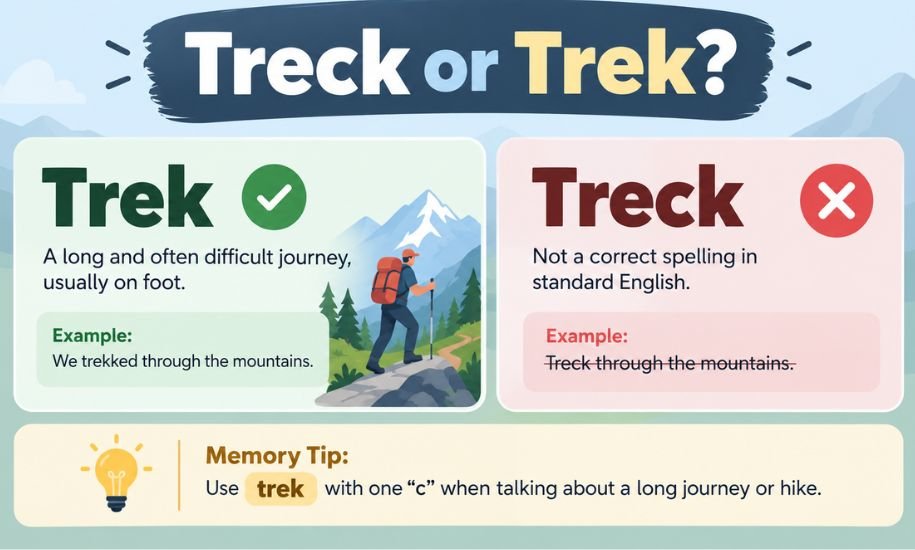
Treck or Trek: Meaning and Correct Usage
When you’re writing about a long hike, a demanding journey, or traveling through difficult terrain, you may hesitate between treck and trek. The two spellings look almost identical, and the extra “c” in treck can seem natural because English contains many words ending in “-ck.” However, there is a clear choice for modern standard English. Trek is the standard spelling for the word meaning a long or difficult journey. Although treck can be found in historical or archaic usage, it is not the normal modern spelling.
Trek is the correct standard spelling in modern English when you mean a long, difficult, or demanding journey. Treck is generally not used as the modern spelling of this word, although it appears as an archaic form in some historical dictionary records. Use trek, trekked, and trekking in contemporary writing.
Trek or Treck: What’s the Difference?
The main difference is straightforward: trek is the standard modern English word, while treck is generally a nonstandard spelling when someone intends to write trek.
| Feature | Trek | Treck |
|---|---|---|
| Standard modern spelling | Yes | No |
| Meaning | A long or difficult journey; to travel such a route | Usually an alternative/misspelled form of trek |
| Part of speech | Noun and verb | Not normally used in modern standard English |
| Formal writing | Appropriate | Generally avoid |
| Past tense | trekked | trecked is not the standard form |
| -ing form | trekking | trecking is not the standard form |
So, if you are describing a challenging mountain journey, write:
We went on a difficult trek through the mountains.
Not:
We went on a difficult treck through the mountains.
What Does “Trek” Mean?
Trek can be used as both a noun and a verb.
As a noun, it refers to a long, difficult, or tiring journey. It is especially common when talking about walking, hiking, mountains, wilderness, or other demanding travel.
For example:
- The hikers began their trek before sunrise.
- It was a difficult trek across the desert.
- We planned a three-day trek through the mountains.
- The village was a long trek from the nearest road.
As a verb, trek means to travel or walk a considerable distance, particularly when the journey is challenging.
Examples:
- We trekked through the forest for several hours.
- They trekked across the valley.
- She loves trekking in remote mountain regions.
The word therefore works naturally in expressions such as mountain trek, long trek, desert trek, and trek through the forest.
Is “Treck” a Real Word?
This question requires a little more explanation than simply saying “no.”
In contemporary standard English, treck is not the normal spelling for the journey-related word. If you are writing an essay, article, email, school assignment, or other modern English text, trek is the spelling to choose.
However, treck does appear in historical dictionary records as an archaic form of trek. That means it is more accurate to describe it as an outdated or nonstandard modern form rather than claiming that the spelling has never existed.
For ordinary modern writing, this distinction is important:
Use “trek,” not “treck,” when referring to a long or difficult journey.
If you encounter treck in an old text or a particular historical source, its presence does not mean that it is the preferred spelling today.
Why Do People Confuse These Spellings?
The confusion is mainly visual. English has many familiar words ending in -ck, including back, track, check, deck, and wreck. Because trek ends with the /k/ sound, it can be tempting to add a “c” before the “k.”
There is another reason the mistake can feel plausible: adding “c” does not change the way most English speakers would expect the word to sound. Both trek and the intended pronunciation of treck would naturally be read with a /k/ sound.
But spelling is not determined solely by pronunciation. The established modern spelling is trek.
Trek as a Noun
As a noun, trek describes the journey itself.
It often suggests that the journey is relatively long, strenuous, or demanding. It does not necessarily have to involve professional mountaineering or extreme conditions.
Consider these examples:
- The trek to the waterfall took four hours.
- Our weekend trek covered several miles.
- The final part of the trek was particularly steep.
- They prepared carefully for their trek through the wilderness.
The word can also be used more broadly and figuratively. Someone might describe a long trip across a city as “a trek” if it feels tiring or inconvenient.
For example:
Getting from one side of the airport to the other was a real trek.
Here, the word does not necessarily mean hiking in nature. It emphasizes the length or effort involved in getting somewhere.
Trek as a Verb
Trek is also a verb. It means to travel or walk, usually over a considerable distance or through challenging conditions.
Its basic forms are:
| Verb form | Example |
|---|---|
| Base form: trek | We will trek through the hills. |
| Third-person singular: treks | He regularly treks in the countryside. |
| Past tense: trekked | They trekked through the valley. |
| Present participle: trekking | She enjoys trekking in the mountains. |
Notice the spelling when suffixes are added:
trek → trekked
trek → trekking
The final k is doubled before -ed and -ing.
Trekked or Trecked?
The correct past-tense form is trekked.
Correct:
We trekked through the forest yesterday.
Incorrect in standard modern English:
We trecked through the forest yesterday.
The same principle applies to the participle:
Correct:
They are trekking across the mountain trail.
Incorrect:
They are trecking across the mountain trail.
This is an important detail because someone who writes treck as the base form may naturally produce trecked or trecking. The standard forms are trekked and trekking.
Trekking or Trecking?
If you are talking about the activity of making long walks or journeys, the correct form is trekking.
For example:
- Trekking is popular in mountainous regions.
- We spent a week trekking through the hills.
- She bought new boots for trekking.
- The group enjoys trekking in remote areas.
Trecking is not the standard modern spelling.
A useful way to remember it is to start with the correct base word:
trek + ing = trekking
There is no need to introduce a “c.”
Examples: Correct vs. Incorrect
Seeing the two spellings side by side can make the distinction easier to remember.
Correct
- We went on a long trek through the mountains.
- The hikers completed the trek in three days.
- They trekked across the valley.
- She enjoys trekking in the countryside.
- It was a challenging trek to the summit.
- The final part of the journey was a difficult trek.
Incorrect in ordinary modern usage
- We went on a long treck through the mountains.
- The hikers completed the treck in three days.
- They trecked across the valley.
- She enjoys trecking in the countryside.
The correction is not complicated: replace treck with trek, and use trekked or trekking when the grammar requires those forms.
Trek vs. Hike: Are They the Same?
Trek and hike can overlap in meaning, but they are not always interchangeable in tone.
A hike is generally a walk, especially one taken outdoors or on a trail. A trek often emphasizes the distance, difficulty, or demanding nature of the journey.
For example:
We went for a short hike in the park.
sounds perfectly natural because the walk was relatively casual.
By contrast:
They completed a five-day trek through the mountains.
suggests a longer and more demanding journey.
There is no strict distance requirement that turns a hike into a trek. Context determines which word sounds most appropriate.
How to Remember the Correct Spelling
The easiest rule is simple:
Trek has one “c”: T-R-E-K.
If you’re describing a long or difficult journey, remember:
Trek = travel a long way.
Then build the other forms from the same spelling:
- trek
- treks
- trekked
- trekking
- trekker
Don’t insert a “c” into any of these forms.
You can also connect trek with familiar words such as trekking and trekker. Seeing the word family together makes the standard spelling easier to recognize.
Common Mistakes to Avoid
1. Writing “treck” in place of “trek”
This is the most common problem in this comparison. In contemporary standard English, use trek.
2. Writing “trecked”
The past tense is trekked, with a doubled k.
3. Writing “trecking”
The correct form is trekking.
4. Assuming “treck” must be correct because it looks familiar
English spelling does not always follow the patterns that seem most intuitive. The established modern form is trek.
5. Calling “treck” completely nonexistent
Although treck is not the standard modern spelling, historical and archaic records of the form exist. Therefore, “nonstandard in modern English” is more precise than saying the spelling has never existed.
What Is the Correct Spelling in British and American English?
There is no major British-versus-American spelling difference here.
Both varieties use:
trek
Examples:
- British English: We went on a trek through the hills.
- American English: We went on a trek through the mountains.
The same spelling is used in both.
So if you are writing for a British, American, or international English-speaking audience, trek is the appropriate modern spelling.
Frequently Asked Questions
Is “treck” or “trek” correct?
Trek is the standard modern spelling when you mean a long, difficult, or demanding journey. Treck is generally not used as the standard spelling today, although it appears as an archaic form in some historical records.
Is treck a word?
Treck can be found in historical or archaic dictionary records as a form of trek. However, it is not the standard modern spelling for the common English word. In contemporary writing, use trek.
What does trek mean?
As a noun, trek means a long, difficult, or tiring journey. As a verb, it means to travel or walk a considerable distance, particularly under challenging conditions.
Is it trekked or trecked?
The correct past tense is trekked. The spelling changes from trek to trekked by doubling the final k before adding -ed.
Is it trekking or trecking?
The standard form is trekking. When trek takes the -ing ending, the final k is doubled.
Is trek a noun or a verb?
It is both. As a noun, trek refers to a journey; as a verb, it means to travel or walk, usually over a significant distance or through difficult conditions.
The Bottom Line
For modern standard English, trek is the spelling to use. It can function as both a noun and a verb, with related forms such as trekked, trekking, and trekker. Although treck has historical or archaic documentation, it should not normally replace trek in contemporary writing. For clear and correct word choice, Grammarifyr recommends keeping the modern spelling firmly in mind: trek, not treck.
You may also Read : Afterward or Afterwards: Difference Explained