Zeroes or Zeros: Which Spelling Is Correct?
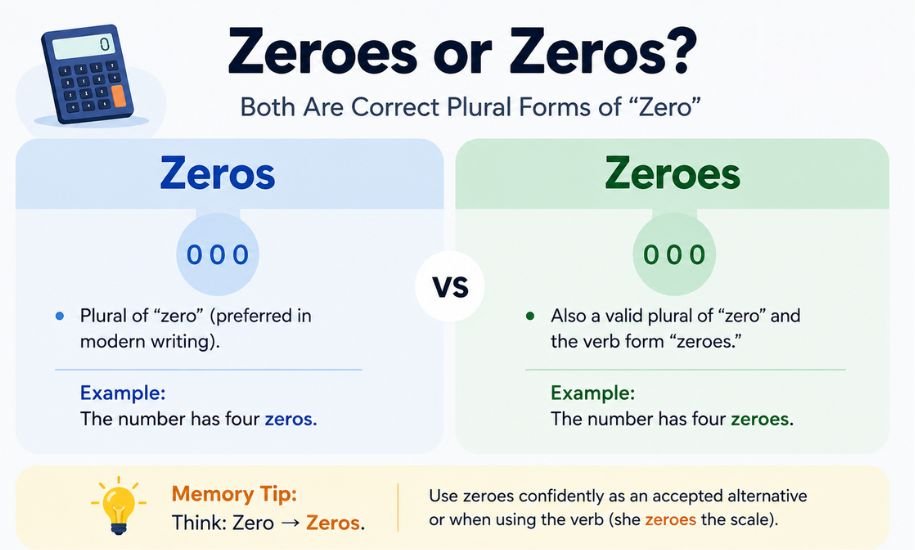
When you need to write the plural of zero, you may hesitate between zeros and zeroes. The confusion is understandable because both forms appear in dictionaries and published English. The good news is that neither spelling is inherently wrong when used as the plural noun. Zeros is generally the best default choice, particularly in modern technical and general writing, while zeroes is also an accepted plural form. There is one additional wrinkle: zeroes can also be a verb form, as in “She zeroes in on the problem.”
Both “zeros” and “zeroes” are correct plural forms of “zero.” However, “zeros” is the better default for most modern writing, and Microsoft’s style guidance specifically recommends “zeros.” “Zeroes” remains a valid plural, while it can also function as the third-person singular form of the verb “zero.”
Zeros or Zeroes: The Quick Comparison
| Feature | Zeros | Zeroes |
|---|---|---|
| Correct plural? | Yes | Yes |
| Singular | zero | zero |
| Meaning as a noun | More than one zero | More than one zero |
| Common recommendation | Preferred default | Accepted alternative |
| Can be a verb? | Yes, less visibly distinctive | Yes |
| Example | The number has three zeros. | The number has three zeroes. |
Merriam-Webster gives zeros as the primary plural and zeroes as an alternative. The Government of Canada’s language guidance likewise says that both spellings can be used.
What Does “Zeros” Mean?
Zeros is the plural form of the noun zero. It refers to more than one instance of the number, digit, value, or mathematical zero.
For example:
- The number 10,000 contains four zeros.
- The computer displayed a string of zeros.
- Add two zeros to the end of the number.
- The equation has two zeros.
- The scoreboard showed several zeros.
“Zeros” is particularly natural in mathematical, scientific, financial, and technical contexts. Microsoft’s Style Guide explicitly recommends zeros, not zeroes, as the plural of zero.
Singular vs. plural
The basic distinction is simple:
One zero
Two zeros
For example:
There is one zero at the end of the number.
There are three zeros at the end of the number.
The same rule applies when you choose the alternative spelling:
There are three zeroes at the end of the number.
What Does “Zeroes” Mean?
Zeroes has two legitimate grammatical uses.
First, it can be the plural noun form of zero:
The number contains five zeroes.
In this sentence, zeroes means the same thing as zeros.
Second, zeroes can be the third-person singular present-tense form of the verb zero:
She zeroes the scale before taking a measurement.
Merriam-Webster lists the verb forms as zeroed, zeroing, zeroes.
This means that context matters. Compare:
The calculator displays several zeroes.
Here, zeroes is a plural noun.
He zeroes the instrument before beginning.
Here, zeroes is a verb.
Why Are Both Plurals Accepted?
The spelling variation is related to the way English forms plurals for nouns ending in -o. English does not have one universal rule that requires every such noun to take either -s or -es.
For example, English has:
- photo → photos
- piano → pianos
- tomato → tomatoes
- hero → heroes
- zero → zeros or zeroes
The important point is that zero has developed two accepted plural spellings. You therefore do not need to treat zeroes as a spelling mistake simply because zeros is more commonly recommended in many contexts. The Canadian government’s Writing Tips resource specifically recognizes both forms.
Is “Zeroes” a Misspelling?
No.
This is one of the most important points to remember. Zeroes is a legitimate English word, not merely a common typo for zeros.
Merriam-Webster’s dictionary entry gives:
plural zeros also zeroes
That means both forms are recognized as plural nouns.
So both of these are correct:
The number contains six zeros.
The number contains six zeroes.
If you are writing for a general audience, however, zeros is usually the safer default because it is the form explicitly preferred by Microsoft’s style guidance.
When Should You Use “Zeros”?
Choose zeros when you want the simplest and most widely recommended plural form.
It works especially well in:
Mathematics
The polynomial has two zeros.
In mathematics, a zero can also mean a value of a variable that makes a function equal to zero. Merriam-Webster includes this mathematical meaning in its definition of zero.
Numbers
The figure ends with three zeros.
Computing
The binary sequence contains both ones and zeros.
Finance
The new figure has several zeros after the first digit.
Everyday writing
There were three zeros on the scoreboard.
In all these cases, zeros is clear, natural, and easy to read.
When Can You Use “Zeroes”?
You can use zeroes when you are using it as the accepted plural noun.
For example:
The form requires several zeroes before the decimal point.
The number contains four zeroes.
He accidentally entered two extra zeroes.
There is no grammatical error in these sentences.
However, if you are preparing technical documentation, educational material, or professional copy and do not have a house style that says otherwise, zeros is generally the more straightforward choice.
The Special Verb Use of “Zeroes”
The word zeroes becomes especially interesting when it functions as a verb.
The verb zero can mean to adjust something to a zero setting or to focus on something.
Examples:
She zeroes the scale before every experiment.
The technician zeroes the instrument before recording the result.
The investigator zeroes in on the main problem.
The Canadian government’s Writing Tips resource specifically notes that the -es ending is used for the present-tense verb form zeroes, while the noun plural may be either zeros or zeroes.
This gives writers a useful way to distinguish the forms in some sentences:
The machine displays several zeros.
The operator zeroes the machine before use.
Here, zeros is the plural noun and zeroes is the verb.
That distinction is helpful, but it does not mean zeroes can only be a verb. As explained above, it is also a valid plural noun.
Examples: Correct and Incorrect Usage
Correct
The number 1,000 has three zeros.
The number 1,000 has three zeroes.
The program returned a series of zeros.
The equation has two zeros.
She zeroes the balance before weighing the object.
Incorrect
The number has three zero.
The problem here is singular/plural agreement. When referring to multiple instances of the digit 0, use zeros or zeroes.
Also avoid treating zeroes as automatically wrong:
The number has three zeroes. ✓
It is a valid sentence.
What About American and British English?
It is tempting to describe zeros as American and zeroes as British, but that is too simplistic.
Both spellings are recognized in English, and evidence from grammar references does not support treating the two as strict US-versus-UK equivalents. Merriam-Webster accepts both, while the Canadian government also lists both forms.
Some style and usage sources report differences in preference, but zeros is certainly not an exclusively American spelling. A corpus discussion reproduced by English Language & Usage, for example, found zeros substantially more frequently than zeroes in both American and British corpus data.
So the practical rule is:
Do not assume that “zeroes” is British and “zeros” is American. Both are accepted.
Which Spelling Should You Choose?
If you simply want to know which form to use, choose zeros.
It is concise, familiar, and specifically recommended by Microsoft’s Style Guide.
Use zeroes if:
- your organization’s style guide prefers it;
- you are following an existing text’s spelling;
- you simply prefer that accepted form;
- or you are using zeroes as a verb.
The most important thing in professional writing is to maintain consistency.
For example, if a document uses zeros throughout, there is little reason to switch to zeroes halfway through.
An Easy Way to Remember
A simple default rule is:
Zero → zeros
Think of zero like several other words that naturally form their plural with -s, such as photo → photos and piano → pianos.
You do not need to remember that zeroes is wrong—because it isn’t. Instead, remember that zeros is the preferred default, while zeroes is an accepted alternative.
There is one extra clue for the verb:
She zeroes the machine.
The -es spelling is especially easy to recognize when zeroes describes what someone does.
Common Mistakes to Avoid
1. Calling “zeroes” incorrect
This is inaccurate. It is an accepted plural form of zero.
2. Assuming every word ending in -o takes -es
English plural formation does not work that neatly. Some nouns take -s, some take -es, and some allow both.
3. Using “zero” for multiple digits
Write:
The number contains five zeros.
not:
The number contains five zero.
4. Confusing the noun and verb
Compare:
There are three zeros in the number.
with:
She zeroes the instrument.
The first is a plural noun; the second is a verb.
5. Switching forms unnecessarily
Both spellings are accepted, but consistent writing is easier for readers to follow. If you choose zeros as your default, keep using it unless there is a reason to change.
Frequently Asked Questions
Is “zeros” or “zeroes” correct?
Both are correct when used as the plural noun of zero. Zeros is generally the better default choice, and Microsoft’s Style Guide specifically recommends it. Zeroes is nevertheless an accepted alternative.
Is “zeroes” a real word?
Yes. Zeroes is a real English word. It can be the plural noun meaning more than one zero, and it can also be the third-person singular form of the verb zero.
What is the plural of zero?
The plural can be zeros or zeroes. For example, “The number has four zeros” and “The number has four zeroes” are both grammatically correct.
Should I use “zeros” in formal writing?
Yes. Zeros is an excellent choice for formal, academic, mathematical, and technical writing. Microsoft’s Style Guide explicitly recommends zeros rather than zeroes.
Is “zeroes” British English?
Not exclusively. Both zeros and zeroes are accepted English forms, and it is misleading to treat them as a strict American-versus-British spelling pair.
How do I remember which one to use?
For the plural noun, simply make zeros your default: one zero, two zeros. Remember zeroes separately as a valid alternative and as the verb form in sentences such as “She zeroes the scale.”
The Bottom Line
Zeros and zeroes are both correct plural forms of zero. If you need to choose one for ordinary, professional, mathematical, or technical writing, zeros is the safest default. Zeroes is not a misspelling, and it remains perfectly acceptable when used as a plural noun.
For clear word-choice guidance, Grammarify helps you understand not just which form works, but when and why to use it.
You may also Read : Cue or Queue: What’s the Difference?

One Comment