Natzi or Nazi: Meaning, Pronunciation and Usage
When writing about World War II, Adolf Hitler, or German history, you may come across the spellings Natzi and Nazi. Although they look similar and are often confused because of their pronunciation, only one is the standard spelling in English. Understanding the difference helps you avoid spelling mistakes and use the word correctly in historical and educational writing.
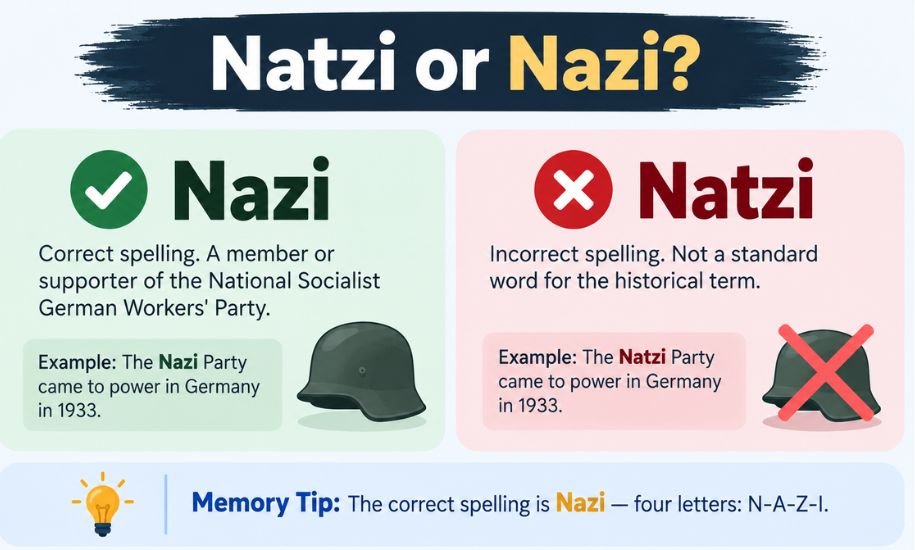
Nazi is the correct spelling when referring to a member or supporter of the National Socialist German Workers’ Party. Natzi is a misspelling in this context. The confusion mainly comes from the way the word sounds when spoken, but its accepted spelling does not include a t.
Quick Answer
Nazi is the correct spelling, while Natzi is incorrect when referring to the historical political movement, its members, or its ideology. The word Nazi is derived from the German term Nationalsozialist. Its plural form is Nazis.
Natzi or Nazi: Which Spelling Is Correct?
The correct spelling is Nazi, with no t between the letters a and z. It is the established English spelling of a term associated with the National Socialist German Workers’ Party (NSDAP), which Adolf Hitler led in Germany.
Natzi is not a recognized alternative spelling of this historical term. Although it may appear in informal writing, online discussions, or as a typing error, it should be avoided in standard English.
| Feature | Nazi | Natzi |
|---|---|---|
| Correct spelling | Yes | No |
| Meaning | Member or supporter of the Nazi movement | No standard meaning in this context |
| Part of speech | Noun and adjective | Misspelling |
| Pronunciation | Commonly /ˈnɑːt.si/ in English | No standard pronunciation |
| Plural | Nazis | Not applicable |
| Formal writing | Accepted | Incorrect |
What Does Nazi Mean?
The word Nazi refers to a member or supporter of the National Socialist German Workers’ Party, a far-right political party that rose to power in Germany under Adolf Hitler.
The party promoted extreme nationalism, antisemitism, racism, dictatorship, and territorial expansion. After Hitler became chancellor in 1933, the Nazi regime established an authoritarian dictatorship, persecuted targeted groups, and played a central role in starting World War II in Europe. The regime also carried out the Holocaust, the systematic murder of six million European Jews, as well as the persecution and killing of millions of other people.
The term is also used as an adjective to describe things connected with the party or its ideology.
Examples include:
- Nazi Germany: Germany under the Nazi dictatorship from 1933 to 1945.
- Nazi Party: The National Socialist German Workers’ Party.
- Nazi ideology: The political beliefs and principles promoted by the Nazi movement.
- Nazi propaganda: Information and messaging used by the regime to influence public opinion.
Is Natzi a Real Word?
Natzi is not a standard English spelling of Nazi. It is generally considered a spelling error when used to refer to the historical German political movement or its supporters.
However, the spelling may occasionally be used as a personal name, username, fictional character’s name, or other intentionally created term. In those specific situations, its spelling depends on the intended name rather than the historical word.
For ordinary historical, educational, or academic writing, always use Nazi.
Why Do People Confuse These Spellings?
The confusion between the two forms is largely related to pronunciation and phonetic spelling. People sometimes attempt to write words exactly as they hear them, especially when they are unfamiliar with the correct written form.
There are a few plausible reasons for the mistake:
- Pronunciation: The word contains a /t/ sound in common English pronunciation, which may lead some writers to insert an extra t.
- Phonetic spelling: English learners may assume that every noticeable sound should be represented by a separate letter.
- Typing errors: The extra letter may be added accidentally while typing.
- Unfamiliarity: Someone who has mainly encountered the word in spoken conversations may not know its conventional spelling.
Despite these possible explanations, the standard spelling remains Nazi.
How to Pronounce Nazi in English and German
The word Nazi is pronounced slightly differently depending on the speaker’s accent, but the general pronunciation is similar across English and German.
| Language | IPA | Approximate pronunciation |
|---|---|---|
| American English | /ˈnɑːt.si/ | NAHT-see |
| British English | /ˈnɑːt.si/ | NAHT-see |
| German | /ˈnaːtsi/ | NAA-tsee |
The stress falls on the first syllable. The /t/ sound is part of the pronunciation, but it is not represented by an extra letter in the standard spelling. This is one reason writers may mistakenly spell the word as Natzi.
What Is the Plural of Nazi?
The plural of Nazi is Nazis. It follows the usual English rule of adding -s to form the plural of many nouns.
| Form | Example |
|---|---|
| Singular | Nazi |
| Plural | Nazis |
| Adjective | Nazi |
Examples:
- The historian studied a document written by a Nazi.
- Several Nazis were prosecuted for war crimes after World War II.
- The museum features historical records from Nazi Germany.
- The book examines the actions of Nazi officials.
Natzis is incorrect when referring to members of the Nazi movement because it is based on the misspelled form.
Correct and Incorrect Examples
Seeing the correct spelling in context makes it easier to remember and apply in your own writing.
Correct examples
- The Nazi Party gained political power in Germany in 1933.
- The documentary explores the history of Nazi Germany.
- Historians continue to study Nazi propaganda.
- The Nazis persecuted millions of people during their rule.
Incorrect examples
- The Natzi Party gained political power in Germany in 1933.
- The documentary explores the history of Natzi Germany.
- Historians continue to study Natzi propaganda.
- The Natzis persecuted millions of people during their rule.
In each example, replacing Natzi with Nazi corrects the spelling without changing the intended meaning.
How to Remember the Correct Spelling
An easy way to remember the spelling is to connect Nazi with its German origin, Nationalsozialist. The accepted English form is written with four letters: N-A-Z-I.
Remember that the word is pronounced with a /t/ sound in English, but the letter t does not appear in its spelling. Focus on the established written form rather than trying to spell it phonetically.
Common Mistakes to Avoid
When using this word, keep these points in mind:
- Adding an extra letter: Write Nazi, not Natzi, when referring to the historical movement.
- Using the wrong plural: The correct plural is Nazis, not Natzis.
- Confusing pronunciation with spelling: A spoken /t/ sound does not mean the letter t belongs in the word.
- Incorrect capitalization: Use Nazi with a capital N when referring to the historical movement, its members, or related ideology.
Paying attention to these details helps maintain accuracy in academic assignments, historical writing, and everyday communication.
Frequently Asked Questions
Is it spelled Natzi or Nazi?
Nazi is the correct spelling in standard English when referring to the historical political movement led by Adolf Hitler. Natzi is a misspelling in this context and should not be used in formal or educational writing.
Why is Nazi pronounced with a T?
The standard English pronunciation includes a /t/ sound, even though the word is spelled without the letter t. The pronunciation reflects the way the word is spoken, not an additional letter in its written form.
What is the plural of Nazi?
The plural form is Nazis. Add -s to the singular word to refer to more than one member or supporter of the Nazi movement.
Is Natzi an alternative spelling of Nazi?
No. Natzi is not an accepted alternative spelling of the historical term. It may be used as an intentional proper name in a different context, but it should not replace Nazi in standard English.
Is Nazi a noun or an adjective?
Nazi can function as both a noun and an adjective. As a noun, it refers to a member or supporter of the Nazi movement. As an adjective, it describes something associated with the Nazi Party, such as Nazi Germany or Nazi ideology.
Final Verdict: Natzi or Nazi?
Nazi is the correct spelling, while Natzi is a misspelling when referring to the historical political movement, its members, or its ideology. Although the word is pronounced with a /t/ sound in English, that sound does not require an additional letter in its spelling. Remembering this distinction will help you write accurately in historical, academic, and everyday contexts. At Grammarifyr, our goal is to help readers know the difference and use the right words with confidence.
You may also Read : Least or Atleast: Which Is Correct? Meaning and Examples