Curtesy or Courtesy: Meaning, Difference and Examples
The words curtesy and courtesy look almost identical and are pronounced similarly, which can make them confusing in writing. However, they have different meanings and are used in distinct contexts. Courtesy is the correct word when referring to politeness, respect, or good manners, while curtesy is a valid but uncommon term traditionally associated with a husband’s legal rights to his deceased wife’s property. Understanding this difference can help you avoid spelling mistakes and choose the right word in everyday conversations, professional writing, and academic texts.
Quick Answer
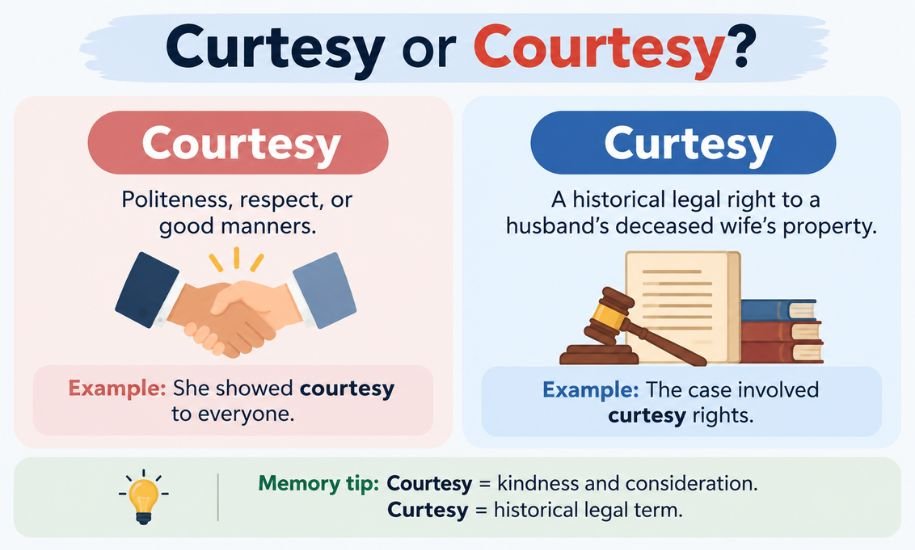
Courtesy is the correct word for politeness, respect, kindness, or considerate behavior. Curtesy is also a real word, but it is primarily a historical legal term referring to a husband’s traditional interest in his deceased wife’s estate. Use courtesy in everyday writing and reserve curtesy for its specific legal or historical meaning.
Curtesy or Courtesy: What’s the Difference?
Both words are accepted in English, but they serve different purposes. The main distinction is their meaning rather than their spelling or pronunciation.
| Feature | Courtesy | Curtesy |
|---|---|---|
| Meaning | Politeness, respect, or good manners | A historical legal property right |
| Part of speech | Noun | Noun |
| Usage | Common in modern English | Rare in everyday English |
| Context | Social, professional, and everyday situations | Historical law and inheritance |
| Pronunciation | KUR-tuh-see | KUR-tuh-see |
| Example | She showed courtesy to everyone. | The case involved curtesy rights. |
If you are writing about polite behavior, customer service, or respectful communication, courtesy is the appropriate spelling. If you are discussing historical inheritance laws, curtesy may be the word you need.
What Does Courtesy Mean?
Courtesy is a noun that refers to polite behavior, respect, consideration, or a thoughtful action toward another person. It describes the way people treat others with good manners and kindness, whether in everyday interactions or formal situations.
Courtesy can involve simple actions, such as saying thank you, holding a door open, listening without interrupting, or speaking respectfully.
Examples of courtesy in sentences:
- The receptionist treated every visitor with courtesy and respect.
- She had the courtesy to inform her colleagues about the meeting.
- Showing courtesy to others can create a positive environment.
- The hotel staff welcomed us with exceptional courtesy.
Courtesy is also used in professional and formal communication. For example, thanking someone for their time or politely acknowledging their assistance are common ways to demonstrate courtesy.
Common Expressions With Courtesy
The word courtesy appears in several familiar expressions.
– Common courtesy: Basic standards of politeness and consideration. It is common courtesy to say thank you when someone helps you.
– Courtesy of someone: Something provided, supplied, or made possible by a person or organization. The photographs are courtesy of the local museum.
– Courtesy call: A visit or telephone call made as a polite or formal gesture. The ambassador paid a courtesy call to the president.
– Courtesy car: A temporary vehicle provided to someone, often while their own car is being repaired. The garage offered us a courtesy car during the repairs.
These expressions are widely used in everyday, business, and formal English.
What Does Curtesy Mean?
Curtesy is a legitimate but rare English noun that traditionally refers to a husband’s right under historical common law to receive a life interest in certain property belonging to his deceased wife, provided specific legal conditions were met.
Historically, this right was generally associated with a marriage in which a child capable of inheriting had been born. The precise requirements and legal effects depended on the applicable legal system.
Examples of curtesy in sentences:
- The historian studied the doctrine of curtesy in English common law.
- The legal textbook explained the historical rights associated with curtesy.
- The case examined the difference between dower and curtesy.
- The students discussed curtesy as part of their inheritance law course.
The word is mainly encountered in legal history, old property documents, and academic discussions of inheritance. It is not suitable as a replacement for courtesy when referring to politeness.
It is also worth knowing that some dictionaries record curtesy as an archaic variant of curtsy, a gesture of respect made by bending the knees. However, the legal meaning is distinct and is particularly relevant to the comparison of these two spellings.
How to Use Courtesy and Curtesy in Sentences
Understanding how each word works in a sentence makes the difference easier to remember.
Courtesy: Correct examples
- Please show courtesy to other passengers on the bus.
- The manager handled the complaint with courtesy and patience.
- He thanked his neighbour for the kindness and courtesy shown to his family.
- The company provided a courtesy car while her vehicle was being repaired.
- The event organizers treated all their guests with courtesy.
Curtesy: Correct examples
- The researcher examined curtesy under historical English law.
- Curtesy was traditionally connected to a husband’s rights in his deceased wife’s estate.
- The legal historian explained how curtesy differed from dower.
- The students explored the historical doctrine of curtesy in property law.
Common spelling mistake
- Incorrect: The employee showed great curtesy to the customers.
- Correct: The employee showed great courtesy to the customers.
In the incorrect example, the writer is referring to polite behavior, so courtesy is required.
Why Are These Words Confused?
The confusion between these words mainly comes from their similar appearance and pronunciation. They share almost all the same letters, with only a slight difference in spelling.
Both words are also nouns, which means they can appear in similar grammatical positions. However, their meanings are quite different, and the context of a sentence usually makes the intended word clear.
Another reason for confusion is that curtesy is rarely encountered in modern everyday English. Writers may assume it is simply an alternative spelling of courtesy, even though its historical legal meaning is different.
Spell-checking software may also accept both spellings because both are recognized words. Therefore, checking the meaning of the sentence is more useful than relying on spelling correction alone.
Courtesy vs Curtesy Pronunciation
In standard English, courtesy and the legal term curtesy are generally pronounced alike or very similarly.
- Courtesy: KUR-tuh-see
- Curtesy: KUR-tuh-see
Both typically have three syllables, with the stress on the first syllable.
The word curtsy, which refers to a formal gesture, is usually pronounced KURT-see, with two syllables. Although it is related in spelling and sometimes in historical usage, it has a different modern meaning.
Because courtesy and curtesy sound so similar, pronunciation alone is not a reliable way to distinguish them. Understanding the context is the easiest way to select the correct spelling.
Easy Way to Remember the Difference
A simple way to remember the distinction is to associate courtesy with consideration and curtesy with customary historical law.
- Courtesy = Kindness: Use it when discussing politeness, respect, manners, or considerate actions.
- Curtesy = Legal history: Use it when discussing the traditional legal rights of a husband in his deceased wife’s estate.
For example, if you want to thank someone for being respectful, write, “Thank you for your courtesy.” If you are describing an old inheritance law, curtesy may be appropriate.
Remember that courtesy is the word you will need in almost all ordinary conversations and modern professional writing.
Is Curtesy British or American English?
Courtesy is the standard spelling in both British and American English when referring to politeness or respectful behavior. There is no British-versus-American spelling difference between the two.
Curtesy is also recognized in historical legal terminology in both varieties of English, although the legal rules associated with it vary by jurisdiction and historical period.
For the modern gesture of bending the knees as a sign of respect, curtsy is the usual spelling in both British and American English.
Common Questions About These Spellings
Is curtesy a real word?
Yes, curtesy is a real English word. It is primarily a historical legal term referring to a husband’s traditional life interest in certain property of his deceased wife. Some dictionaries also record it as an archaic variant of curtsy.
Is courtesy the correct spelling for politeness?
Yes. Courtesy is the correct spelling when referring to politeness, good manners, respect, or consideration. For example, “The teacher treated every student with courtesy” uses the word correctly.
What does courtesy of someone mean?
The expression courtesy of someone means that something has been provided, supplied, or made possible by that person or organization. For example, “The refreshments were provided courtesy of the event sponsors.”
What is the meaning of a courtesy call?
A courtesy call is a visit or telephone call made as a polite, formal, or diplomatic gesture. It may be used to show respect, maintain a professional relationship, or acknowledge someone’s position.
Is curtesy another spelling of curtsy?
Some dictionaries recognize curtesy as an archaic or alternative spelling of curtsy. However, curtsy is the standard modern spelling for the gesture of bending the knees to show respect. Curtesy also has a separate historical legal meaning.
Can courtesy and curtesy be used interchangeably?
No. Although both are valid words and have similar pronunciations, they have different meanings. Courtesy refers to politeness and consideration, while curtesy generally refers to a historical legal right. Using them interchangeably can change the meaning of a sentence.
Final Verdict: Curtesy or Courtesy?
The choice between these two words depends on what you want to express. Courtesy is the correct spelling for politeness, kindness, respect, and good manners, while curtesy is mainly used in historical legal contexts involving marital property rights. Remembering this distinction will help you avoid confusion in everyday writing. At Grammarifyr, the goal is to help you understand these subtle differences so you can know the difference and use the right words.
You may also Read : Emaculate vs Immaculate: Which Spelling Is Correct?