Least or Atleast: Which Is Correct? Meaning and Examples
The English language has many words and phrases that sound natural when spoken but can be confusing when written. “Least” and “at least” are two forms that often cause uncertainty, especially when deciding whether to write them separately or together. Although both are correct in English, they have different meanings and grammatical uses. The correct phrase is at least, not atleast. Understanding how least works on its own and how at least expresses a minimum or adds emphasis can help you write more clearly and avoid common spelling mistakes.
Quick Answer
“Least” and “at least” are both correct, but “atleast” is not a standard English spelling. Least refers to the smallest amount, number, or degree, while at least means no less than a particular amount or number. Always write at least as two separate words.
Least or Atleast: Which Is Correct?
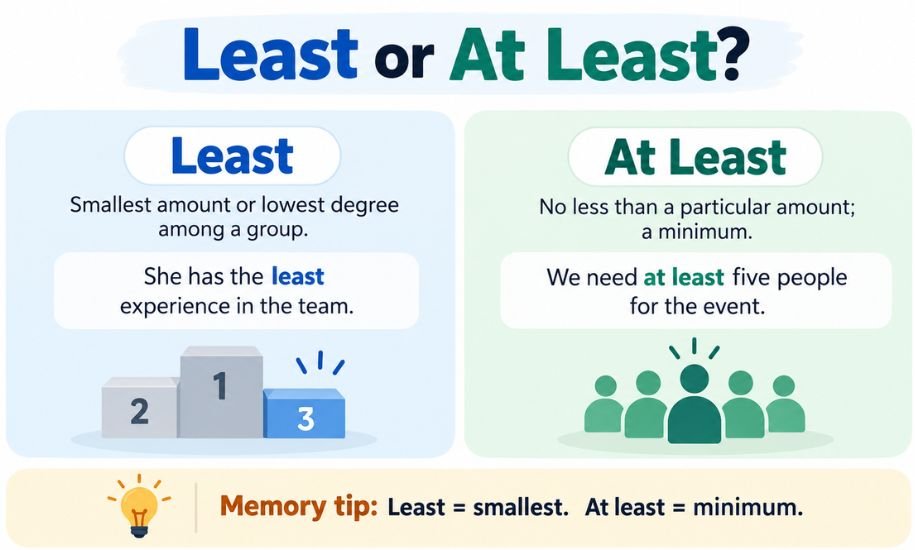
Least and at least are both grammatically correct, but they serve different purposes. Atleast, written as one word, is a spelling mistake and should be avoided in standard English.
- Least: Refers to the smallest amount, number, or degree among several things.
- At least: Means no less than a particular amount, or expresses a minimum expectation.
- Atleast: An incorrect, nonstandard spelling of at least.
| Expression | Correct? | Meaning | Example |
|---|---|---|---|
| Least | Yes | Smallest amount or degree | She has the least experience. |
| At least | Yes | No less than; at a minimum | We need at least five people. |
| Atleast | No | Incorrect spelling | We need atleast five people. |
The important distinction is that least is a word in its own right, while at least is a two-word expression with its own established meaning.
What Does “Least” Mean?
Least is the superlative form of little when referring to quantity or degree. It describes the smallest amount, lowest level, or least extent compared with other things.
It can function as an adjective, pronoun, or adverb, depending on how it is used in a sentence.
Examples:
- Sarah has the least experience among all the employees.
- This is the least expensive phone in the shop.
- He showed the least interest in the meeting.
- Of all the players, James practised the least.
In the first two examples, least describes a noun or its implied quantity. In the last example, it describes the extent to which an action was performed.
When to use least:
Use least when comparing three or more people, objects, amounts, or degrees to identify the smallest or lowest one.
For example, if three bags weigh 2 kg, 5 kg, and 8 kg, the 2 kg bag weighs the least.
What Does “At Least” Mean?
At least is a phrase that means no less than, at a minimum, or not below a specified amount. It is commonly used to establish a minimum quantity, time, age, requirement, or expectation.
It can also introduce a positive point in an otherwise disappointing situation.
Examples:
- You need at least two hours to finish the assignment.
- Every participant must be at least 18 years old.
- We invited at least 30 guests to the wedding.
- I didn’t win the match, but at least I tried.
- At least we have enough food for everyone.
In the first three examples, the phrase sets a minimum. In the final two, it emphasizes something positive or reassuring.
When to use at least:
Use at least when you want to indicate the minimum acceptable amount, emphasize a basic expectation, or point out a positive aspect of a situation.
Why Is “Atleast” Incorrect?
The word atleast is not accepted as a standard English spelling. The correct expression consists of two separate words: at and least.
Although these words often appear together in sentences, they do not combine into one word in standard written English. The mistake can occur when people type quickly or assume that a frequently used phrase should be written as a single word.
Incorrect: You should exercise atleast 30 minutes every day.
Correct: You should exercise at least 30 minutes every day.
Incorrect: She is atleast five years older than me.
Correct: She is at least five years older than me.
This rule applies to both British and American English. In formal writing, professional communication, and academic work, always use the two-word spelling.
Key Differences Between “Least” and “At Least”
Although the two expressions share the word least, their meanings and grammatical functions are different.
| Feature | Least | At least |
|---|---|---|
| Word type | Superlative adjective, pronoun, or adverb | Multiword expression |
| Meaning | Smallest amount or lowest degree | No less than; at a minimum |
| Main purpose | Comparison | Minimum or emphasis |
| Typical use | Comparative statements | Requirements, quantities, and reassurance |
| Example | He made the least effort. | He made at least some effort. |
Consider these sentences:
- Least: Emma has the least amount of homework in her class.
- At least: Emma has at least three assignments to complete.
The first sentence compares Emma’s workload with that of other students. The second establishes a minimum number of assignments.
Grammar Rules for Using “At Least”
The phrase can be used in different situations depending on what you want to communicate.
1. To Express a Minimum
Place at least before a number, quantity, measurement, or period to indicate that the actual amount may be higher.
- We need at least 10 volunteers for the event.
- The journey takes at least four hours.
- You should drink at least two litres of water daily.
- The room can accommodate at least 50 people.
2. To Express a Minimum Expectation
Use the phrase to describe the smallest action or effort that is expected in a situation.
- You should at least inform your manager.
- He could at least say thank you.
- We should at least try to solve the problem.
In these examples, the expression emphasizes a basic expectation rather than a numerical minimum.
3. To Highlight a Positive Point
At least can be used to find something positive in a difficult or disappointing situation.
- I missed the bus, but at least I arrived safely.
- We lost the game, but at least we played well.
- She didn’t pass the exam, but at least she learned from her mistakes.
4. To Qualify a Statement
The expression can also introduce a limitation or clarify the perspective from which a statement is being made.
- The plan seems reasonable, at least to me.
- He is the most experienced candidate, at least among those we interviewed.
- The situation is improving, at least for now.
Synonyms for “At Least”
Several expressions can replace at least, depending on the intended meaning. Some indicate a minimum, while others emphasize a conclusion or qualification.
| Synonym | Example |
|---|---|
| At a minimum | You need at a minimum three references. |
| No less than | The room must have no less than 20 seats. |
| At the very least | You should at the very least apologise. |
| At a bare minimum | At a bare minimum, we need two days. |
| In any case | In any case, we did our best. |
| Not fewer than | There were not fewer than 40 participants. |
At a minimum, no less than, and at the very least are particularly useful when expressing minimum requirements. In any case is not a direct substitute in every context because it usually expresses a conclusion or a return to the main point.
At Least vs. At Most: What Is the Difference?
At least and at most express opposite limits. The first sets a minimum, while the second sets a maximum.
| At least | At most |
|---|---|
| Indicates a minimum | Indicates a maximum |
| Means no less than | Means no more than |
| The amount can be higher | The amount can be lower |
| At least 10 students | At most 10 students |
Examples:
- You must be at least 18 years old to apply. (18 or older.)
- You must be at most 18 years old to qualify. (18 or younger.)
- The shop needs at least five employees. (Five or more.)
- The shop can employ at most five people. (Five or fewer.)
This distinction is particularly important when writing instructions, explaining eligibility requirements, and describing mathematical limits.
Common Mistakes to Avoid
Even though the rule is straightforward, a few errors can occur when using these expressions.
- Writing “atleast” as one word: Always separate at and least.
- Confusing “least” with “at least”: Use least for the smallest amount or degree and at least to express a minimum or emphasize a point.
- Using “at least” when you mean “at most”: Check whether your sentence describes a minimum or a maximum.
- Using “least” without a clear comparison: When making a comparison, ensure that the context makes it clear what has the smallest amount or degree.
Correct and incorrect examples
| Incorrect | Correct |
|---|---|
| I need atleast 10 minutes. | I need at least 10 minutes. |
| This is at least expensive option. | This is the least expensive option. |
| You can bring at least three people maximum. | You can bring at most three people. |
| She has atleast experience. | She has at least some experience. |
Easy Way to Remember the Difference
A simple way to remember the distinction is to associate least with the smallest and at least with a minimum.
- Least = smallest: Think of a comparison in which one person or thing has the lowest amount or degree.
- At least = minimum: Think of a lower limit that must be met, although a higher amount is acceptable.
- Atleast = incorrect: Remember that the phrase always needs a space.
For example, the least expensive product is the product with the lowest price in a comparison, whereas at least $20 means $20 or more.
Frequently Asked Questions
Is “atleast” one word or two?
The correct spelling is at least, written as two separate words. Atleast is a nonstandard spelling and should not be used in formal or standard English writing.
Is “least” a correct English word?
Yes, least is a correct English word. It is the superlative form of little when referring to quantity or degree. It describes the smallest amount, lowest level, or least extent among things being compared.
What is another word for “at least”?
Depending on the context, alternatives include at a minimum, no less than, at the very least, and at a bare minimum. The best alternative depends on whether you are expressing a quantity, an expectation, or emphasis.
Can I use “at least” in formal writing?
Yes. At least is appropriate in formal, academic, professional, and informal writing. It is widely used to express minimum requirements, quantities, and expectations, as well as to qualify statements.
What is the difference between “at least” and “at most”?
At least expresses a minimum, meaning no less than a particular amount. At most expresses a maximum, meaning no more than a particular amount. For example, at least five people means five or more, while at most five people means five or fewer.
How do I use “at least” in a sentence?
Use at least before a quantity or number to establish a minimum, or use it to emphasize a positive point or basic expectation. For example, “You need at least three days to complete the project” establishes a minimum time requirement.
Final Verdict: Least or Atleast?
Both least and at least are correct English expressions, but they have different meanings. Least refers to the smallest amount or degree, while at least indicates a minimum, expresses an expectation, or highlights a positive point. “Atleast” is always incorrect in standard English and should be written as “at least.” Understanding this simple distinction will help you avoid spelling mistakes and choose the right expression. For more practical explanations of confusing English words and grammar rules, Grammarifyr helps you know the difference and use the right words.
You may also Read : Wracking or Racking: Meaning and Examples
One Comment