Genotype and Phenotype: Differences, Examples and Ratios
In genetics, genotype and phenotype are two closely related concepts that help explain how inherited information influences an organism’s characteristics. Although these terms are often used together, they have different meanings. Genotype refers to an organism’s genetic makeup, while phenotype describes its observable or measurable traits. Understanding the difference between them makes it easier to learn how genes are inherited, why individuals have different characteristics, and how environmental factors influence development. From human blood groups to plant height, these concepts are essential for understanding genetics and biological inheritance.
Quick Answer
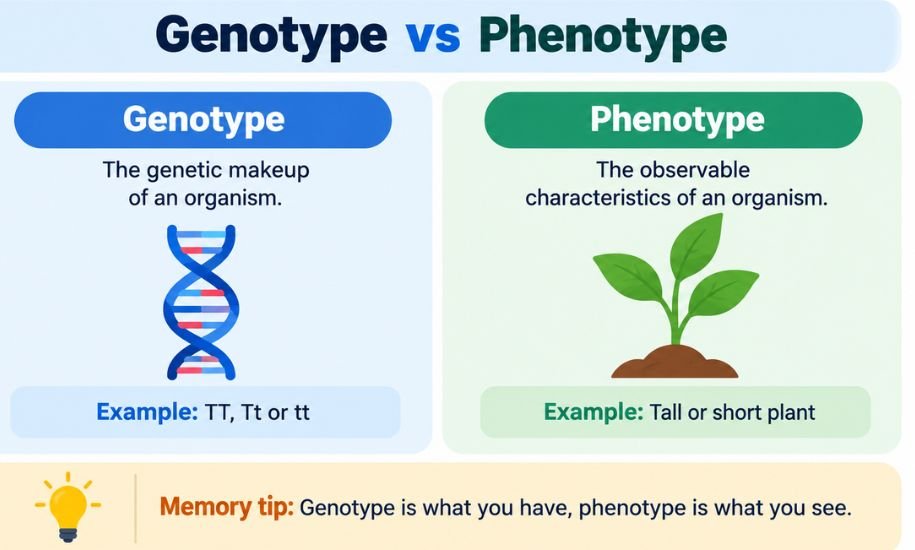
Genotype is the genetic makeup of an organism, including the alleles it carries, while phenotype refers to its observable or measurable characteristics. Genotype influences phenotype, but environmental conditions and interactions between genes also play an important role. For example, a plant’s genotype may be TT or Tt, but both can produce a tall plant when T is dominant.
What Is Genotype?
Genotype refers to the genetic constitution of an organism. It includes the genes and specific alleles inherited from its biological parents, which provide genetic information that can influence physical characteristics, biological functions, and susceptibility to certain conditions.
In organisms with two copies of each chromosome, such as humans, an individual typically inherits one allele of a gene from each biological parent. The combination of these alleles forms the genotype for that particular gene.
For example, in a simplified model of plant height, the letter T may represent a dominant allele for tallness, while t represents a recessive allele for shortness. The possible genotypes are TT, Tt, and tt.
Genotypes can be identified through genetic testing, DNA sequencing, or other laboratory methods. However, knowing an organism’s genotype does not always make it possible to predict exactly how a trait will appear because some characteristics are affected by several genes and environmental factors.
What Is Phenotype?
Phenotype refers to the observable or measurable characteristics of an organism. These characteristics develop through the interaction of genetic information, environmental conditions, and biological processes.
A phenotype can include physical features, such as height, eye colour, and flower shape, as well as physiological characteristics, such as blood group, enzyme activity, and certain aspects of metabolism. Some phenotypes may also involve behavioural characteristics.
For example, a pea plant may have a tall or short phenotype depending on its genetic makeup and the conditions in which it grows. Similarly, human height is influenced by many genetic variants, nutrition, health, and other environmental factors.
Phenotypes can be studied through observation, physical measurements, laboratory testing, and clinical assessments. Unlike genotype, which describes genetic information, phenotype describes the characteristics that are expressed or measured.
Genotype vs Phenotype: What Is the Difference?
The main difference is that genotype describes the genetic information an organism carries, whereas phenotype describes the characteristics that result from genetic and environmental influences.
| Feature | Genotype | Phenotype |
|---|---|---|
| Definition | Genetic makeup of an organism | Observable or measurable characteristics |
| Nature | Genetic information | Expressed traits |
| Determined by | Inherited alleles and genetic variations | Genes, environment, and their interactions |
| Identification | DNA analysis or genetic testing | Observation, measurements, and testing |
| Representation | Often written as AA, Aa, or aa | Described as traits, such as tall or short |
| Inheritance | Genetic variants are inherited | Traits may be influenced by inherited information and environment |
| Variation | Can differ between individuals | Can vary even among individuals with similar genotypes |
| Examples | TT, Tt, or tt | Tall or short plant |
Both concepts are important because genotype helps explain the genetic basis of a characteristic, while phenotype shows how that characteristic is expressed or measured.
For instance, two plants may have different genotypes, such as TT and Tt, but display the same tall phenotype. This happens because the dominant allele T masks the effect of the recessive allele t in this simplified example.
Examples of Genotype and Phenotype
Simple examples help explain how genetic makeup and observable characteristics are connected.
1. Plant height
Plant height is a classic example used to explain Mendelian inheritance. In a simplified model, T represents the dominant allele for tallness and t represents the recessive allele for shortness.
| Genotype | Phenotype |
|---|---|
| TT | Tall plant |
| Tt | Tall plant |
| tt | Short plant |
A plant with TT has two dominant alleles, while a plant with Tt has one dominant and one recessive allele. Both are tall because the dominant allele determines the phenotype in this example.
2. Human blood groups
The ABO blood group system provides an example of how different genotypes can result in the same phenotype.
| Genotype | Blood group phenotype |
|---|---|
| IᴬIᴬ | A |
| Iᴬi | A |
| IᴮIᴮ | B |
| Iᴮi | B |
| IᴬIᴮ | AB |
| ii | O |
The A and B alleles are codominant, meaning both are expressed in individuals with the IᴬIᴮ genotype. The i allele is recessive to both. As a result, someone with blood group A may have either IᴬIᴬ or Iᴬi as their genotype.
This example demonstrates why a phenotype does not always reveal an individual’s exact genetic makeup.
3. Human height
Human height is a complex phenotype influenced by many genetic variants. Environmental factors, including nutrition, childhood health, hormones, and living conditions, can also affect growth.
Two people with similar genetic potential may have different adult heights because of differences in their developmental environments. This illustrates why complex human traits cannot be explained by a single gene alone.
4. Skin pigmentation
Skin pigmentation is another example of a complex phenotype. Several genes influence melanin production and distribution, while environmental factors such as sunlight exposure can affect visible skin pigmentation.
This demonstrates how inherited genetic information and environmental conditions can work together to shape observable characteristics.
Genotype and Phenotype Ratio
Genotype and phenotype ratios explain the expected distribution of genetic combinations and observable traits among offspring. These ratios are commonly studied through Punnett squares, which help predict the possible outcomes of genetic crosses.
Consider a cross between two heterozygous pea plants with the genotypes Tt and Tt. Each parent can pass either T or t to its offspring.
Punnett square: Tt × Tt
T
t
T
TT
Tall
Tt
Tall
t
Tt
Tall
tt
Short
Genotype ratio
1:2:1
TT : Tt : tt
Phenotype ratio
3:1
Tall : Short
The genotype ratio is 1:2:1 because one-quarter of the expected offspring have TT, half have Tt, and one-quarter have tt. The phenotype ratio is 3:1 because three-quarters are expected to be tall and one-quarter short.
These are theoretical probabilities for a simple genetic cross with complete dominance. Actual offspring numbers may differ, especially in small groups. Other inheritance patterns, including codominance and incomplete dominance, can produce different ratios.
How Are Genotype and Phenotype Related?
Genotype and phenotype are connected through the biological processes that use genetic information to build and maintain an organism. Genes can provide instructions for producing proteins and functional RNA, which contribute to cellular activities and the development of traits.
The relationship generally involves several processes:
- Inheritance: An organism receives genetic material from its biological parents.
- Gene expression: Cells use information in particular genes to produce functional molecules.
- Development: Genetic products interact with cellular systems to influence the organism’s growth and characteristics.
- Environmental influence: Nutrition, temperature, sunlight, and other environmental factors can affect how traits develop.
- Phenotypic expression: The combined effects of genetic and environmental factors contribute to observable or measurable traits.
A genotype may influence the likelihood of developing a particular characteristic without guaranteeing that it will appear in exactly the same way in every individual. This is especially true for complex traits that involve many genes and environmental influences.
Factors That Affect Phenotype
An organism’s phenotype is shaped by several interacting factors rather than by genetic information alone.
- Genetic variation: Different alleles and DNA variants can influence physical and biological traits.
- Environment: Temperature, sunlight, nutrition, and exposure to environmental conditions can affect development and gene expression.
- Gene interactions: Multiple genes may work together or influence one another when determining a characteristic.
- Development: Age, hormones, and stages of growth can change how a trait is expressed.
- Epigenetic regulation: Chemical modifications that influence gene activity without changing the DNA sequence can affect certain characteristics.
- Lifestyle: Diet, physical activity, and other lifestyle factors may influence some measurable traits and health outcomes.
For example, a person’s genetic makeup contributes to their potential height, but nutrition, health, and childhood development also influence how tall they eventually become. This is why people with similar genetic backgrounds may still show differences in their physical characteristics.
Genotype and Phenotype in Humans
In humans, genetic makeup influences many characteristics, including blood groups, inherited conditions, pigmentation, and aspects of physical development. Some traits are controlled mainly by a single gene, while others involve numerous genes and environmental factors.
Blood group is a relatively straightforward example because the ABO system has well-defined allele combinations. In contrast, height is a polygenic trait, meaning that many genetic variants contribute to differences in the characteristic.
Genetic testing can help identify particular DNA variants, inherited conditions, and genetic risk factors. However, a person’s genetic information does not necessarily determine whether a disease will develop or precisely how a characteristic will appear.
Understanding both concepts is useful in medical genetics, where researchers investigate inherited conditions, disease susceptibility, and differences in how people respond to certain treatments. Genetic information is one part of a broader picture that also includes environmental and lifestyle influences.
Why Are These Concepts Important?
Understanding genetic makeup and observable traits helps explain biological inheritance, variation, and development. These concepts have important applications in several scientific fields.
- Medicine: Helps researchers investigate inherited disorders, genetic risk factors, and potential differences in treatment responses.
- Agriculture: Supports the development and selection of crops and livestock with desirable characteristics.
- Evolution: Helps scientists understand how inherited variations contribute to changes in populations over generations.
- Biotechnology: Provides a foundation for genetic research, genetic engineering, and other biological applications.
- Genetics research: Helps scientists explore how genetic variants and environmental influences contribute to different characteristics.
Together, these concepts help researchers understand why organisms share certain characteristics while displaying differences in appearance, development, and biological functions.
Common Misconceptions
Several misunderstandings can make these concepts more difficult to learn.
- Genotype and phenotype mean the same thing: They are related but different. Genotype is genetic makeup, while phenotype is the set of observable or measurable traits.
- Every phenotype is controlled by one gene: Many characteristics, including height and skin pigmentation, are influenced by multiple genes.
- Individuals with the same genotype always have identical phenotypes: Environmental conditions, gene regulation, and development can produce differences, even among genetically identical individuals.
- A phenotype reveals the complete genotype: Observable characteristics do not always provide enough information to identify an organism’s exact genetic makeup.
Recognizing these distinctions makes it easier to understand inheritance and the complexity of biological traits.
Frequently Asked Questions
1. What is the simplest way to remember genotype and phenotype?
Think of genotype as the genetic information an organism carries and phenotype as the characteristics it displays. Genotype relates to DNA and alleles, while phenotype includes physical features and other measurable biological traits.
2. Can two different genotypes produce the same phenotype?
Yes. In a simple dominant-recessive inheritance pattern, TT and Tt can both produce a tall plant. Although their genetic combinations differ, they display the same observable characteristic.
3. What is the genotype and phenotype ratio in a monohybrid cross?
In a cross between two heterozygous parents (Tt × Tt), the expected genotype ratio is 1:2:1, while the phenotype ratio is 3:1 when complete dominance applies.
4. What is an example of genotype and phenotype in humans?
ABO blood groups are a useful example. An individual with the genotype IᴬIᴬ or Iᴬi has blood group A. The genotype is the allele combination, while the blood group is the phenotype.
5. Is phenotype inherited from parents?
Phenotypes can be influenced by inherited genetic information, but they are not always inherited in a simple or predictable way. Environmental conditions and developmental processes also influence many observable characteristics.
6. Can phenotype change without a change in genotype?
Yes. Environmental influences, development, and changes in gene regulation can alter certain phenotypic characteristics without changing the underlying DNA sequence. For example, sunlight exposure can increase skin pigmentation without changing the genes responsible for pigmentation.
Final Verdict: Genotype vs Phenotype
Genotype and phenotype describe two different but closely connected aspects of genetics. Genotype is an organism’s genetic makeup, while phenotype refers to the observable or measurable characteristics influenced by that makeup and the environment. Understanding the distinction helps explain inheritance, genetic variation, and biological development. For more straightforward explanations of scientific terms and confusing concepts, Grammarifyr helps readers know the difference and use the right words.
You may also Read : Patient or Patience: Grammar Rules and Usage