Advise or Advice: What’s the Difference?
If you have ever paused over advise and advice, you are not alone. The two words look almost identical and are closely related in meaning, but they play different grammatical roles. One is a noun, while the other is a verb. That small difference determines which word belongs in a sentence. The confusion becomes especially noticeable in phrases such as “please advise,” “your advice,” and “I advised him.” Once you understand what each word does, choosing the right form becomes much easier.
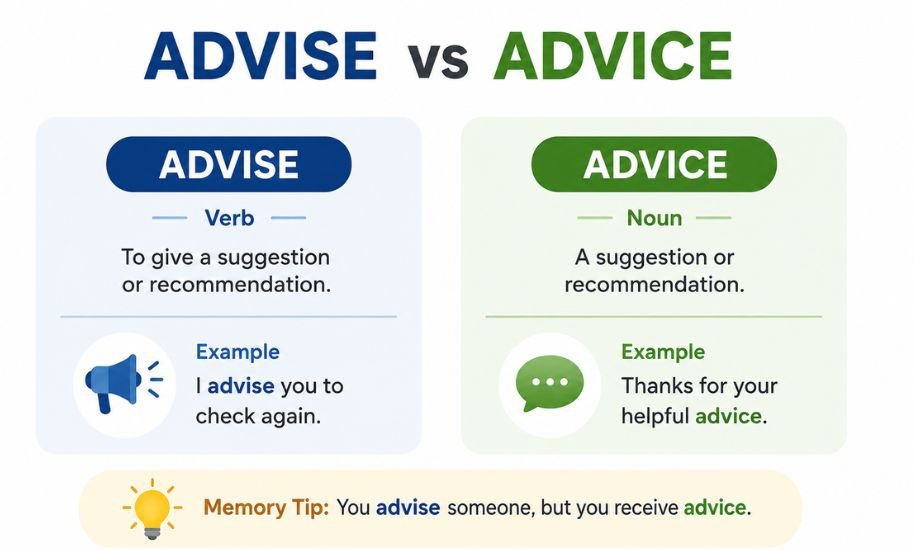
Advice is a noun meaning a suggestion or recommendation, while advise is a verb meaning to give someone advice or recommend a course of action. So you ask for “some advice,” but you “advise someone to wait.” In the phrase “please advise,” advise is the correct form.
Advise vs. Advice at a Glance
| Feature | Advice | Advise |
|---|---|---|
| Part of speech | Noun | Verb |
| Meaning | A suggestion or recommendation | To give a suggestion or recommendation |
| Example | Thanks for your advice. | I advise you to wait. |
| Pronunciation | Ends with an /s/ sound | Ends with a /z/ sound |
| Past form | Not applicable | Advised |
The easiest rule is:
You give advice, but you advise someone.
What Does “Advice” Mean?
Advice is a noun. It refers to an opinion, recommendation, or suggestion about what someone should do.
For example:
- She gave me some helpful advice.
- I asked my brother for advice.
- His advice saved us a lot of time.
- Thank you for your advice.
Notice that advice names the thing being given or received.
Is “Advice” Countable?
In standard English, advice is normally an uncountable noun. That means you generally should not say an advice or two advices.
Use:
- some advice
- a piece of advice
- two pieces of advice
- some useful advice
For example:
Correct: She gave me a useful piece of advice.
Incorrect: She gave me a useful advice.
Incorrect: He gave me three advices.
This distinction is particularly important in formal and professional writing.
What Does “Advise” Mean?
Advise is a verb. It means to give someone advice, make a recommendation, or tell someone what you think they should do.
Examples include:
- I advise you to check the figures again.
- The doctor advised him to rest.
- She advised us against taking the shortcut.
- Can you advise me on the next step?
Here, advise describes an action.
Compare these two sentences:
She gave me some advice.
She advised me to wait.
The first sentence uses a noun. The second uses a verb.
“Please Advise” or “Please Advice”?
The correct phrase is “please advise.”
Correct: Please advise me on what to do next.
Correct: Please advise us of any changes.
Correct: Please advise whether the meeting is still scheduled.
Incorrect: Please advice me on what to do next.
Why? Because please is introducing a request for an action, and advise is the verb that describes that action.
“Please advise” is especially common in formal correspondence. It can mean something like “Please let me know” or “Please tell me what you recommend.”
For a more conversational tone, you could write:
- Could you please let me know what you recommend?
- Could you advise me on the next steps?
- I would appreciate your advice on this matter.
Why “Please Advice” Is Incorrect
Advice is a noun, so it cannot normally perform the verb role in please advice.
Think of the difference this way:
Please advise me. → asking someone to perform an action.
Please give me some advice. → asking for a thing.
Both sentences express a similar idea, but their grammatical structures are different.
How to Spell Advice and Advise
If you are wondering how to spell advice or advise, both spellings are correct—but they belong to different words.
Advice
A-D-V-I-C-E
I need some advice.
Advise
A-D-V-I-S-E
I advise you to wait.
The final letters are the key:
adviCE = noun
adviSE = verb
Pronunciation can also help. Advice ends with an /s/ sound, while advise ends with a /z/ sound.
Is It “Advised” or “Adviced”?
The correct form is advised, not adviced.
Advised is the past tense and past participle of advise.
Examples:
- The teacher advised us to arrive early.
- She advised him to read the instructions carefully.
- We were advised to keep the receipt.
- The passengers were advised to check for delays.
So:
Correct: The doctor advised me to rest.
Incorrect: The doctor adviced me to rest.
The spelling changes from advise to advised, not adviced.
Common Mistakes With These Words
1. “Your advise was helpful.”
Use advice because you are referring to a suggestion.
Correct: Your advice was helpful.
2. “Please advice me.”
Use advise because you are asking someone to perform the action of giving information or guidance.
Correct: Please advise me.
3. “She gave me an advice.”
Advice is generally uncountable.
Correct: She gave me some advice.
Or:
Correct: She gave me a piece of advice.
4. “He adviced me to wait.”
The past tense is advised.
Correct: He advised me to wait.
5. “I need two advices.”
Use pieces of advice when you want to count individual recommendations.
Correct: I need two pieces of advice.
A Simple Way to Remember the Difference
Remember this sentence:
You give advice; you advise someone.
You can also connect the endings to their grammatical roles:
- adviCE → the noun
- adviSE → the verb
Try putting give before the word. If the sentence makes sense, you probably need advice:
Give me some advice.
If you need an action word, use advise:
I advise you to wait.
This simple test works in many everyday situations.
Advice or Advise? Examples in Sentences
Seeing the words side by side makes the distinction clearer:
My manager gave me some advice about the presentation.
My manager advised me to practice beforehand.
I appreciate your advice.
I would advise you to double-check the information.
She asked her parents for advice.
Her parents advised her to consider all the options.
The guide gave us useful advice.
The guide advised us to leave before dark.
In each pair, advice identifies the recommendation, while advise describes the act of giving it.
How to Choose the Right Word
When you are unsure whether it is advice or advise, ask what role the word plays.
If it is a thing or recommendation → advice
I need your advice.
That was excellent advice.
If it is an action → advise
Can you advise me?
I advise you to wait.
If you are writing “please…” → usually advise
Please advise.
Please advise us of any changes.
If you are talking about the past action → advised
She advised me to apply early.
A useful mental shortcut is:
Advice is something you receive. Advise is something you do.
Frequently Asked Questions
Is it advice or advise?
Both words are correct, but they have different grammatical functions. Advice is a noun meaning a recommendation or suggestion. Advise is a verb meaning to give advice or recommend something.
Is “please advise” correct?
Yes. Please advise is the standard form. It is a formal way of asking someone to provide information, guidance, or a recommendation. Please advice is not correct in standard English.
How do you spell advice?
The noun is spelled advice, ending in -ice: A-D-V-I-C-E. For example: Thank you for your advice.
How do you spell advise?
The verb is spelled advise, ending in -ise: A-D-V-I-S-E. For example: I advise you to wait.
Is “adviced” a correct word?
No, not as the standard past form of advise. The correct form is advised: The lawyer advised us to read the agreement carefully.
Can you say “an advice”?
Generally, no. Advice is normally uncountable, so use some advice or a piece of advice. For multiple recommendations, use pieces of advice.
The Bottom Line
Advice and advise are both correct words, but they do different jobs. Use advice when you mean a recommendation or suggestion, and use advise when you mean the act of giving that recommendation. Remember: you give advice, but you advise someone. For “please advise,” use the verb, and for the past tense, use advised, never adviced. Grammarify helps you make these small distinctions clear so you can choose the right word with confidence.
You may also Read :Octopi or Octopuses: Which Plural Is Correct?
One Comment