Requestor or Requester: Difference in UK English
When writing a formal email, completing an application, or preparing a business document, you may wonder whether to use requestor or requester. Both spellings are accepted in English, and they refer to someone who makes a request. However, they are not equally common in everyday writing. The difference is mainly a matter of spelling preference and usage rather than meaning. Understanding when to use each form can help you write more clearly, particularly in British English, professional communication, and formal documents.
Quick Answer
Both requestor and requester are correct spellings. Requester is the more familiar general-purpose form in English, while requestor is an accepted alternative that sometimes appears in legal, administrative, and technical contexts. For most everyday and formal writing, requester is a suitable choice.
Requestor or Requester: What’s the Difference?
The main difference between these two words is their spelling, not their definition. Both describe a person, organisation, or system that asks for something, such as information, permission, assistance, or a service.
| Feature | Requester | Requestor |
|---|---|---|
| Correct spelling | Yes | Yes |
| Meaning | Someone who makes a request | Someone who makes a request |
| Part of speech | Noun | Noun |
| General usage | Common | Less common |
| Formal writing | Accepted | Accepted |
| Legal and technical contexts | Used | Also used |
| Plural | Requesters | Requestors |
| General-purpose choice | Suitable | Alternative |
The spelling requester follows the familiar English pattern of adding -er to a verb to describe a person performing an action. Examples include teach becoming teacher and write becoming writer.
The -or ending in requestor is also found in English nouns, such as actor and administrator. Both forms have become established, so neither should automatically be treated as a spelling mistake.
What Does Requester Mean?
A requester is a person or organisation that asks for something or formally submits a request. The word is commonly used in everyday communication, customer service, administration, education, and professional environments.
For example, someone who asks a university for a transcript is the requester. Similarly, a customer who contacts a company for technical assistance can be described as a requester.
Examples of requester in sentences:
- The requester must provide their contact details before submitting the application.
- Our team contacted the requester to clarify the information provided.
- The requester received an email confirming that the documents were ready.
- Each requester is responsible for completing the application form accurately.
The word is a noun formed from the verb request and the suffix -er. It identifies the person or entity performing the action of requesting.
What Does Requestor Mean?
Requestor is an alternative spelling of requester. It has the same basic meaning and refers to someone who makes a request. It is a recognised English word, although it is less familiar in general-purpose writing.
This form can appear in legal documents, workplace procedures, technical systems, and administrative records. Some organisations use requestor as their preferred term in forms, databases, or internal policies.
Examples of requestor in sentences:
- The requestor must submit the required documents before the deadline.
- The requestor was informed that the application had been approved.
- Please contact the requestor if additional details are needed.
- The system automatically sends a confirmation to the requestor.
There is no universal grammatical rule requiring requestor to be used in legal or technical writing. Its use in these settings often reflects an organisation’s terminology or established style.
Requester or Requestor in UK English
In British English, requester is an appropriate general-purpose spelling, while requestor is also recognised as a less common alternative. Neither spelling is exclusive to Britain or the United States.
For example:
- Requester: The requester has asked for access to the council’s records.
- Requestor: The requestor has asked for access to the council’s records.
Both sentences are grammatically correct and convey the same meaning.
If you are writing for a British audience, requester is a straightforward choice for emails, reports, educational materials, and general business communication. However, if a British organisation consistently uses requestor in its official documentation, following that established terminology can help maintain consistency.
The same principle applies to other varieties of English. Choose a form appropriate to your audience and use it consistently throughout your document.
Requester vs. Requestee: What Is the Difference?
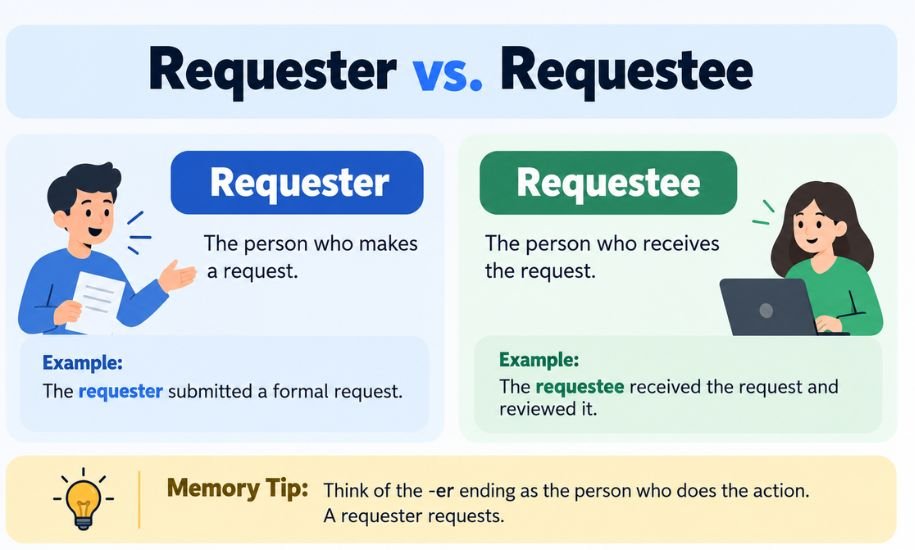
Although requester and requestor are alternative spellings, requestee refers to a different role. A requester makes a request, whereas a requestee is the person to whom the request is directed.
Consider this example:
“Emma asked Daniel to provide a copy of the report.”
- Emma is the requester because she is making the request.
- Daniel is the requestee because he is the person being asked.
| Word | Meaning | Role |
|---|---|---|
| Requester | The person making a request | Initiates the request |
| Requestor | Alternative spelling of requester | Initiates the request |
| Requestee | The person being asked | Receives the request |
The word requestee is less common than requester. In everyday writing, recipient, person receiving the request, or person being asked may sound more natural, depending on the context.
Requestor or Requester Examples in Sentences
Seeing both spellings in context makes it easier to understand how they work in practical communication. Since their meanings are the same, either can be used in a sentence where the person making the request is being described.
Examples using requester:
- The requester submitted a formal complaint to the management team.
- The customer service representative asked the requester to verify their identity.
- Every requester must provide a valid reason for accessing the information.
- The requester received a response within three working days.
Examples using requestor:
- The requestor has been notified about the status of the application.
- The requestor must obtain approval from the department manager.
- The administrator reviewed the requestor’s submitted documents.
- The requestor can track the progress of the application online.
In each pair, the two forms are interchangeable without changing the sentence’s meaning. The important thing is to follow the spelling conventions used by your organisation or publication.
Requester Synonyms and Related Words
Several words can replace requester, but the most appropriate choice depends on what the person is requesting and the circumstances.
| Synonym | Meaning or usage |
|---|---|
| Applicant | Someone formally applying for something |
| Inquirer | Someone seeking information |
| Asker | Someone who asks a question or makes a request |
| Petitioner | Someone submitting a formal petition |
| Claimant | Someone making a claim or seeking an entitlement |
| Customer | Someone requesting a product or service |
| Submitter | Someone who submits a form, application, or document |
For example, applicant is suitable when someone is applying for a job, grant, or permit. Inquirer is more appropriate when someone is asking for information.
These terms are related but are not exact replacements in every situation. If you simply mean a person who makes a request, requester remains clear and precise.
Common Mistakes to Avoid
Although the two spellings are both correct, a few usage mistakes can make writing confusing.
- Treating requestor as a misspelling: It is a recognised alternative, so it should not automatically be marked incorrect.
- Assuming the words have different meanings: Requester and requestor describe the same role. Their difference is spelling preference.
- Confusing requester with requestee: The requester makes the request, while the requestee is the person being asked.
- Switching spellings unnecessarily: Using both forms in the same document can make the writing inconsistent. Choose one unless you are reproducing official terminology.
- Using a synonym that changes the meaning: An applicant, claimant, and requester may have different roles in a formal process.
A simple way to avoid these mistakes is to identify who is making the request and use the appropriate term consistently.
How to Remember Which Spelling to Use
A practical way to remember requester is to connect it with other familiar words that use the -er suffix to identify someone performing an action.
- Teach → Teacher
- Write → Writer
- Request → Requester
This pattern makes requester an intuitive choice for general writing.
However, remember that requestor is also a valid spelling. The -or ending appears in many established English nouns, so it is not inherently incorrect. If you are unsure which form to choose, use requester as your general-purpose option.
Frequently Asked Questions
Is requester or requestor the correct spelling?
Both spellings are correct. Requester is the more familiar general-purpose form, while requestor is an accepted alternative. You can use either, provided it is appropriate for your audience and consistent with the terminology of your document.
Is requestor acceptable in British English?
Yes. Requestor is recognised in British English, although requester is the more suitable general-purpose choice. British writers can use either form, depending on the context and any relevant style guidelines.
Is requestor a real word in the Oxford Dictionary?
Requestor is an established alternative spelling of requester. For a precise dictionary entry, consult the current Oxford English Dictionary or
Oxford English Dictionary
directly, as dictionary coverage and entry details may vary.
What is the plural of requester and requestor?
The plural of requester is requesters, while the plural of requestor is requestors. Both follow the usual English rule of adding -s to form the plural.
Is a requestee the same as a requester?
No. A requester is the person who makes a request, while a requestee is the person being asked. For example, if Maria asks James to review a document, Maria is the requester and James is the requestee.
Which spelling should I use in formal writing?
Requester is a suitable choice for most formal writing, including reports, business emails, and academic documents. However, requestor is also acceptable. If your workplace, institution, or legal document has an established spelling preference, follow it.
Final Verdict: Requestor or Requester?
Both requestor and requester are correct, and they share the same meaning. The difference is primarily a matter of spelling preference and convention, not grammar. Requester is a natural choice for everyday, academic, and professional writing, while requestor remains an accepted alternative in various contexts.
Understanding this distinction helps you choose the right form for your audience and maintain consistency in your writing. At Grammarifyr, our goal is to make English differences easier to understand so you can know the difference and use the right words with confidence.
You may also Read : Breath or Breathe: Meaning, Pronunciation and Usage
One Comment