Mustache vs Moustache: American vs British English
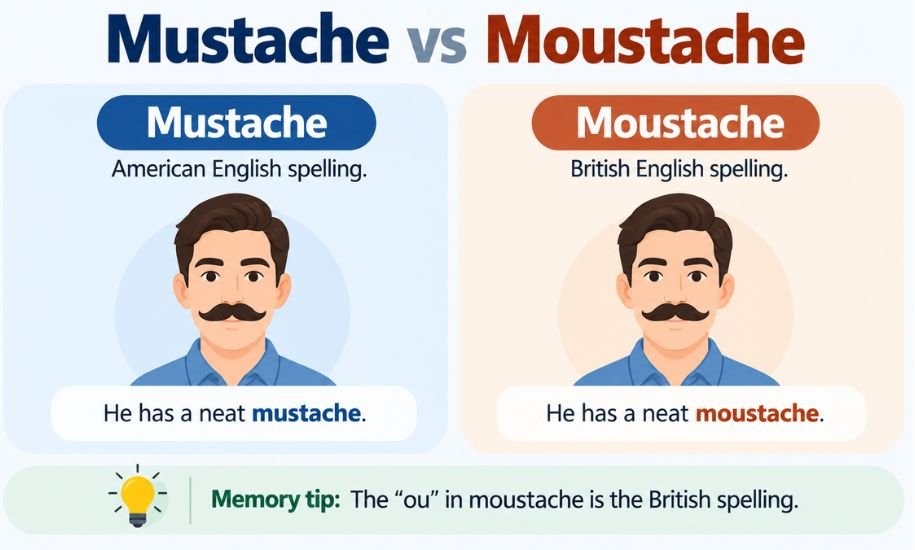
If you have ever wondered whether you should write mustache or moustache, you are not dealing with two different words. Both spellings refer to the same facial hair that grows above the upper lip. The main difference is regional: mustache is the standard spelling in American English, while moustache is preferred in British English and is also common in other varieties influenced by British usage. The pronunciation and meaning are essentially the same, so the choice usually depends on which form of English you are writing.
Mustache and moustache are both correct spellings for facial hair above the upper lip. Mustache is preferred in American English, while moustache is preferred in British English. The meaning does not change.
Mustache vs Moustache: The Quick Difference
The easiest way to remember the distinction is geographical rather than grammatical.
| Feature | Mustache | Moustache |
|---|---|---|
| Meaning | Facial hair above the upper lip | Facial hair above the upper lip |
| Correct spelling? | Yes | Yes |
| Main usage | American English | British English |
| Part of speech | Noun | Noun |
| Pronunciation | Essentially the same word | Essentially the same word |
| Plural | Mustaches | Moustaches |
Neither spelling is inherently more correct than the other. The important thing is to match your spelling to the variety of English you are using and remain consistent.
What Does “Mustache” Mean?
Mustache is a noun referring to hair that grows on a person’s upper lip.
This is the spelling most commonly associated with American English. It is perfectly standard in US writing, including formal writing, journalism, books, and everyday communication.
For example:
- He decided to grow a mustache during the summer.
- His neatly trimmed mustache suited his face.
- The actor wore a thick mustache for the character.
- She noticed that her grandfather’s mustache had turned gray.
The word can describe facial hair of different lengths and styles. It does not imply a particular shape.
What Does “Moustache” Mean?
Moustache has exactly the same basic meaning. It refers to hair growing above the upper lip.
The spelling with ou is preferred in British English.
For example:
- He has had a moustache for several years.
- The barber carefully trimmed his moustache.
- His gray moustache made him look older.
- The character was recognizable by his large moustache.
If you are writing for a primarily British audience, moustache is generally the natural choice.
Why Are There Two Spellings?
The difference comes from the development of the word through European languages and the different spelling conventions that developed in English.
English adopted the word through forms related to French and Italian, ultimately tracing back to Greek. British English retained the spelling moustache, while American English commonly developed the shorter spelling mustache.
This is not unusual in English. Similar regional differences appear in words such as:
- colour / color
- favourite / favorite
- centre / center
- theatre / theater
The two forms of this particular word therefore represent a regional spelling difference, rather than a difference in meaning.
Is the Pronunciation Different?
Normally, no major pronunciation difference separates the two spellings.
The pronunciation can vary somewhat between American and British accents, as many English words do, but the extra o in moustache does not mean that British speakers pronounce an entirely different word.
In other words, you should not assume that the spelling difference represents a separate pronunciation rule.
If you are learning English, it is more useful to associate the spelling with the variety of English you are writing:
American English: mustache
British English: moustache
Mustache vs Moustache for Men and Women
The spelling does not change according to gender.
A woman can have a mustache in American English or a moustache in British English, just as a man can. The regional spelling rule remains the same.
For example, in American English:
She chose to remove the hair above her upper lip.
You could refer to that hair as a mustache if appropriate.
In British English, moustache would normally be used instead.
The terms male and female do not determine which spelling is correct. Geography and editorial style do.
What About Mustache Styles?
The two spellings also do not refer to different hairstyles.
A mustache and a moustache can have exactly the same styles. Depending on the length, shape, and grooming method, someone might have a:
- Handlebar style
- Pencil style
- Chevron style
- Walrus style
- Horseshoe style
- English-style mustache or moustache
For example, an American publication might write:
He chose a classic handlebar mustache.
A British publication could write:
He chose a classic handlebar moustache.
The style has not changed. Only the regional spelling has.
Mustache and Beard: Are They the Same?
No. A mustache or moustache is a specific type of facial hair.
A mustache/moustache grows primarily above the upper lip, whereas a beard generally refers to facial hair growing around the chin, cheeks, jaw, and sometimes neck.
Someone can therefore have:
- A mustache without a beard
- A beard without a mustache
- Both a mustache and a beard
- A connected mustache and beard
For example:
He shaved his beard but kept his mustache.
This sentence makes it clear that the two terms describe different areas of facial hair.
What Is the US Spelling?
The standard American spelling is mustache, without the o after the initial m.
So if you are writing American English, these forms are appropriate:
- mustache
- mustaches
- mustached
Examples:
The detective had a distinctive mustache.
Several actors wore fake mustaches for the performance.
For an American audience, using mustache consistently will usually look more natural.
What Is the British Spelling?
The standard British spelling is moustache, with ou.
The related plural form is moustaches.
Examples:
The gentleman had a carefully groomed moustache.
His moustache had become completely gray.
If the rest of your article follows British spelling conventions, moustache is generally the better choice.
Mustache or Moustache: Which Should You Use?
The answer depends on your audience.
Choose mustache when you are writing in American English. Choose moustache when you are writing in British English.
The most important rule is consistency.
For instance, an American-style article might use:
The actor’s favorite character had a large mustache.
A British-style article might use:
The actor’s favourite character had a large moustache.
Both sentences are correct within their respective spelling systems.
You do not need to use both spellings in the same article unless you are specifically discussing the difference between American and British English.
Mustaches vs Moustaches: The Plural Forms
The regional difference remains when the word becomes plural.
American English:
- Singular: mustache
- Plural: mustaches
British English:
- Singular: moustache
- Plural: moustaches
Examples:
The museum displayed photographs of famous mustaches.
The book featured photographs of famous moustaches.
Again, the difference is purely spelling. Both forms refer to multiple examples of the same type of facial hair.
Common Mistakes to Avoid
Treating “moustache” as a misspelling
Moustache is not an incorrect version of mustache. It is a standard spelling, particularly in British English.
Treating “mustache” as wrong in British English
Mustache is widely recognized and is the standard American form. It should not be described as universally incorrect.
Assuming the words describe different styles
They do not. A handlebar mustache is the same style of facial hair whether an American writer spells it mustache or a British writer spells it moustache.
Changing spelling based on gender
Gender does not determine the spelling. The same regional distinction applies regardless of whether the person is male or female.
Mixing regional styles unnecessarily
If an article is otherwise written in American English, switching randomly between mustache and moustache can make the writing look inconsistent. Choose the spelling that fits your intended variety of English.
An Easy Way to Remember the Difference
Think of the “o” in moustache as the British spelling.
A simple rule is:
US English → mustache
UK English → moustache
You can also connect it with other familiar spelling differences:
color → colour
favorite → favourite
mustache → moustache
The shorter spelling is generally associated with American English, while the version containing ou is associated with British English.
Examples in Sentences
Here are a few examples showing how the two forms work naturally.
American English
My uncle has had the same mustache for decades.
The barber trimmed his mustache before the wedding.
The actor grew a mustache for his new role.
British English
My uncle has had the same moustache for decades.
The barber trimmed his moustache before the wedding.
The actor grew a moustache for his new role.
Notice that the meaning remains unchanged. Only the spelling differs.
Frequently Asked Questions
Is “mustache” or “moustache” correct?
Both are correct. Mustache is the preferred spelling in American English, while moustache is preferred in British English. Neither form is universally more correct.
Is “moustache” the British spelling?
Yes. Moustache is the standard spelling commonly used in British English. American English generally prefers mustache.
Is “mustache” the American spelling?
Yes. Mustache is the standard American spelling, although American dictionaries may recognize moustache as an alternative.
Are mustache and moustache pronounced differently?
They are essentially the same word and normally have very similar pronunciation. Accent differences may affect the exact sound, but the spelling distinction does not represent a different meaning or type of facial hair.
Does the spelling change for a female mustache?
No. Gender does not determine the spelling. Use mustache in American English and moustache in British English regardless of whether the facial hair belongs to a man or woman.
Which spelling should I use in formal writing?
Use the spelling appropriate for your audience. For American English, choose mustache. For British English, choose moustache. Most importantly, keep your regional spelling consistent throughout the piece.
Final Verdict: Mustache or Moustache?
Mustache and moustache are two correct spellings of the same word. The main distinction is regional: American English generally uses mustache, while British English generally uses moustache. The words have the same meaning, and the spelling does not indicate a different hairstyle, gender, or type of facial hair.
If you are writing for an American audience, choose mustache. If your audience follows British English, choose moustache. For more straightforward explanations of confusing spellings and word choices, Grammarifyr follows the same principle: know the difference and use the right words.
You may also Read : Apart vs A Part: Meaning and Examples