Lets or Let’s: Meaning and Grammar Explained
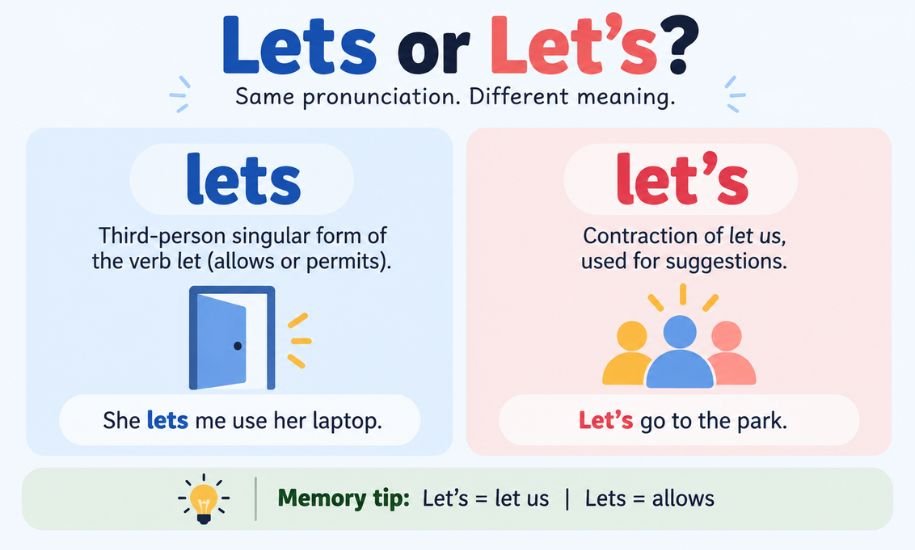
It is easy to confuse lets and let’s because they look almost identical and are pronounced the same in most contexts. The apostrophe, however, changes the grammatical function of the word. Lets is a form of the verb let, usually meaning “allows” or “permits,” while let’s is a contraction of let us, commonly used to make a suggestion. Understanding this small difference will help you choose the correct form in expressions such as “Let’s go” and sentences such as “She lets me go.”
Both “lets” and “let’s” are correct, but they have different meanings. Let’s means “let us” and is used mainly for suggestions, as in “Let’s go.” Lets is the third-person singular form of let, meaning “allows” or “permits,” as in “She lets me choose.”
Lets or Let’s: Which Is Correct?
The correct choice depends on what you are trying to say.
| Form | Meaning | Grammatical role | Example |
|---|---|---|---|
| lets | allows or permits | Verb | My teacher lets us ask questions. |
| let’s | let us | Contraction | Let’s ask the teacher. |
Both forms are standard English. The apostrophe in let’s is important because it signals that two words have been shortened into one.
Cambridge Dictionary explains that let’s is the short form of let us and is commonly used to make suggestions that include the speaker and other people. Lets, meanwhile, is a form of the verb let used for permission or allowing someone to do something.
What Does “Lets” Mean?
Lets is the third-person singular present form of the verb let.
The verb let can mean to allow, permit, or give someone permission to do something. When the subject is he, she, it, or another singular noun, the form becomes lets.
For example:
- She lets her children play outside.
- My manager lets me work from home on Fridays.
- The app lets users save their favorite articles.
- His parents let him stay up late.
Notice the difference between the singular and other subjects:
- I let him choose.
- You let him choose.
- We let him choose.
- They let him choose.
- She lets him choose.
The final -s is simply the normal third-person singular ending for this verb.
“Lets” Can Be Followed by “Us”
A useful detail is that lets can sometimes appear immediately before us, which can make it even more confusing.
For example:
My parents let us stay up late.
Here, let is the verb because the subject is my parents.
But:
My parents lets us stay up late. ❌
is incorrect because my parents is plural.
With a singular subject:
My father lets us stay up late. ✅
LanguageTool likewise identifies lets as the third-person singular form of let.
What Does “Let’s” Mean?
Let’s is a contraction of let us.
It is commonly used when making a suggestion, proposing an action, encouraging someone, or suggesting that you and another person or group do something together.
Examples include:
- Let’s go home.
- Let’s have lunch.
- Let’s try again.
- Let’s start the meeting.
- Let’s watch a movie tonight.
- Let’s look at the problem carefully.
For instance:
Let’s go to the park.
can be expanded to:
Let us go to the park.
The contracted form is much more natural in ordinary conversation and informal writing.
Cambridge describes this use as making suggestions that include the speaker and other people.
Let’s Go or Lets Go: Which Is Correct?
The standard expression is:
Let’s go! ✅
not:
Lets go! ❌
when you mean “Let us go.”
For example:
Let’s go to the beach before it gets dark.
The meaning is:
Let us go to the beach before it gets dark.
This is one of the easiest places to see why the apostrophe matters.
More Examples
Correct:
Let’s go home.
Correct:
Let’s go for a walk.
Correct:
Let’s go and see what happened.
Incorrect for this meaning:
Lets go home.
Cambridge’s grammar guidance specifically gives “Let’s go” as an example of the suggestion form and notes that “Lets stop now” is not the correct spelling when the intended meaning is let us.
How to Tell Which Form You Need
There is a simple test for deciding between the two.
Try replacing “let’s” with “let us”
If the sentence still makes sense, let’s is probably correct.
Let’s begin.
Try:
Let us begin.
It works, so let’s is correct.
Another example:
Let’s order pizza.
→ Let us order pizza.
Again, it works.
Now consider:
She lets me use her laptop.
Try replacing lets with let us:
She let us me use her laptop. ❌
That does not work. Therefore, lets is the correct form.
This substitution test is also recommended by LanguageTool as a practical way to distinguish the two forms.
Let’s vs. Lets in Sentences
Seeing the two forms side by side makes the distinction clearer.
When to use “lets”
Use lets when someone or something allows an action.
- The teacher lets students leave early.
- This feature lets you edit your photos.
- Sarah lets her dog sleep indoors.
- The new design lets visitors find information quickly.
- My brother lets me borrow his bike.
In each sentence, lets could be replaced by allows:
The teacher allows students to leave early.
This feature allows you to edit your photos.
That is a strong clue that you need lets, without an apostrophe.
When to use “let’s”
Use let’s when you mean let us.
- Let’s start now.
- Let’s take a break.
- Let’s discuss the problem.
- Let’s meet tomorrow.
- Let’s not waste any more time.
The substitution test works:
Let’s discuss the problem.
→ Let us discuss the problem.
Therefore, let’s is correct.
The Difference Between “Let’s” and “Lets” in One Simple Rule
Remember these two definitions:
LET’S = LET US
LETS = ALLOWS / PERMITS
For example:
Let’s leave now.
= Let us leave now.
But:
He lets us leave early.
= He allows us to leave early.
The meanings are completely different even though the pronunciation is essentially the same.
Why Are These Words So Easy to Confuse?
The main difficulty is the apostrophe.
In let’s, the apostrophe represents omitted letters because the word is a contraction of let us.
Similar contractions appear throughout English:
- it’s = it is / it has
- we’re = we are
- they’re = they are
- don’t = do not
- can’t = cannot
- let’s = let us
By contrast, lets is not a contraction. It is simply the third-person singular form of let.
This is why writing “She let’s me…” is incorrect. The writer may recognize that let’s is a familiar form but use the apostrophe where the grammatical contraction does not belong.
Writer’s Digest makes the same distinction: lets functions as the third-person present form of let, while let’s is the contraction of let and us.
Common Mistakes to Avoid
1. Writing “Lets go” when you mean “Let us go”
Incorrect:
Lets go to dinner.
Correct:
Let’s go to dinner.
Because the intended meaning is Let us go to dinner.
2. Adding an apostrophe to “lets” after a singular subject
Incorrect:
She let’s me choose.
Correct:
She lets me choose.
Here, lets means allows. It is not a contraction.
3. Confusing “lets” with “let”
Remember that lets is used with a third-person singular subject.
I let him decide.
They let him decide.
She lets him decide.
The verb changes because the subject changes.
4. Using “let’s” simply because the sentence contains “us”
The presence of us does not automatically require an apostrophe.
The coach lets us practice longer. ✅
Here, lets means allows.
But:
Let’s practice longer. ✅
Here, let’s means let us.
The surrounding grammar determines the correct form.
A Note About “Let’s Not”
The negative form let’s not is also standard.
Examples:
- Let’s not argue.
- Let’s not rush the decision.
- Let’s not forget the deadline.
- Let’s not make the same mistake twice.
In each case, let’s still means let us.
Cambridge identifies let’s not as the common negative form for making a suggestion.
The phrase “don’t let’s” also exists, particularly in British English, but let’s not is generally the more straightforward form.
Grammar After “Let”
There is another useful grammar point connected with these words.
When let means “allow,” it is followed by an object and a verb in the bare infinitive, meaning the verb does not take to.
Correct:
She lets me use her computer.
Correct:
They let him leave early.
Incorrect:
She lets me to use her computer. ❌
Incorrect:
They let him to leave early. ❌
Cambridge specifically notes that let is followed by an object and an infinitive without to.
This distinction is separate from the apostrophe question, but it can be useful when checking a sentence containing lets.
Easy Way to Remember the Difference
Use this two-word memory rule:
LET’S = LET US
LETS = ALLOWS
Whenever you see let’s, ask:
Can I replace it with “let us”?
If yes, use the apostrophe.
Let’s go. → Let us go. ✅
If the meaning is allows, leave out the apostrophe.
The software lets me save the file. → The software allows me to save the file. ✅
This simple check works in most everyday situations.
Quick Comparison Examples
| Sentence | Correct form | Why? |
|---|---|---|
| ___ go home. | Let’s | Means “Let us go home.” |
| She ___ me use her phone. | lets | Means “allows.” |
| ___ try again. | Let’s | Makes a suggestion. |
| The app ___ you change the settings. | lets | Means “allows.” |
| ___ not worry about it. | Let’s | Means “Let us not worry.” |
| My teacher ___ us work in pairs. | lets | Means “allows.” |
| ___ go! | Let’s | Means “Let us go.” |
Frequently Asked Questions
Is “lets” a real word?
Yes. Lets is a correct English word. It is the third-person singular present form of the verb let, generally meaning “allows” or “permits.” For example: The program lets users change their settings.
Is “let’s” always short for “let us”?
In standard modern usage, let’s is the contraction of let us. It is especially common when making suggestions or proposals, as in Let’s start the meeting. Cambridge also notes formal contexts where the full form let us may be used.
Is it “lets go” or “let’s go”?
When you mean “let us go,” the correct form is “Let’s go.” For example: Let’s go to the restaurant. The apostrophe shows that let’s is a contraction of let us.
Is “she let’s me” correct?
No. The correct sentence is “She lets me.” Here, lets means “allows,” so it is the verb form and does not need an apostrophe.
Can “lets” and “let’s” be pronounced the same?
Yes. In ordinary speech, they are generally pronounced alike. That is why the difference can be difficult to notice when listening. In writing, however, their grammatical roles are different, so the apostrophe matters.
How can I quickly remember which one to use?
Try the “let us” test. If you can replace the word with let us, use let’s. If the word means allows or permits, use lets.
The Bottom Line
Lets and let’s are both correct, but they serve different purposes. Use lets when a person or thing allows something: “The teacher lets us leave early.” Use let’s when you mean “let us”, especially in a suggestion: “Let’s go home.” If you can remember “let’s = let us” and “lets = allows,” you can avoid most mistakes. For more clear explanations of confusing English forms, Grammarifyr helps you know the difference and use the right words.
You may also Read : Traveled or Travelled: Correct English Spelling
One Comment