Labelling or Labeling: Meaning and Correct Spelling
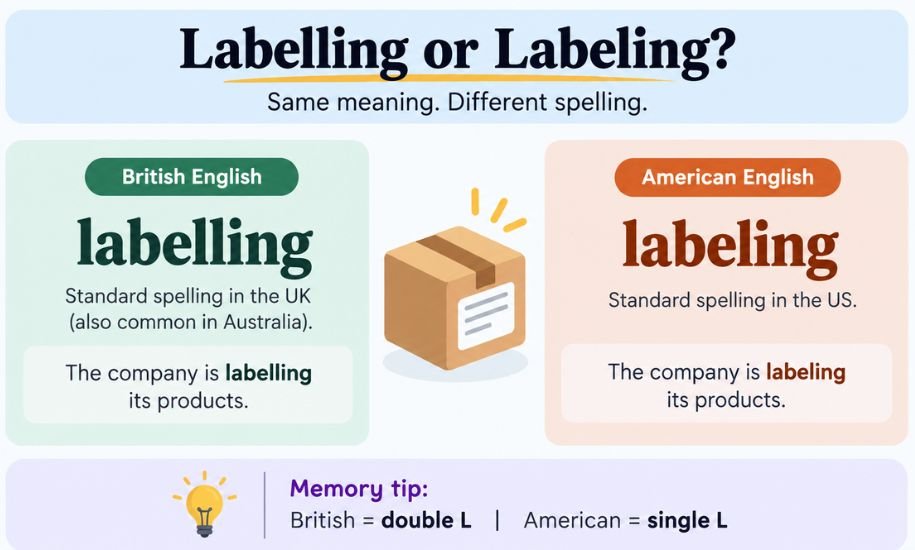
If you have ever paused over labelling or labeling, the confusion is understandable. Both forms are used in standard English, and both have the same meaning. The difference is mainly regional: labelling is the usual British English spelling, while labeling is the standard American English form. Australian English generally uses the British-style spelling, while Canadian usage can vary depending on the style being followed. Knowing these conventions makes it easier to choose the right form for your audience and keep your writing consistent.
Both labelling and labeling are correct. Labelling is standard in British English, while labeling is standard in American English. Australian English generally follows the British form, and Canadian English uses both, with labelling well established in formal usage.
Labelling or Labeling: Which Is Correct?
The answer depends on the variety of English you are writing.
| Spelling | Main usage | Example |
|---|---|---|
| labelling | British English; also common in Australia and Canada | The company is labelling its products. |
| labeling | American English | The company is labeling its products. |
Neither spelling is a misspelling. Cambridge lists labelling as the UK form and labeling as the US form. It defines the word as the present participle of label and also uses labelling as a noun for the act of putting labels on things.
The important rule is consistency. If your document follows British English, use labelling. If it follows American English, use labeling.
What Does Labelling or Labeling Mean?
Both forms have exactly the same basic meaning.
Labelling or labeling can refer to:
- putting a label on a product, object, container, or document;
- providing identifying information;
- naming or classifying something;
- describing someone or something with a particular term.
For example:
- The staff are labelling the boxes before delivery.
- The staff are labeling the boxes before delivery.
- Accurate food labelling helps consumers understand a product.
- Accurate food labeling helps consumers understand a product.
- The scientist is labelling each sample carefully.
- The scientist is labeling each sample carefully.
The meaning remains unchanged. Only the spelling convention differs.
Cambridge gives examples involving food, product, nutritional, and mandatory labelling, confirming that the word is widely used in practical and technical contexts.
Why Do Labelling and Labeling Have Different Spellings?
The difference comes from regional spelling conventions.
The base word is:
label
When the -ing ending is added, British English normally writes:
label → labelling
American English normally writes:
label → labeling
The same regional distinction appears with the past participle:
- British: labelled
- American: labeled
And with the person performing the action:
- British: labeller
- American: labeler
So the difference is not about grammar or meaning. It is a spelling convention associated with different varieties of English.
Merriam-Webster’s word information recognizes both sets of forms, including labeled/labelling and labeling/labelled, demonstrating that both patterns exist in English.
Labelling or Labeling in UK English
For British English, labelling is the standard choice.
Use:
- product labelling
- food labelling
- nutritional labelling
- safety labelling
- labelling requirements
- clearly labelled
Examples:
The manufacturer is labelling all packages before shipment.
The ingredients are clearly labelled on the container.
New food labelling requirements were introduced.
If you are writing for a British audience, using labelling alongside other British spellings such as organising, colour, and centre will keep the text stylistically consistent.
Cambridge specifically identifies labelling as UK usage and labeling as its US equivalent.
Labelling or Labeling in US English
In American English, the preferred spelling is labeling.
Examples:
The company is labeling its new products.
The boxes are being labeled before they leave the warehouse.
Clear product labeling is important for consumers.
American English generally uses one l before the -ing ending in this word:
label → labeling
So if you are writing an American English article, report, website, or business document, labeling is the natural choice.
Labelling or Labeling in Australia
Australian English generally uses labelling, following the British-style spelling.
For example:
The manufacturer updated its product labelling.
The ingredients must be clearly labelled.
This usage is also visible in Australian government material. The NSW Food Authority, for example, uses “Labelling – general requirements” and discusses food labelling requirements under the Australia New Zealand Food Standards Code.
Therefore, for labelling or labeling Australia, labelling is generally the appropriate form.
Labelling or Labeling in Canada
Canadian English is slightly more complicated because Canadian spelling has influences from both British and American English.
Labelling is well established in Canadian formal and regulatory language. For example, Canadian government material uses terminology such as labelling in regulatory contexts. The Office québécois de la langue française also lists both labelling and labeling as English terms for the relevant concept, illustrating that both forms can occur in Canadian usage.
At the same time, labeling also appears in Canadian-related material, particularly in contexts influenced by American terminology. For example, the U.S. Department of Commerce’s current Canada trade guidance uses labeling when discussing Canadian regulatory requirements.
So there is no need to treat one form as an absolute Canadian spelling rule.
If you are writing specifically for Canada, follow the style guide of the publication, organization, or institution whenever one is available. Labelling is a well-established choice, particularly in formal Canadian contexts.
Labelling vs. Labeling Examples
Seeing the two forms side by side makes the distinction easy to understand.
British English
The company is labelling the products.
The products have been labelled correctly.
New labelling regulations apply to the packaging.
American English
The company is labeling the products.
The products have been labeled correctly.
New labeling regulations apply to the packaging.
Notice that the sentence structure and meaning do not change. Only the spelling changes.
Labelling, Labeling, Labelled, and Labeled
The spelling difference is easier to remember when you look at the related forms together.
| Form | British English | American English |
|---|---|---|
| Base verb | label | label |
| -ing form | labelling | labeling |
| Past participle | labelled | labeled |
| Person who labels | labeller | labeler |
This pattern can help prevent accidental mixing.
For example, a consistently British sentence is:
The worker is labelling the boxes that have already been labelled.
A consistently American version is:
The worker is labeling the boxes that have already been labeled.
Common Mistakes to Avoid
1. Calling “labeling” incorrect
Labeling is not a spelling mistake. It is the standard American English form.
2. Calling “labelling” incorrect
Likewise, labelling is not wrong. It is the standard British English spelling and is also used in other varieties of English.
3. Mixing regional forms
Avoid switching unnecessarily between:
The products are labelling correctly and have been labeled for export.
If you are following British English, use:
The products are labelling correctly and have been labelled for export.
For American English:
The products are labeling correctly and have been labeled for export.
4. Assuming spelling changes the meaning
It does not. Both forms describe the same action or process.
5. Treating regional spelling as a grammar difference
This is fundamentally a spelling variation, not a difference in tense, meaning, or grammatical function.
An Easy Way to Remember the Difference
Think of the final l:
British English:
label → labelling → labelled
American English:
label → labeling → labeled
A simple memory aid is:
British = double L; American = single L
This is not a universal rule for every English word, but it works well for labelling/labeling and its related forms.
Which Spelling Should You Use?
Choose according to your intended audience.
If your readers are primarily in the United Kingdom, use labelling.
If your readers are primarily in the United States, use labeling.
For Australia, labelling is generally the natural choice, including in official food-related terminology.
For Canada, either form may be encountered, but labelling is strongly established in formal Canadian usage. When writing professionally, follow the relevant Canadian style guide or house style when one is specified.
Most importantly, do not switch randomly between the two forms within the same piece of writing.
Frequently Asked Questions
Is “labelling” or “labeling” correct?
Both are correct. Labelling is the standard British English spelling, while labeling is standard American English. The choice depends on the English variety you are using.
Is “labelling” British or American English?
Labelling is the British English form. American English normally uses labeling, with one l before the -ing ending.
Is “labeling” a real word?
Yes. Labeling is a standard English word. It is the American English present participle or gerund form of label.
Should I use labelling in Australian English?
Generally, yes. Labelling is the conventional Australian spelling, and Australian government food guidance uses the double-l form.
Which spelling is used in Canada?
Both can be found in Canadian English. Labelling is well established, particularly in formal and regulatory contexts, but Canadian English also contains American spelling influences. Follow the applicable style guide when one exists.
Is it “labelled” or “labeled”?
Both are correct regional forms. Labelled is standard British English, while labeled is standard American English.
Final Verdict: Labelling or Labeling?
Labelling and labeling are both correct spellings. Use labelling for British English and generally for Australian English, while labeling is the standard American form. Canadian usage allows more variation, with labelling firmly established in formal contexts. The best choice is therefore the one that matches your audience and the spelling system used throughout your writing. For more clear, practical explanations of confusing English forms, Grammarifyr follows the same principle: Know the Difference. Use the Right Words.
You may also Read : Their or Thier: Correct Spelling and Meaning