Apart vs A Part: Meaning and Examples
Apart and a part look and sound similar, but they have different meanings and grammatical uses. The confusion becomes especially noticeable in phrases such as “a part of the team” and “apart from the team.” One describes separation, while the other refers to being included in a larger whole. Understanding this small difference can help you avoid mistakes such as writing “apart of” when you mean “a part of.”
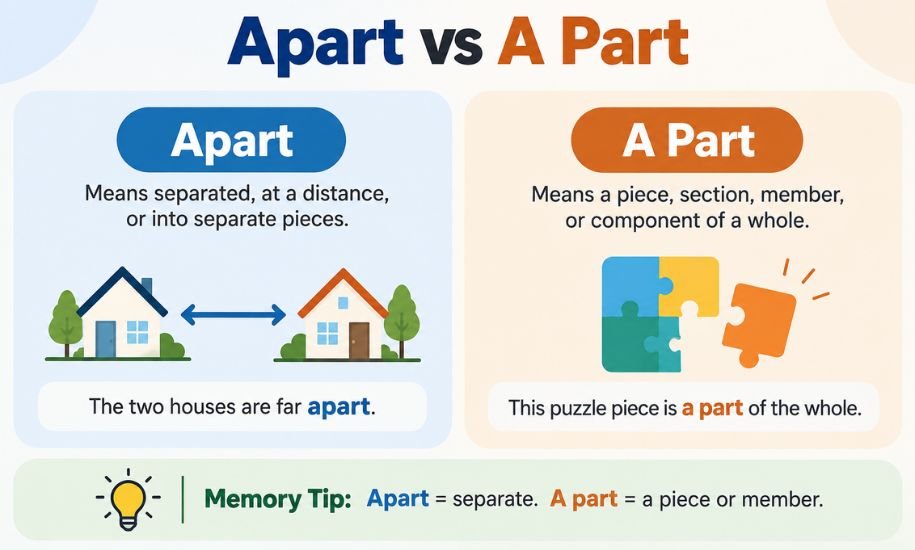
Apart means separated, at a distance, or into separate pieces. A part means a piece, section, member, component, or portion of something larger. If you mean that someone belongs to a team or group, use “a part of” or simply “part of,” not “apart of.”
Apart vs A Part: The Key Difference
The easiest way to distinguish the two is to think about separation versus inclusion.
Apart is usually an adverb describing separation or distance:
- The two houses are far apart.
- The children stood apart from one another.
- The old chair came apart.
A part is a noun phrase referring to one piece or member of something larger:
- She is a part of the team.
- One part of the machine is broken.
- Everyone wants to play a part in the project.
So, if you mean “separate” or “away,” choose apart. If you mean “a piece, portion, member, or component,” choose a part.
| Feature | Apart | A part |
|---|---|---|
| Basic meaning | Separate or away | A piece or member of a whole |
| Form | One word | Two words |
| Typical grammatical role | Adverb | Noun phrase |
| Common expression | Far apart | A part of the team |
| Example | The books are spread apart. | This is a part of the collection. |
What Does “Apart” Mean?
Apart describes things that are separated from each other or located at a distance. It can refer to physical distance, emotional separation, differences, or something being divided into pieces.
Physical separation
- The two villages are several miles apart.
- Keep the chairs a little apart.
- The twins sat apart during the ceremony.
Emotional or relational separation
The word can also describe people who are no longer close.
- They have grown apart over the years.
- Living apart from her family was difficult.
- The disagreement drove the friends apart.
Something breaking into pieces
“Apart” also appears in expressions such as fall apart, come apart, and take apart.
- The old book was falling apart.
- The toy came apart when I dropped it.
- He carefully took the device apart.
In these examples, the idea is separation rather than membership in something.
What Does “A Part” Mean?
A part refers to one piece, section, component, or member of a larger thing.
For example:
- A wheel is a part of a bicycle.
- She is a part of our community.
- This chapter is a part of the book.
- He played a part in the decision.
The phrase can describe both physical components and more abstract forms of participation.
A part as a component
The engine is a part of the car.
Here, the engine is one component within a larger object.
A part as a member
Maria is a part of the school team.
Here, the phrase means that Maria belongs to or participates in the team.
A part as a contribution or role
Everyone played a part in making the event successful.
Here, “a part” means a role or contribution.
“Apart of” or “A Part of”?
This is one of the most common mistakes involving these words.
When you mean belonging to, included in, or being one component of something, the correct expression is “a part of.”
Correct:
I am a part of the team.
Incorrect:
I am apart of the team.
The difference is only a space, but the meaning changes considerably.
Apart means separate:
The two teams trained apart.
A part means one member or component:
She is a part of the team.
You can often remove the article without changing the basic meaning:
She is a part of the team.
She is part of the team.
Both versions are standard.
Apart or A Part of a Team?
When talking about membership, the correct expression is generally “a part of the team” or “part of the team.”
For example:
I am proud to be a part of the team.
Or:
I am proud to be part of the team.
If you write:
I am proud to be apart of the team.
the sentence is incorrect for the intended meaning.
Why? Because apart expresses separation, while the sentence is supposed to express inclusion.
Compare these:
The players stood apart from each other.
This means they stood separately.
The players are a part of the same team.
This means they belong to the team.
The context makes the distinction clear.
“I Want to Be Apart or A Part”?
The correct choice depends on what you mean.
If you want to express membership or inclusion, write:
I want to be a part of the team.
You can also write:
I want to be part of the team.
If you write:
I want to be apart from the team.
you are saying that you want to be separate from the team.
Therefore:
- I want to be a part of the team. = I want to belong to the team.
- I want to be apart from the team. = I want to remain separate from the team.
This is a useful example because the two expressions can communicate almost opposite ideas.
Falling Apart vs A Part
The phrase “falling apart” has nothing to do with the noun phrase “a part.”
Falling apart means breaking into pieces, losing stability, or becoming disorganized.
Examples:
- The old sofa is falling apart.
- The building is slowly falling apart.
- Their friendship seems to be falling apart.
By contrast, a part means one portion or component:
- A part of the sofa needs replacing.
- A part of the building was damaged.
- Communication is a part of a healthy friendship.
The first expression describes deterioration or separation. The second identifies a component of something larger.
What Does “Apart From” Mean?
Apart from is a common expression with two related uses.
It can mean “except for”:
Apart from James, everyone arrived on time.
Here, James is the exception.
It can also express separation:
She lives apart from her parents.
Here, the meaning is that she lives separately from them.
The intended meaning comes from the surrounding context.
Compare:
Apart from one small error, the report was excellent.
This means except for one error.
The siblings have lived apart from each other for years.
This describes physical or personal separation.
Examples in Sentences
Here are some side-by-side examples that show the difference clearly:
Apart:
- The two houses are several blocks apart.
- Please keep the boxes apart.
- The machine began to fall apart.
- Their political views are worlds apart.
- The children were sitting apart.
A part:
- She is a part of the research team.
- This piece is a part of the larger machine.
- He wants to play a part in the project.
- A small part of the wall needs repair.
- Music has always been a part of her life.
Notice that the first group centers on separation or distance, while the second centers on belonging, components, or portions.
Common Mistakes to Avoid
1. Writing “apart of” instead of “a part of”
Incorrect:
He is apart of the organization.
Correct:
He is a part of the organization.
Or:
He is part of the organization.
2. Using “a part” when you mean “separate”
Incorrect:
The two houses are a part.
If you mean they are separated, use:
The two houses are apart.
3. Confusing “apart from” with “a part of”
These expressions are especially easy to mix up:
Apart from John, everyone attended.
= Everyone attended except John.
John is a part of the team.
= John belongs to the team.
The prepositions from and of are important clues.
4. Assuming the two forms are interchangeable
They are not interchangeable simply because they sound similar.
The children stood apart.
does not mean:
The children stood a part.
Likewise:
She is a part of the group.
does not mean:
She is apart of the group.
An Easy Way to Remember
Use this simple rule:
Apart = away or separate.
Think:
The two friends live apart.
A part = a piece or member.
Think:
She is a part of the team.
Another useful test is to substitute “a piece”.
If “a piece” makes sense, a part may be the right choice:
A part of the machine is broken.
A piece of the machine is broken.
But you cannot use that test with:
The two machines are far apart.
The meaning there is separation.
Frequently Asked Questions
Is “apart of” correct English?
Not when you mean that someone or something belongs to, is included in, or is a component of something. In that context, use “a part of” or “part of.” For example, “She is a part of the team” is correct, while “She is apart of the team” is incorrect.
Should I say “a part of the team” or “part of the team”?
Both are correct. “Part of the team” is often more concise and natural, while “a part of the team” places slightly more emphasis on the individual as one component or member of the group.
What is the difference between “apart” and “a part”?
Apart means separate, distant, or divided. A part means one piece, section, member, or component of something larger. For example, “The houses are far apart” describes distance, while “She is a part of the neighborhood” describes membership.
Is “apart from” the same as “a part of”?
No. Apart from can mean “except for” or can describe separation, depending on context. A part of means that something belongs to or forms one component of a larger whole.
Is “falling apart” correct?
Yes. Falling apart is a standard expression meaning that something is breaking into pieces, losing its structure, or, figuratively, becoming unstable or dysfunctional. For example, “The old chair is falling apart.”
How can I remember which one to use?
Remember apart = separate and a part = a piece or member. If you mean that things are away from one another, choose apart. If you mean one portion or member of a larger whole, choose a part.
Final Verdict: Apart or A Part?
The choice comes down to the meaning you want to express. Apart describes separation, distance, or something coming into separate pieces. A part identifies one piece, member, section, or contribution within a larger whole. So, write “The houses are far apart” but “She is a part of the team.” Once you associate apart with separation and a part with belonging or a piece, the distinction becomes much easier to remember. For more clear explanations of confusing English words, Grammarifyr helps you know the difference and use the right words.
You may also Read : Seam vs. Seem: Definitions, Uses and Examples