Effective or Affective: Correct Meaning and Usage
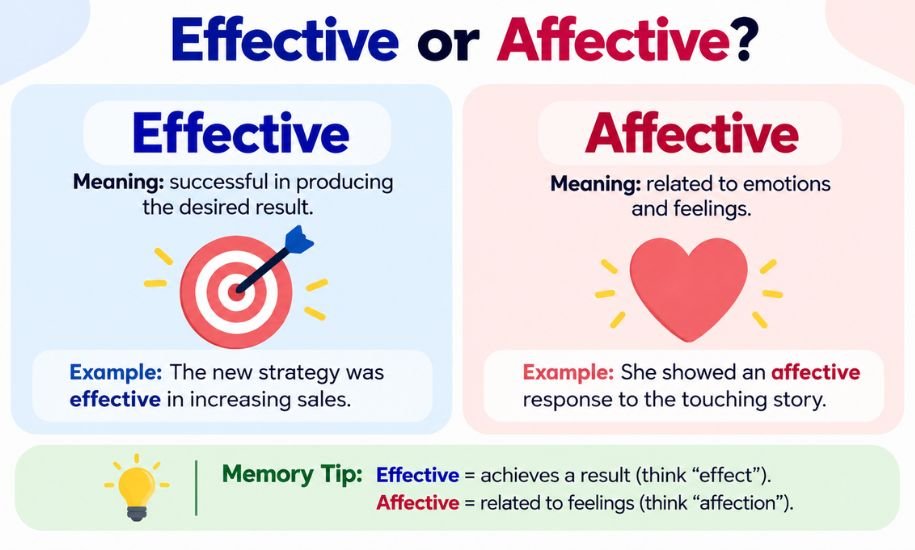
The words effective and affective look almost identical, but they have different meanings. Both are correct English words, and choosing the right one depends on what you want to express. One describes how well something achieves a result, while the other relates to feelings and emotions. Understanding this distinction will help you avoid mistakes in everyday writing, professional communication, and academic work. Fortunately, a simple rule makes the difference easy to remember: think about results when using effective and emotions when using affective.
Both effective and affective are correct words. Effective means producing the intended result or being in force, as in “an effective solution.” Affective means relating to emotions or feelings, as in “an affective response.”
Effective vs. Affective: Quick Comparison
The easiest way to distinguish these words is to focus on their meanings and typical uses.
| Feature | Effective | Affective |
|---|---|---|
| Part of speech | Adjective | Adjective |
| Main meaning | Producing the intended result | Relating to feelings or emotions |
| Common contexts | Work, education, medicine, everyday communication | Psychology, emotional development, academic research |
| Synonyms | Successful, useful, productive | Emotional, emotive, feeling-related |
| Example | This is an effective teaching method. | The study examined affective responses. |
Although the words share several letters, they serve different purposes. Substituting one for the other can change the meaning of a sentence or make it incorrect in context.
What Does “Effective” Mean?
Effective is an adjective that describes something that works well or achieves its intended purpose. It is useful when discussing methods, strategies, treatments, tools, decisions, and solutions.
For example, an effective study plan helps a student learn more successfully. An effective treatment produces the desired therapeutic outcome. An effective communication strategy helps people understand a message.
The word can also describe something that has officially come into operation or taken effect.
Examples of effective in sentences
- Regular practice is an effective way to improve your writing.
- The company introduced an effective strategy to attract new customers.
- This cleaning product is effective at removing stubborn stains.
- The teacher found an effective way to explain the difficult concept.
- The new policy becomes effective immediately.
In the final example, effective means that the policy begins to apply at once. It does not refer to anyone’s emotions.
Common synonyms for effective
Depending on the sentence, useful alternatives include:
- Successful: Achieving the desired outcome.
- Productive: Producing useful results.
- Useful: Helping someone accomplish a task.
- Efficient: Achieving a result with minimal wasted time, effort, or resources.
- Efficacious: Producing the intended effect, particularly in formal or technical contexts.
These words are related, but they are not always interchangeable. For example, a process can be efficient because it saves time but ineffective because it fails to achieve its main goal.
What Does “Affective” Mean?
Affective is an adjective that relates to emotions, feelings, moods, or emotional responses. It is especially common in psychology, education, and research involving human behavior.
For example, researchers might study how people emotionally respond to music, how children develop emotional awareness, or how a particular experience influences someone’s mood.
The word is less common in everyday conversation than effective, but it has a clear and important role in academic and professional writing.
Examples of affective in sentences
- The researchers studied the affective responses of children to music.
- The course aims to support students’ affective development.
- The psychologist examined the affective aspects of human behavior.
- The film had a powerful affective impact on its audience.
- The study explored how classroom experiences influence students’ affective states.
In each sentence, the word relates to emotions or feelings rather than the success of a method or action.
Common synonyms for affective
Depending on the context, possible alternatives include:
- Emotional: Relating to feelings.
- Emotive: Evoking or expressing emotion.
- Feeling-related: Connected with emotional experiences.
- Mood-related: Associated with a person’s emotional state.
In academic writing, affective may be more precise than these alternatives, so replacing it is not always necessary.
When Should You Use Each Word?
A simple question can help you choose the correct word: Are you describing a result or an emotion?
Use effective when you want to explain whether something works, succeeds, or achieves a goal.
Examples:
- An effective revision strategy improves exam preparation.
- The new safety measures were effective.
- The agreement becomes effective next month.
Use affective when you are discussing emotions, feelings, moods, or emotional reactions.
Examples:
- The research measured affective responses to stress.
- Teachers can support students’ affective development.
- The experiment examined changes in participants’ affective states.
Consider these two sentences:
- The teacher developed an effective approach to classroom management.
- The teacher studied the affective responses of students to classroom activities.
The first describes an approach that works well. The second describes students’ emotional responses. Both words are correct, but they communicate different ideas.
Is It “Effective Immediately” or “Affective Immediately”?
The correct expression is effective immediately when you mean that a rule, policy, decision, or change begins to apply at once.
The phrase is common in workplace announcements, official notices, contracts, and organizational communications.
Correct examples:
- The revised policy is effective immediately.
- The new working hours become effective immediately.
- The manager’s resignation is effective immediately.
Incorrect for this meaning:
- The revised policy is affective immediately.
The mistake occurs because the two words look similar. However, affective refers to emotions, so it does not express the intended meaning in these examples.
You can also use effective from to identify a starting date:
“The new schedule will be effective from November 1.”
In this context, effective means officially in force or operational.
Effective or Affective in Psychology?
Both words can appear in psychology, but they describe different things.
Affective relates to emotions and moods. Psychologists may use terms such as affective response, affective state, and affective development when examining emotional experiences and reactions.
Effective, on the other hand, describes whether an intervention, treatment, or technique achieves its intended result.
For example:
- The therapist evaluated whether the treatment was effective.
- The researcher measured participants’ affective responses during the experiment.
The first sentence concerns the treatment’s results. The second concerns emotional reactions.
The expression affective disorder is also used in clinical terminology relating to mood disorders. Seasonal affective disorder, for instance, is a recognized term associated with depressive symptoms that follow a seasonal pattern.
Understanding the distinction is particularly helpful when reading research papers, psychology textbooks, and medical information.
Common Mistakes to Avoid
Although the difference is straightforward, several mistakes can occur when these words are used in similar contexts.
1. Using affective to describe a successful method
Incorrect: “This is an affective way to learn vocabulary.”
Correct: “This is an effective way to learn vocabulary.”
The sentence describes a method that produces a desired result, so effective is the appropriate word.
2. Using effective when describing emotional reactions
Incorrect: “The researchers measured the effective responses of participants to the photographs.”
Correct: “The researchers measured the affective responses of participants to the photographs.”
The intended meaning concerns participants’ emotional reactions, making affective the better choice.
3. Confusing effective with efficient
These words are related but have different meanings.
An effective method achieves its goal. An efficient method uses resources wisely.
For example, a delivery service might be efficient because it uses less fuel, but ineffective if packages still arrive late.
4. Assuming affective is a misspelling
Affective is a legitimate English word. It should not be treated as an incorrect version of effective. The correct choice depends on the intended meaning.
An Easy Way to Remember the Difference
Use this simple memory trick:
Effective = Effect or result.
Think of whether an action produces the desired outcome. If it works as intended, effective is usually the right word.
Affective = Affect or emotion.
Think of feelings, moods, and emotional reactions. If the sentence discusses these subjects, affective may be appropriate.
Try this quick practice exercise:
- The new teaching technique was highly ______.
- The study examined the ______ responses of participants.
- The policy becomes ______ immediately.
- Music can influence a person’s ______ state.
Answers: 1. effective; 2. affective; 3. effective; 4. affective.
The key is to consider what the sentence means rather than choosing a word based only on how it looks.
Frequently Asked Questions
Is effective or affective correct?
Both are correct English words. Effective describes something that achieves a desired result or is in force. Affective describes something connected with emotions, feelings, or moods. The right choice depends on the context.
What is the difference between effective and affective?
The primary difference is meaning. An effective solution works well, while an affective response is an emotional reaction. They are both adjectives, but they are used in different situations.
What is a synonym for affective?
Emotional is one of the closest everyday synonyms for affective. Depending on the context, emotive, mood-related, or feeling-related may also work. In psychology, however, the original term may be more precise.
Is it effective immediately or affective immediately?
Use effective immediately when announcing that a policy, decision, or change takes effect at once. Affective immediately does not convey this meaning because affective relates to emotions.
Can effective and affective be used in the same sentence?
Yes. For example: “The researchers evaluated whether the intervention was effective and examined its affective impact on participants.” Here, effective describes the outcome, while affective describes the emotional impact.
What is the difference between effective and efficient?
Effective means achieving the intended result. Efficient means accomplishing something with minimal waste of time, effort, or resources. A process can be efficient without being effective if it uses few resources but fails to achieve its goal.
Final Verdict: Effective or Affective?
Choose effective when describing success, results, or something that has officially come into force. Choose affective when discussing emotions, moods, or emotional responses. Remembering the difference between results and feelings will help you use both words confidently. For more straightforward explanations of confusing English words, Grammarifyr helps you understand the difference and choose the right word for every context.
You may also Read : Bear or Bare: Meaning, Difference, and Examples
One Comment