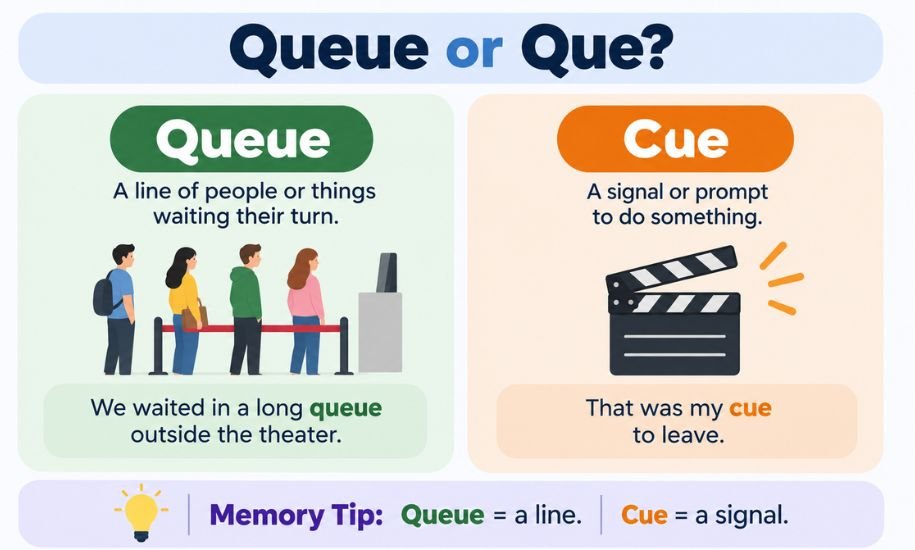
Queue or Que: Spelling, Meaning, and Examples
If you are unsure whether to write queue or que, you are not alone. The confusion often comes from the unusual spelling of queue and the fact that it sounds exactly like the word cue. But que is not the standard English spelling for a line of people waiting. The correct word is queue, while cue has a different meaning related to a signal or prompt. Understanding the difference makes these words much easier to use correctly in writing.
If you mean a line of people, vehicles, or things waiting their turn, the correct spelling is queue. Que is not normally a standard English spelling of this word. If you mean a signal or prompt, use cue. Both queue and cue are pronounced /kjuː/.
Queue or Que: The Correct Form
When referring to a line or an ordered group waiting for something, queue is the correct English word.
For example:
- We waited in a long queue outside the theater.
- Please join the queue behind those customers.
- There was a queue at the ticket counter.
- The files are waiting in a processing queue.
Que should not normally be used as a shortened version of queue in standard English writing.
So, if you are asking how to spell the word for a waiting line, remember:
Correct: queue
Incorrect in standard English: que
However, there is another word that sounds exactly like queue: cue. This is where an additional layer of confusion comes in.
Queue vs. Cue: What’s the Difference?
Although queue and cue have the same pronunciation, they have different meanings and spellings.
| Feature | Queue | Cue |
|---|---|---|
| Correct English word? | Yes | Yes |
| Main meaning | A line or ordered sequence | A signal or prompt |
| Common use | Waiting for a turn | Telling someone when to act |
| Pronunciation | /kjuː/ | /kjuː/ |
| Example | We joined the queue. | That was my cue to leave. |
Queue is generally associated with waiting or order.
Cue is generally associated with a signal, instruction, or prompt.
For example:
The audience formed a queue outside the theater.
But:
The actor waited for his cue to enter the stage.
The words sound identical when spoken, but their meanings are completely different.
What Does “Queue” Mean?
Queue is a noun meaning a line of people or things waiting for something. It can also describe an ordered sequence in which items are processed or handled.
The word is particularly common in British English. In American English, line is often preferred when talking about people waiting.
As a noun:
There was a long queue at the coffee shop.
We joined the queue for the museum.
The passengers stood in a queue at the gate.
It can also be used as a verb. To queue means to wait in a line or form a line.
We had to queue for tickets.
Customers were queuing outside the store.
The word is also common in computing. A printer, for example, may have a print queue, where documents wait to be processed.
What Does “Cue” Mean?
Cue is a different word. As a noun, it commonly means a signal that tells someone when to do or say something.
For example:
The change in music was the dancer’s cue to begin.
The director gave the actor a cue.
His sudden silence was my cue to stop asking questions.
The word is also used in expressions such as on cue and take your cue from.
For example:
Right on cue, the lights went out.
She took her cue from the other speakers.
There is another meaning of cue: a long stick used to strike a ball in games such as pool, billiards, or snooker.
He picked up his cue and prepared to take the shot.
So although cue sounds exactly like queue, it should not be used when you mean a waiting line.
Is “Que” a Real English Word?
Que can appear in English texts, but it is not normally the standard spelling of the word meaning a line.
This distinction matters because someone may see que used as an abbreviation or as a word borrowed from another language and assume that it is a shortened form of queue. It is not the normal spelling to use when writing about people waiting in line.
For standard English:
We waited in the queue.
is correct.
We waited in the que.
is not standard English spelling for that meaning.
If you are writing formally, academically, professionally, or for general publication, use queue when that is the meaning you intend.
Why Are Queue and Cue Confused?
The main reason is pronunciation.
Queue and cue are homophones, meaning they have the same pronunciation but different spellings and meanings. Both are pronounced /kjuː/.
That means you cannot always determine which word someone means simply by hearing it.
Consider this sentence:
“That was my cue.”
You hear the same sound as queue, but the surrounding context tells you that the speaker means a signal or prompt.
Likewise:
“I waited in the queue.”
The context makes it clear that the word refers to a line.
The spelling therefore becomes especially important in writing.
How Do You Spell Queue?
The spelling queue looks much longer than its pronunciation. It contains five letters but is pronounced as one syllable.
A useful way to remember the spelling is to notice the repeated vowels:
Q-U-E-U-E
The four letters after Q are U-E-U-E.
You may also remember that the word has a surprisingly long spelling for a very short sound. This is one reason it is frequently misspelled as que.
Examples
Correct:
- The queue moved quickly.
- We joined the queue near the entrance.
- Several customers were queuing outside.
- Your request has been added to the queue.
Incorrect:
- The que moved quickly.
- We joined the que near the entrance.
- Several customers were queuing?
The final example is worth noting: queuing is actually a correct form of queue. The spelling changes because the verb takes the -ing ending, but the base word remains queue.
Queue, Queuing, and Queued
The word has several useful grammatical forms.
| Form | Example |
|---|---|
| queue | We joined the queue. |
| queues | There are two queues outside. |
| queued | The request has been queued. |
| queuing | Customers are queuing outside. |
The spelling queuing can look strange, but it is correct.
For example:
Passengers were queuing at the airport.
The system has queued the request for processing.
This is different from treating que as a shortened spelling.
Queue the Music or Cue the Music?
This is one of the most useful distinctions to remember.
The correct expression is:
Cue the music.
Here, cue means to signal or prompt the music to start.
For example:
Cue the music!
You would not normally write:
❌ Queue the music!
unless you literally mean placing music tracks into a queue or arranging them in a sequence.
There is a legitimate technical or literal use of queue the music, such as telling someone to place songs into a playback queue. But in the familiar expression meaning “start the music,” cue the music is correct.
Compare:
Cue the music.
Signal the music to begin.
Queue the music.
Put music into an ordered waiting list.
The context completely changes the meaning.
Common Mistakes to Avoid
1. Writing “que” for a waiting line
Incorrect:
There was a long que outside the store.
Correct:
There was a long queue outside the store.
2. Using queue when you mean a signal
Incorrect:
That was my queue to leave.
Correct:
That was my cue to leave.
The second sentence means that something gave you a signal or indication that it was time to go.
3. Writing “queue the music” when you mean “cue the music”
If you are giving someone a signal to start the music, use cue.
Cue the music.
If you are putting songs into an ordered playlist or playback line, queue can be appropriate.
4. Assuming queue and cue have the same meaning because they sound alike
They are homophones, not interchangeable words. Their pronunciation is the same, but their meanings are not.
An Easy Way to Remember the Difference
Use this simple association:
Queue = a line.
People queue when they wait for their turn.
Cue = a signal.
A cue tells you when to act.
You can also connect cue with the phrase “cue the music.” When someone says “cue,” think of a signal to start something.
For queue, picture people standing one behind another waiting to enter a store.
More Examples in Sentences
Here are some examples that show the distinction naturally:
Queue
We joined the queue before the doors opened.
The supermarket queue was longer than expected.
Your application is now in the processing queue.
Passengers were queuing for security.
Cue
The actor missed his cue.
The flashing light was a cue to begin.
Her expression was a cue that something was wrong.
That was my cue to end the conversation.
Que
❌ We waited in the que.
Use queue instead:
✅ We waited in the queue.
Frequently Asked Questions
Is “que” short for “queue”?
No, not in standard English. When you mean a line of people or things waiting for their turn, queue is the standard spelling. Que may occur in other contexts or as an abbreviation, but it should not normally be used as a shortened spelling of queue.
Is queue or cue correct?
Both queue and cue are correct English words, but they have different meanings. Queue refers to a line or ordered sequence, while cue usually means a signal or prompt. They are pronounced the same but spelled differently.
Is “queue” pronounced like “cue”?
Yes. In standard English, queue and cue are pronounced the same: /kjuː/. They are therefore homophones. Their spelling and meaning are what distinguish them.
Should I write “cue the music” or “queue the music”?
Use cue the music when you mean “signal the music to start.” Queue the music can be grammatical when you literally mean placing music into an ordered playback list, but it is not the usual expression for giving the signal to start.
What is the plural of queue?
The plural is queues. For example: “Several queues had formed outside the venue.” The verb can also take forms such as queued and queuing.
Why is queue spelled with so many letters?
The unusual spelling reflects the word’s historical development through French. Modern English retained the spelling even though the pronunciation became much shorter. Today, queue is pronounced as a single syllable.
Final Verdict: Queue or Que?
When you mean a line of people or things waiting their turn, use queue. Que is not the standard spelling for that meaning. If you mean a signal or prompt, use cue. Although queue and cue sound identical, their meanings and spellings are different. For clear, accurate word choices, Grammarifyr recommends remembering the simple rule: queue is a line, while cue is a signal.
You may also Read : Ser or Estar: Rules, Examples, and Conjugations
One Comment