Dived or Dove: British and American English Explained
Have you ever wondered whether to write dived or dove when describing someone entering a swimming pool or moving quickly downward? Both forms are correct, but their use depends partly on regional English conventions. Dived is the traditional form and is preferred in British English, while dove is especially common in American English. Understanding the difference also helps you choose the correct form in sentences involving the present perfect or past perfect tense. The good news is that the basic rule is simple once you know how these verb forms work.
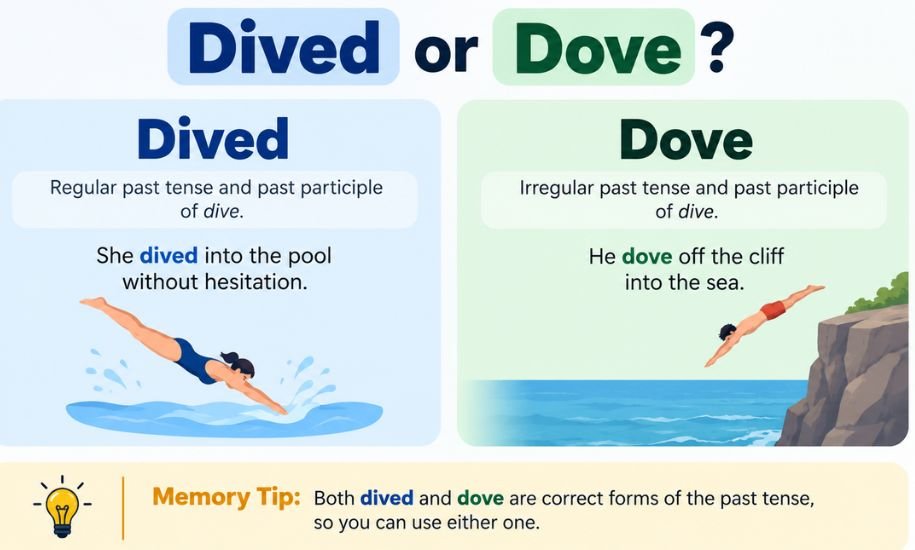
Both “dived” and “dove” are correct past-tense forms of the verb “dive.” British English generally prefers “dived,” while American English commonly uses “dove” as well as “dived.” For the past participle, as in “I have ___ into the water,” “dived” is the safest standard choice.
Dived vs. Dove: The Key Difference
The main difference between these words is regional preference, not meaning. Both can describe an action that happened in the past, such as jumping into water, moving downward quickly, or rushing into an activity.
| Feature | Dived | Dove |
|---|---|---|
| Correct word? | Yes | Yes |
| Part of speech | Verb | Verb |
| Simple past tense | Yes | Yes |
| British English | Preferred form | Less common |
| American English | Accepted | Common |
| Past participle | Standard form | Less widely accepted in this role |
| Example | She dived into the pool. | She dove into the pool. |
The simple rule: Use dived for British English and as a reliable choice across English varieties. Use dove when writing for an American audience if it fits your preferred style.
What Does “Dived” Mean?
Dived is the simple past tense and past participle of the verb dive. It describes moving headfirst or quickly downward, especially into water, but it can also be used figuratively.
Here are some common examples:
- The swimmer dived into the lake before sunrise.
- The goalkeeper dived to stop the ball from entering the net.
- The bird dived toward the water to catch a fish.
- She has dived at this location several times.
- After reading the instructions, he dived straight into the project.
In the first three sentences, the word describes physical movement. In the final example, it means beginning an activity enthusiastically or without hesitation.
When should you use “dived”?
Use this form when writing in British English, when you want a form accepted across English varieties, or when you need a standard past participle.
For example:
British English: “The children dived into the sea after lunch.”
International or formal writing: “The rescue team has dived into the water to search for the missing equipment.”
The form works naturally in everyday conversation, academic writing, journalism, and professional communication.
What Does “Dove” Mean?
Dove is an accepted simple past-tense form of dive, particularly in American English. It has the same basic meaning as dived when used as a verb.
Consider these examples:
- The children dove into the swimming pool.
- He dove behind the wall when he heard the noise.
- The goalkeeper dove to his right but could not reach the ball.
- The eagle dove toward the river.
- She dove into her research as soon as the project began.
Each sentence describes a completed action. Replacing dove with dived would preserve the meaning.
Is “Dove” Only an American English Word?
No. Although dove is especially common in American English, it is not exclusive to the United States. Speakers of other English varieties may use it too.
However, if you are writing for a British audience, dived is generally the more natural choice. American writers can use either form, although dove is often the more familiar option in everyday American usage.
Why Are There Two Past-Tense Forms?
Most regular English verbs form the simple past by adding -ed. For example, jump becomes jumped and walk becomes walked. The verb dive follows this pattern in the form dived.
The alternative dove developed in American English and became established as another past-tense form. Its pattern resembles irregular verbs such as drive, which becomes drove, and write, which becomes wrote.
This explains why both forms exist today. English contains many verbs with more than one accepted form, and regional usage can influence which version sounds most natural to a particular audience.
Dive: Past Tense and Past Participle
Understanding the different forms of dive is important because the simple past and past participle do not always work in the same way.
| Verb form | Word | Example |
|---|---|---|
| Base form | Dive | I dive every summer. |
| Simple past | Dived / dove | Yesterday, I dived into the pool. |
| Past participle | Dived | I have dived here before. |
| Present participle | Diving | She is diving into the water. |
The simple past describes a completed action, often at a specific time. The past participle is used with auxiliary verbs such as have, has, and had to form perfect tenses.
For example:
- Simple past: He dove into the river yesterday.
- Present perfect: He has dived into the river before.
- Past perfect: He had dived into the water before the boat arrived.
- Present continuous: He is diving into the river now.
Should You Say “I Haven’t Dived” or “I Haven’t Dove”?
The safest standard choice is “I haven’t dived.”
In this sentence, dived functions as the past participle after have not. The same pattern applies to other perfect-tense constructions:
- I haven’t dived in deep water before.
- She hasn’t dived since last summer.
- They had dived several times before the competition.
You may encounter dove as a past participle in some American usage, including expressions such as “I have dove.” However, dived is the more widely recommended form for this grammatical role and is the best choice when you want to avoid uncertainty.
Dived or Dove: Examples in Sentences
The following pairs demonstrate how both words work in the simple past tense.
Example 1: Swimming
- The swimmer dived into the pool.
- The swimmer dove into the pool.
Both sentences are correct. The first fits British usage particularly well, while the second is common in American English.
Example 2: Sports
- The goalkeeper dived toward the ball.
- The goalkeeper dove toward the ball.
Neither sentence changes the meaning. Both describe the goalkeeper’s movement.
Example 3: Birds
- The hawk dived toward its prey.
- The hawk dove toward its prey.
Both forms describe the same downward movement.
Example 4: Figurative use
- She dived into the new assignment.
- She dove into the new assignment.
Both expressions mean that she began the task eagerly or immediately.
The key is to choose the form that fits your audience and maintain consistency throughout your writing.
Common Mistakes to Avoid
Even though both past-tense forms are correct, a few mistakes are worth avoiding.
1. Assuming that “dove” is always incorrect
This is a common misconception. Dove is an established past-tense form, particularly in American English. It should not automatically be labelled a grammatical error.
2. Assuming that “dived” is incorrect in American English
American English accepts dived as well. You do not need to replace it with dove in every sentence.
3. Confusing simple past with past participle
Compare these sentences:
- Correct standard usage: “She has dived into the pool.”
- Simple past: “She dove into the pool yesterday.”
The second sentence uses dove as a simple past form, while the first uses dived as a past participle.
4. Switching forms without a reason
Both forms can appear in the same piece of writing, but consistency is usually preferable. If your article follows British English conventions, use dived as your default. If it follows American English conventions, choose the form that best suits your style.
Easy Way to Remember the Difference
Use this straightforward memory rule:
- British English: Think dive → dived.
- American English: Think dive → dived or dove.
- Perfect tenses: Choose dived for the safest standard construction.
You can also remember that dove follows a pattern similar to drove: both are short, irregular-looking past-tense forms. This is a useful association, although it does not mean every verb ending in -ive forms its past tense in the same way.
Frequently Asked Questions
1. Is “dived” or “dove” grammatically correct?
Both are grammatically correct as the simple past tense of dive. British English generally prefers dived, while American English commonly uses dove as well as dived. Your choice should depend on your audience and the style of English you are following.
2. Is “dove” the past tense of “dive” in American English?
Yes. Dove is a widely accepted American English past-tense form. For example, “He dove into the pool” is a natural sentence in American English. The alternative “He dived into the pool” is also correct.
3. Do people in the UK say “dived” or “dove”?
Dived is the traditional and generally preferred form in British English. Although some British speakers may use dove, it is less common in standard British usage. Writers following British conventions should normally choose dived.
4. Is “dived” a real word?
Yes. Dived is a fully correct form of the verb dive. It serves as both the simple past tense and the past participle. Examples include “She dived into the water” and “She has dived here before.”
5. Should I write “I have dived” or “I have dove”?
“I have dived” is the safest standard choice. Here, dived is the past participle used with have. Although “I have dove” occurs in some American usage, I have dived is preferable when writing for a broad international audience or following standard British English conventions.
6. Is “dove” pronounced like the name of the bird?
When dove is the past tense of dive, it rhymes with rove. When dove refers to the bird, it usually rhymes with love. The spelling is identical, but the pronunciation and meaning differ.
Final Verdict: Which Form Should You Choose?
Both forms are correct, but the best choice depends on context. Use dived when following British English conventions or when you need a reliable past participle. Choose dove for the simple past when writing in a style that follows common American usage.
The main lesson is simple: understanding the difference helps you write naturally without treating an accepted regional variation as an error. For more practical explanations of confusing words and grammar rules, Grammarifyr follows one guiding principle: Know the Difference. Use the Right Words.
You may also Read : Recognise or Recognize: British and American English




One Comment