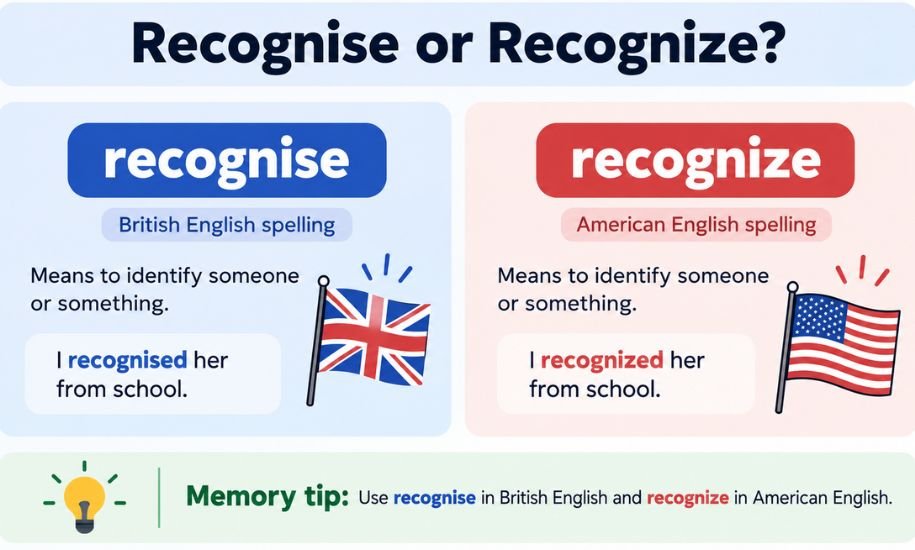
Recognise or Recognize: British and American English
Have you ever wondered whether to write recognise or recognize? Both spellings are correct, but the preferred form depends on the variety of English you are using. The difference is similar to colour and color: British and American English often follow different spelling conventions. Understanding this distinction helps you write clearly and avoid inconsistencies in essays, emails, articles, and other documents. Although the spelling changes, the meaning remains the same. The key is to know which form suits your audience and to use it consistently throughout your writing.
Both recognise and recognize are correct spellings of the same verb. Recognise is the usual spelling in British English, while recognize is standard in American English. British English also accepts the -ize form, particularly under Oxford spelling conventions.
Recognise vs Recognize: What’s the Difference?
The main difference is regional spelling preference, not meaning, grammar, or pronunciation. Both forms can describe identifying someone, acknowledging a fact, or appreciating an achievement.
| Feature | Recognise | Recognize |
|---|---|---|
| Correct spelling? | Yes | Yes |
| Common usage | British English | American English |
| Meaning | Identify or acknowledge | Identify or acknowledge |
| Pronunciation | Generally the same | Generally the same |
| Past tense | Recognised | Recognized |
| Present participle | Recognising | Recognizing |
For example:
- British English: I didn’t recognise the person standing by the door.
- American English: I didn’t recognize the person standing by the door.
Both sentences are grammatically correct and communicate exactly the same message.
If you are writing for a British audience, recognise is generally the safest choice. For an American audience, use recognize. If a publisher, employer, university, or style guide specifies a particular convention, follow that requirement.
What Does “Recognise” Mean?
Recognise is a verb with several related meanings. It can refer to identifying something familiar, becoming aware of a fact, accepting something as valid, or acknowledging someone’s contribution.
Here are its main uses.
1. To identify someone or something
You recognise a person when you know who they are, perhaps because you have met them before.
Examples:
- I recognised my former teacher at the shopping centre.
- She recognised the melody from an old film.
- The detective recognised the suspect from the photograph.
2. To acknowledge a fact or situation
The word can also mean accepting that something is true or important.
Examples:
- We must recognise the challenges facing small businesses.
- He recognised that his original plan needed improvement.
- She recognised the importance of regular practice.
3. To appreciate an achievement
When someone recognises another person’s work, they acknowledge its value or importance.
Examples:
- The school recognised her contribution to the community.
- The company recognised the team’s outstanding performance.
- His efforts were recognised at the annual ceremony.
4. To accept something officially
In formal contexts, the verb can describe accepting a status, qualification, right, or institution as valid.
Examples:
- The university recognises qualifications from several institutions.
- The government recognised the new administration.
- The organisation recognises the agreement as legally valid.
In American English, the same meanings apply to recognize. There is no difference in definition between the two spelling variants.
Is “Recognize” Correct in British English?
Yes. Although recognise is the conventional British spelling in many publications, recognize is also accepted in British English.
The distinction becomes clearer when you understand Oxford spelling. Some British publications follow a convention that prefers -ize endings in words such as recognize, organize, and realize. This approach is not an American-only spelling system.
Other British publications follow the more familiar -ise convention, using recognise, organise, and realise.
Both approaches can be appropriate. The important consideration is the style guide being followed.
For example:
- A British newspaper using the -ise convention may write, “The committee recognised her achievement.”
- A British publication following Oxford spelling may write, “The committee recognized her achievement.”
- An American publication would normally use the second version.
Therefore, it would be inaccurate to label recognize universally incorrect in the UK. If you are unsure, check the publication’s preferred spelling system.
Recognise or Recognize in Sentences
Seeing both spellings in context makes the difference easier to understand. The following examples demonstrate how the verb works in everyday and formal writing.
Everyday examples
- I immediately recognised my neighbour’s voice.
- I immediately recognized my neighbour’s voice.
- Did you recognise the actor in that television programme?
- Did you recognize the actor in that television program?
- She recognised the song after hearing its first few notes.
- She recognized the song after hearing its first few notes.
Each pair expresses the same idea. Some examples also include other regional differences, such as programme/program, which follow their own spelling conventions.
Examples in professional writing
- British convention: The organisation recognised the employee’s dedication.
- American convention: The organization recognized the employee’s dedication.
- British convention: The report recognises the need for further research.
- American convention: The report recognizes the need for further research.
The correct choice depends on the intended spelling convention. Neither form changes the sentence’s underlying meaning.
Recognised or Recognized: Which Past-Tense Form Is Correct?
Both recognised and recognized are correct past-tense and past-participle forms of the verb.
The verb follows a regular pattern:
| Verb form | British -ise convention | American / Oxford -ize convention |
|---|---|---|
| Base form | recognise | recognize |
| Third-person singular | recognises | recognizes |
| Past tense | recognised | recognized |
| Past participle | recognised | recognized |
| Present participle | recognising | recognizing |
Examples:
- She recognised the error before submitting the report.
- She recognized the error before submitting the report.
- The achievement has been recognised by the organisation.
- The achievement has been recognized by the organization.
Remember that the choice of spelling does not change the grammatical tense. Both forms work in the same sentence structures.
How to Remember Which Spelling to Use
The simplest approach is to associate each spelling with the writing convention you are following.
- British -ise: recognise, organise, realise.
- American -ize: recognize, organize, realize.
This is a useful general pattern, although British English also permits many -ize spellings. Do not treat the pattern as an absolute rule for every word.
A practical trick is to consider your other spelling choices before deciding. If you have already written colour, organise, and centre, then recognise will usually fit your British spelling style. If you are using color, organize, and center, then recognize will usually be consistent.
Consistency matters more than mixing two accepted conventions in the same document without a reason.
Common Mistakes to Avoid
Even though both spellings are valid, writers can still make mistakes when choosing between them.
1. Assuming that one spelling is always wrong
Neither form is universally incorrect. The appropriate choice depends on the regional convention or style guide.
2. Mixing spelling conventions unnecessarily
Using recognise in one paragraph and recognize in another can make a document look inconsistent. Choose a convention and stick to it.
3. Changing the meaning unnecessarily
The two forms mean the same thing. You do not need to choose one spelling for identifying a person and the other for acknowledging an achievement.
4. Changing related words inconsistently
If your document uses the -ise convention, forms such as recognises and recognised will generally fit. Under the -ize convention, use recognizes and recognized.
5. Treating pronunciation as the deciding factor
The two spellings are generally pronounced alike. You can select the appropriate spelling based on the audience without changing how you say the word.
Frequently Asked Questions
1. Is “recognise” or “recognize” correct in the UK?
Both are accepted in British English. Recognise is the usual choice in many British publications, while recognize is used by writers and publishers who follow Oxford spelling conventions. For formal work, follow the relevant publication or institution’s style guide.
2. Is “recognize” American or British spelling?
Recognize is the standard American spelling. It is also accepted in British English under certain spelling conventions, including Oxford spelling. It is therefore better to describe it as the standard American form rather than an exclusively American word.
3. Do the two spellings have different meanings?
No. Both forms mean to identify someone or something, acknowledge a fact, appreciate an achievement, or accept something officially. The difference is orthographic: the words are spelled differently according to regional or editorial preferences.
4. Are “recognised” and “recognized” both correct?
Yes. Both are correct past-tense and past-participle forms. Recognised is commonly used with the British -ise convention, while recognized is standard in American English and is also used in Oxford-style British writing.
5. Are the words pronounced differently?
Generally, no. Both spellings have the same pronunciation in standard British and American English, although accents can produce small differences in vowel quality or rhythm. The spelling choice does not require a different pronunciation.
6. What is a synonym for “recognise”?
Depending on the context, suitable synonyms include identify, acknowledge, notice, appreciate, and accept. For example, you can identify a familiar face, acknowledge a mistake, or appreciate someone’s contribution. Choose a synonym that preserves the intended meaning.
Final Verdict: Recognise or Recognize?
Both spellings are correct, and the choice comes down to your preferred English convention. Use recognise for the usual British -ise style and recognize for American English or a style guide that prefers -ize spellings. Keep related word forms consistent, and check your publication’s requirements when necessary. At Grammarifyr, the goal is simple: know the difference, use the right words, and make every sentence clear.
You may also Read : Fact or Opinion Explained With Examples
One Comment