Bellow or Below: Correct Usage Explained
Have you ever wondered whether to write “bellow” or “below”? These two words look almost identical, but they have completely different meanings. One describes a loud shout or roar, while the other refers to something at a lower position, level, or amount. Because both are correctly spelled English words, a spellchecker may not catch the mistake when you use one instead of the other. Understanding their meanings and seeing how they work in sentences will help you choose the right word in emails, everyday writing, and formal documents.
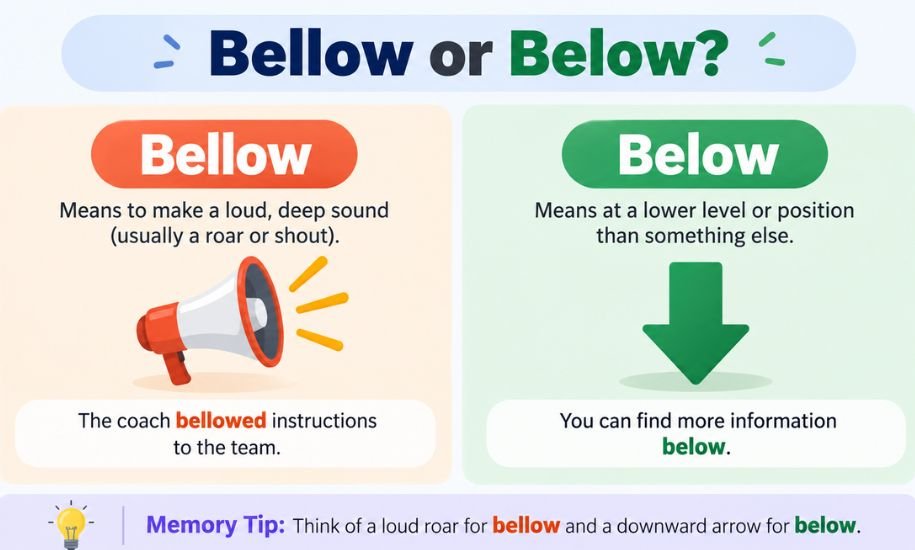
Both “bellow” and “below” are correct English words, but they have different meanings. “Bellow” means to shout loudly or make a deep, loud sound. “Below” means at a lower position, level, or amount. For example, write “The bull began to bellow” but “Please see the information below.”
Bellow vs. Below: What’s the Difference?
The main difference is that bellow describes a loud sound, while below describes a lower position or level. Neither word is a misspelling, so you must choose according to the meaning of your sentence.
| Feature | Bellow | Below |
|---|---|---|
| Meaning | To shout loudly or produce a deep roar | At a lower position or level |
| Part of speech | Verb and noun | Preposition and adverb |
| Common use | Loud voices and animal sounds | Locations, measurements, and written text |
| Example | The angry man began to bellow. | The temperature fell below zero. |
| Related words | Shout, yell, roar | Under, beneath, lower than |
| Opposite | No single direct opposite | Above, in positional contexts |
For a quick way to decide, ask yourself what the sentence is describing. If someone is shouting loudly, use “bellow.” If you are referring to something farther down or at a lower level, use “below.”
What Does “Bellow” Mean?
“Bellow” is a verb that means to shout in a loud, deep, or forceful voice. It can also describe the powerful sound made by an animal, such as a bull.
As a noun, “bellow” refers to the loud shout or roar itself.
People may bellow when they are angry, trying to be heard over noise, or calling to someone at a distance. The word usually suggests a stronger, deeper, or more forceful sound than an ordinary speaking voice.
Examples of bellow in a sentence
- The coach began to bellow instructions across the football field.
- We heard a bull bellow from the other side of the farm.
- “Get out of the way!” the driver bellowed.
- A sudden bellow echoed through the empty hall.
In the first three examples, the word describes the action of producing a loud sound. In the final example, it refers to the sound itself.
Synonyms of bellow
Depending on the context, synonyms include:
- Shout: To speak or call in a loud voice.
- Yell: To cry out loudly, often because of excitement, fear, or anger.
- Roar: To make a deep, powerful sound.
- Holler: To call or shout loudly, often in informal conversation.
- Bawl: To cry or shout loudly, depending on the context.
These words have similar meanings, but they are not always interchangeable. “Bellow” particularly emphasizes a loud, forceful, or deep sound.
What Does “Below” Mean?
“Below” means at a lower position, level, or amount than something else. It can also refer to information that appears farther down a page, email, or document.
The word is commonly used as a preposition or adverb.
As a preposition, it connects something to a lower reference point. For example, in “The village lies below the mountain,” it describes the village’s position relative to the mountain.
As an adverb, it can refer to something farther down. For instance, “The answer is given below” directs the reader to information in a lower part of the text.
Examples of below in a sentence
- Please see the instructions below before starting the task.
- The temperature dropped below freezing during the night.
- Her apartment is two floors below ours.
- The student’s score was below average.
- Write your name below the date.
- The submarine travelled below the surface of the water.
In each example, “below” describes position, direction, placement in written material, or a level that is lower than a reference point.
Synonyms of below
The best alternative depends on the sentence:
- Under: In a lower position, often directly beneath something.
- Beneath: At a lower position or underneath something.
- Underneath: Directly under an object or surface.
- Lower than: At a lesser height, amount, or level.
- Inferior to: Lower in rank, quality, or status.
For example, “The temperature is below zero” can be rephrased as “The temperature is lower than zero.”
However, not every synonym fits every context. “Please see below” is a natural instruction in a document, while “Please see beneath” usually sounds unnatural in that same context.
Is It “Please See Below” or “Please See Bellow”?
The correct expression is “please see below.”
Use it when directing someone to information that appears farther down in a document, message, email, or webpage. In this expression, “below” tells the reader where to find the relevant material.
Correct examples:
- Please see below for further details.
- Please find the requested information below.
- Refer to the table below for the results.
- The full list is provided below.
- Please see the notes below before proceeding.
Incorrect for the intended meaning:
- Please see bellow for further details.
- The full list is provided bellow.
These sentences use “bellow” incorrectly because they refer to the placement of information rather than a loud sound.
Although both spellings are valid English words, only “below” fits this expression.
How to Remember the Difference
A simple memory trick can help you avoid confusing these words.
Bellow = a loud sound. Think of a bull producing a deep roar or a person shouting across a crowded room. When the sentence describes a loud voice or sound, “bellow” is usually the right choice.
Below = low. The word “below” contains the word “low.” If something is lower than a reference point, appears farther down a page, or falls beneath a particular measurement, use “below.”
Compare these two sentences:
- The angry teacher began to bellow at the students.
- The instructions are written below the heading.
The first describes how the teacher speaks. The second tells the reader where the instructions appear.
Remember that this is a memory aid rather than a strict spelling rule. The meaning of the sentence is what determines the correct choice.
Common Mistakes to Avoid
Because both words are legitimate English words, choosing the wrong one can change the meaning of a sentence or make it confusing.
| Incorrect usage | Correct usage | Explanation |
|---|---|---|
| The information is written bellow. | The information is written below. | Refers to the location of text. |
| The temperature fell bellow zero. | The temperature fell below zero. | Refers to a measurement. |
| The bull began to below. | The bull began to bellow. | Describes an animal’s sound. |
| Please scroll bellow to continue. | Please scroll below to continue. | Refers to content farther down. |
| The man belowed at the crowd. | The man bellowed at the crowd. | Uses the correct past-tense form of the verb. |
Here are two additional points worth remembering:
1. Both words can be correct in the same context, but their meanings remain different. For example, “The bull began to bellow below the balcony” uses “bellow” for the sound and “below” for the location.
2. Spellcheck alone may not catch the error. Since both words are correctly spelled, a writing tool may accept either one. Read the sentence carefully to make sure the word expresses your intended meaning.
Frequently Asked Questions
1. Is bellow or below the correct spelling?
Both are correct spellings, but they mean different things. “Bellow” means to shout loudly or make a deep, loud sound. “Below” refers to a lower position, level, or amount. The correct choice depends on what you want to communicate.
2. What is the meaning of bellow?
“Bellow” means to shout in a loud, deep, or forceful voice. It can also describe a loud sound made by an animal. As a noun, it refers to a loud shout or roar. For example, “The bull let out a bellow.”
3. What is the meaning of below?
“Below” means lower than something else in position, level, or amount. It is also used to direct readers to information farther down a page or document. For example, “Please see the explanation below.”
4. Is it “please see below” or “please see bellow”?
“Please see below” is correct when referring to information farther down a document, email, or webpage. “Bellow” refers to shouting or a loud sound, so it does not fit this expression.
5. What is a synonym for bellow or below?
Synonyms for “bellow” include shout, yell, and roar. Depending on the context, alternatives for “below” include under, beneath, and lower than. Choose a synonym that preserves the intended meaning of the sentence.
6. Is below the opposite of above?
Yes. “Above” is the usual opposite of “below” when describing position or level. For example, “The shelf is above the desk” contrasts with “The shelf is below the window.” The most appropriate wording depends on the reference point.
Final Verdict: Bellow or Below?
Both words are correct, but they serve different purposes. Use “bellow” when describing a loud shout or roar, and choose “below” when referring to a lower position, level, amount, or part of a document. When writing “please see below,” remember that the second word is always “below” for this meaning.
Understanding this small but important distinction can make your writing clearer and more accurate. Grammarifyr helps readers distinguish confusing English words so they can communicate confidently and follow the principle: Know the Difference. Use the Right Words.
You may also Read : Dived or Dove: British and American English Explained

One Comment