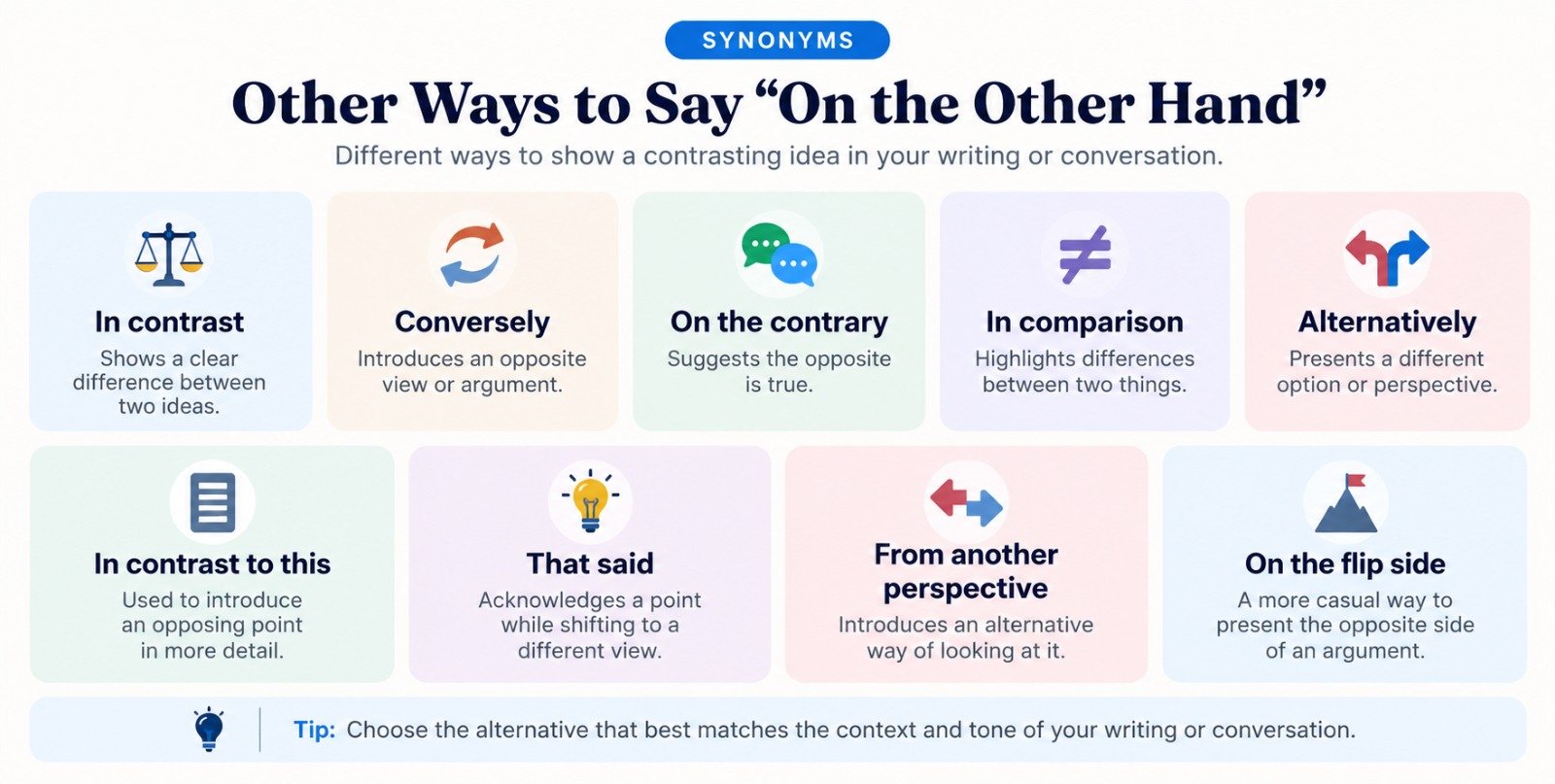
25 Other Ways to Say “On the Other Hand” for Any Situation
When you want to introduce a contrasting idea, “on the other hand” is a reliable choice. But using the same transition repeatedly can make your writing feel predictable. Fortunately, there are plenty of other ways to say on the other hand, depending on whether you are writing an essay, sending a professional email, or having a casual conversation.
Some alternatives, such as “however” and “in contrast,” work well in formal writing, while expressions like “then again” and “on the flip side” sound more conversational. The key is choosing an expression that matches the relationship between your ideas.
Best Alternatives at a Glance
| Alternative | Tone | Best Used For | Main Function |
|---|---|---|---|
| However | Neutral/Formal | Essays, emails, general writing | Introduces a contrast |
| In contrast | Formal | Comparisons and essays | Highlights differences |
| By contrast | Formal | Academic and analytical writing | Compares opposing features |
| Conversely | Formal | Academic and professional writing | Shows an opposite relationship |
| Alternatively | Formal/Neutral | Choices and options | Presents another possibility |
| Nevertheless | Formal | Essays and reports | Shows contrast despite something |
| Nonetheless | Formal | Professional and academic writing | Introduces a contrasting qualification |
| Yet | Neutral | Writing and speech | Adds a contrasting point |
| Still | Neutral/Casual | Conversation and general writing | Acknowledges a point while contrasting |
| That said | Neutral/Professional | Emails, articles, conversations | Qualifies a previous statement |
| Even so | Neutral | Conversation and writing | Shows contrast despite a fact |
| At the same time | Neutral | Balanced arguments | Presents another consideration |
| Then again | Casual | Conversation | Reconsiders or introduces another angle |
| On the flip side | Casual | Conversation and informal writing | Presents the opposite side |
| On the contrary | Formal | Correcting a mistaken idea | Directly contradicts something |
Other Ways to Say “On the Other Hand”
1. However
“However” is one of the most versatile alternatives. It introduces an idea that contrasts with what came before and works in both professional and everyday writing.
Example:
The apartment is small. However, it is in an excellent location.
Use it when you want a simple, natural transition without changing the meaning significantly.
2. In Contrast
“In contrast” works particularly well when you are directly comparing two people, things, situations, or ideas.
Example:
The first proposal focuses on reducing costs. In contrast, the second focuses on improving quality.
It is especially useful in essays, reports, reviews, and analytical writing.
3. By Contrast
“By contrast” has a similar function to “in contrast” and sounds polished in formal writing.
Example:
The old system was difficult to maintain. By contrast, the new system is much easier to manage.
Choose this expression when the purpose is to emphasize a clear difference.
4. Conversely
“Conversely” is a formal transition that introduces an opposite or reversed situation.
Example:
Some employees prefer working independently. Conversely, others perform better as part of a team.
It is particularly suitable for academic, analytical, and professional writing. It is not always a natural substitute when you simply want to mention a second unrelated consideration.
5. Alternatively
“Alternatively” is useful when the second idea represents another option, choice, or possibility.
Example:
You could take the train. Alternatively, you could rent a car.
This is different from “on the other hand.” Use “alternatively” when you are presenting an actual alternative rather than simply contrasting two observations.
6. Nevertheless
“Nevertheless” introduces something that remains true despite what was just mentioned.
Example:
The instructions were complicated. Nevertheless, we managed to complete the project.
It is more formal than many conversational alternatives and fits essays, reports, and professional communication.
7. Nonetheless
“Nonetheless” works much like “nevertheless.” It acknowledges the previous point but introduces a contrasting conclusion or qualification.
Example:
The project required considerable effort. Nonetheless, the final results were worthwhile.
It is a good choice when you want your writing to sound formal without becoming overly complicated.
8. Yet
“Yet” is a short and effective way to introduce contrast.
Example:
The course is challenging, yet many students enjoy it.
Unlike “on the other hand,” “yet” can fit directly into a sentence, making it useful when you want a more concise transition.
9. Still
“Still” can acknowledge the previous point before presenting a different consideration.
Example:
The restaurant is quite expensive. Still, the food is excellent.
It sounds more conversational than “nevertheless” or “nonetheless,” so it works particularly well in everyday writing and speech.
10. That Said
“That said” is a natural way to recognize a previous argument before adding a qualification or different perspective.
Example:
The software takes some time to learn. That said, it offers several useful features.
This phrase is common in professional writing, articles, reviews, and thoughtful conversations.
11. Even So
“Even so” means that the second point remains true despite what has already been said.
Example:
The weather forecast looked bad. Even so, we decided to go hiking.
It is useful when the contrast involves an unexpected decision or result.
12. At the Same Time
“At the same time” is helpful when you want to acknowledge two ideas that can both be true.
Example:
Working from home saves commuting time. At the same time, it can make collaboration more difficult.
This expression is especially useful when you want to present a balanced argument rather than a strict opposite.
13. Then Again
“Then again” is a conversational expression used when you reconsider an idea or introduce another way of looking at it.
Example:
I could buy the cheaper laptop. Then again, the more expensive one might last longer.
It is natural in speech and informal writing but usually isn’t the best choice for a formal academic essay.
14. On the Flip Side
“On the flip side” is an informal alternative that introduces the opposite side or another perspective.
Example:
Working remotely gives you more flexibility. On the flip side, it can sometimes feel isolating.
It is friendly and conversational, making it suitable for blogs, social media, casual discussions, and informal articles.
15. On the Contrary
“On the contrary” is stronger than “on the other hand.” It is generally used when you want to directly contradict or correct a previous statement.
Example:
The job isn’t boring. On the contrary, I find it extremely interesting.
Be careful with this phrase. It should not be used simply because two ideas are different. There should usually be a genuine contradiction or correction.
16. In Another Respect
“In another respect” can introduce a different consideration about the same subject.
Example:
The device is affordable. In another respect, however, its limited storage may be a disadvantage.
This expression is more formal and works well when discussing several aspects of a topic.
17. From Another Perspective
“From another perspective” is useful when you want to show that an issue can be viewed differently.
Example:
The decision may seem risky. From another perspective, it could create an important opportunity.
It is particularly effective in essays, opinion pieces, discussions, and analytical writing.
18. From a Different Angle
“From a different angle” introduces another way of considering an issue.
Example:
The proposal appears expensive at first. From a different angle, it could save money over several years.
This expression sounds natural and works especially well when discussing opinions, problems, and potential solutions.
19. On the Other Side
“On the other side” can be used when literally or figuratively discussing another side, although it is not always a direct replacement for “on the other hand.”
Example:
The park is crowded on weekends. On the other side, the area is much quieter during the week.
For abstract contrasts, “in contrast” or “however” will often sound more natural.
20. But
Sometimes the simplest alternative is the best. “But” introduces a contrasting idea in a direct and natural way.
Example:
I wanted to attend the event, but I had another commitment.
It is perfectly natural in everyday communication. In formal academic writing, however, writers may prefer transitions such as “however” or “in contrast,” depending on the sentence.
21. Despite This
“Despite this” emphasizes that the second point remains true even though the previous fact might suggest otherwise.
Example:
The company faced several setbacks. Despite this, it continued to expand.
It is useful when the relationship between the ideas is one of contrast or unexpected continuation.
22. In Spite of That
“In spite of that” has a similar meaning to “despite this” but often sounds more conversational.
Example:
The journey was exhausting. In spite of that, we were glad we went.
It works well when the second statement describes something that happened despite the first circumstance.
23. Even Though
“Even though” is a subordinating conjunction rather than a direct transition equivalent to “on the other hand.”
Example:
Even though the price was high, we decided to buy it.
It is worth including as a related option because it expresses contrast, but it changes the grammatical structure of the sentence.
24. Whereas
“Whereas” is useful when two things are being compared within the same sentence.
Example:
The first plan emphasizes speed, whereas the second prioritizes accuracy.
This is particularly effective in academic and analytical writing. Unlike “on the other hand,” it normally connects two clauses rather than starting a separate contrasting sentence.
25. Looking at It Another Way
“Looking at it another way” is a conversational phrase that introduces a different interpretation.
Example:
The change may seem inconvenient. Looking at it another way, it could make the process much faster.
It works well when discussing opinions, decisions, or situations that can reasonably be interpreted in more than one way.
Formal Ways to Say “On the Other Hand”
If you’re writing an essay, research paper, report, or formal email, some alternatives are more appropriate than others.
The strongest choices include:
- However
- In contrast
- By contrast
- Conversely
- Nevertheless
- Nonetheless
- Alternatively
- Whereas
- On the contrary
- Despite this
For example:
The first study produced positive results. However, the sample size was relatively small.
Or:
The northern region experienced significant growth. By contrast, the southern region remained relatively stable.
These expressions can make a comparison clearer without making your writing unnecessarily complicated.
Professional Ways to Say “On the Other Hand”
In workplace emails and professional communication, you usually want language that is clear and diplomatic.
Good options include:
- However
- That said
- At the same time
- In contrast
- Nevertheless
- Even so
- Alternatively
For example:
The proposed schedule would reduce costs. That said, it may create difficulties for the support team.
This sounds more measured than simply presenting the two ideas as direct opposites.
Casual Ways to Say “On the Other Hand”
For conversations, texts, and informal writing, you have more freedom.
Try:
- But
- Still
- Then again
- On the flip side
- That said
- Even so
- Looking at it another way
For example:
The apartment is a little far from downtown. On the flip side, the neighborhood is quiet and peaceful.
Or:
I could go out tonight. Then again, I might just stay home and relax.
Other Ways to Say “On the Other Hand” in an Essay
For academic writing, avoid choosing an alternative simply because it sounds sophisticated. The transition should accurately describe the relationship between your ideas.
For a general contrast: use however.
The treatment was effective for most patients. However, several participants experienced side effects.
For a direct comparison: use in contrast or by contrast.
Younger participants preferred the digital format. In contrast, older participants generally preferred printed materials.
For an opposite relationship: use conversely.
Higher prices may reduce demand. Conversely, lower prices can encourage more purchases.
For an unexpected result despite a problem: use nevertheless or nonetheless.
The experiment had several limitations. Nevertheless, the findings provide useful evidence.
For two clauses with different characteristics: use whereas.
The first approach focuses on prevention, whereas the second focuses on treatment.
The best academic writing does not use complicated transition words simply to sound formal. Precision matters more than sophistication.
“On the Other Hand” vs. “However”
These expressions are closely related, but they are not always interchangeable.
“However” can introduce a contrast without necessarily presenting two clearly balanced sides.
The product is affordable. However, it is not widely available.
“On the other hand” often suggests that you are deliberately considering another side of an issue.
The product is affordable. On the other hand, its limited availability may make it difficult to purchase.
When presenting a balanced discussion, “on the other hand” can make the two perspectives feel more deliberately connected.
“On the Other Hand” vs. “On the Contrary”
These phrases are sometimes confused.
“On the other hand” introduces another perspective or contrasting point.
The job pays well. On the other hand, the hours are long.
“On the contrary” usually rejects or corrects the idea that came before.
I don’t find the job stressful. On the contrary, I find it quite enjoyable.
So, don’t automatically replace “on the other hand” with “on the contrary.” They perform different rhetorical jobs.
“On the Other Hand” vs. “Alternatively”
“Alternatively” is best when you are presenting another option.
You can submit the form online. Alternatively, you can submit it in person.
By contrast:
The online process is convenient. On the other hand, some people may prefer submitting the form in person.
The first sentence offers a choice; the second presents a contrasting consideration.
“On the Other Hand” vs. “Nevertheless”
“Nevertheless” expresses contrast involving something that remains true despite a previous fact.
The instructions were confusing. Nevertheless, we completed the task successfully.
“On the other hand” is broader and can simply introduce another side.
The instructions are detailed. On the other hand, they are quite lengthy.
Understanding this difference helps you avoid using a transition that changes the intended meaning.
Examples of “On the Other Hand” Alternatives in Context
Here are a few examples showing how different transitions work naturally:
Professional:
The new software should reduce administrative work. However, employees will need some initial training.
Academic:
The first group showed considerable improvement. In contrast, the control group showed little change.
Balanced argument:
Remote work can improve flexibility. At the same time, it may make spontaneous collaboration more difficult.
Alternative choice:
We could postpone the meeting. Alternatively, we could hold it online.
Conversational:
The hotel is expensive. On the flip side, it has an excellent location.
Reconsideration:
I was thinking about buying the smaller model. Then again, the larger one might be more practical.
Despite a difficulty:
The project encountered several delays. Nevertheless, the team met its main objectives.
Which Alternative Should You Choose?
The easiest way to choose is to first identify what kind of relationship exists between your two ideas.
- Simple contrast: Choose however.
- Clear comparison: Choose in contrast or by contrast.
- Opposite relationship: Choose conversely.
- Another choice: Choose alternatively.
- Contrast despite a problem: Choose nevertheless or nonetheless.
- Balanced consideration: Choose at the same time.
- Casual reconsideration: Choose then again.
- Informal opposite side: Choose on the flip side.
- Direct contradiction: Choose on the contrary.
- Comparison within one sentence: Choose whereas.
This approach is more useful than memorizing a list because it helps you select the transition that actually matches your meaning.
Frequently Asked Questions
What is another way to say “on the other hand”?
Common alternatives include however, in contrast, by contrast, conversely, nevertheless, nonetheless, alternatively, yet, still, that said, and at the same time. The best option depends on the type of contrast you want to express.
What is a formal way to say “on the other hand”?
For formal writing, however, in contrast, by contrast, conversely, nevertheless, and nonetheless are strong choices. They work well in academic papers, reports, and professional communication.
What can I say instead of “on the other hand” in an essay?
For an essay, consider however, in contrast, by contrast, conversely, nevertheless, or whereas. Choose based on whether you are showing contrast, comparing two subjects, or presenting an opposing relationship.
Is “however” the same as “on the other hand”?
Not always. Both can introduce contrast, but “on the other hand” often emphasizes another side of an issue, while “however” is a broader contrast marker. They can be interchangeable in some sentences but not all.
Is “on the contrary” the same as “on the other hand”?
No. “On the contrary” is normally used to contradict or correct a previous idea, whereas “on the other hand” introduces another perspective or contrasting consideration.
Is “alternatively” a synonym for “on the other hand”?
Only in certain contexts. “Alternatively” specifically introduces another option or possibility. It should not be used whenever you simply want to contrast two facts.
What is a casual way to say “on the other hand”?
In casual conversation, you can use “then again,” “still,” “on the flip side,” “but,” or “that said.” “On the flip side” is particularly informal and conversational.
Can I use “on the other hand” in academic writing?
Yes. “On the other hand” is perfectly acceptable in academic writing when you are presenting a contrasting perspective. However, alternatives such as “in contrast,” “by contrast,” or “conversely” may be more precise in some analytical contexts.
Conclusion
There are plenty of other ways to say on the other hand, but the best replacement depends on what you are trying to communicate. Use however for a general contrast, in contrast for comparisons, alternatively for another option, and nevertheless when something remains true despite a previous point. For informal conversations, expressions such as then again and on the flip side can sound much more natural.
Choosing the right transition is less about finding the fanciest synonym and more about matching the phrase to your meaning, audience, and level of formality. That attention to small differences is exactly what Grammarifyr is designed to make easier—helping you choose words that fit the situation naturally.
You may also Read : Different Ways to Say Bro: Cool, Funny & Casual Alternatives
One Comment