Different Ways to Say Yes: 50+ Polite, Funny, Casual & Professional Alternatives
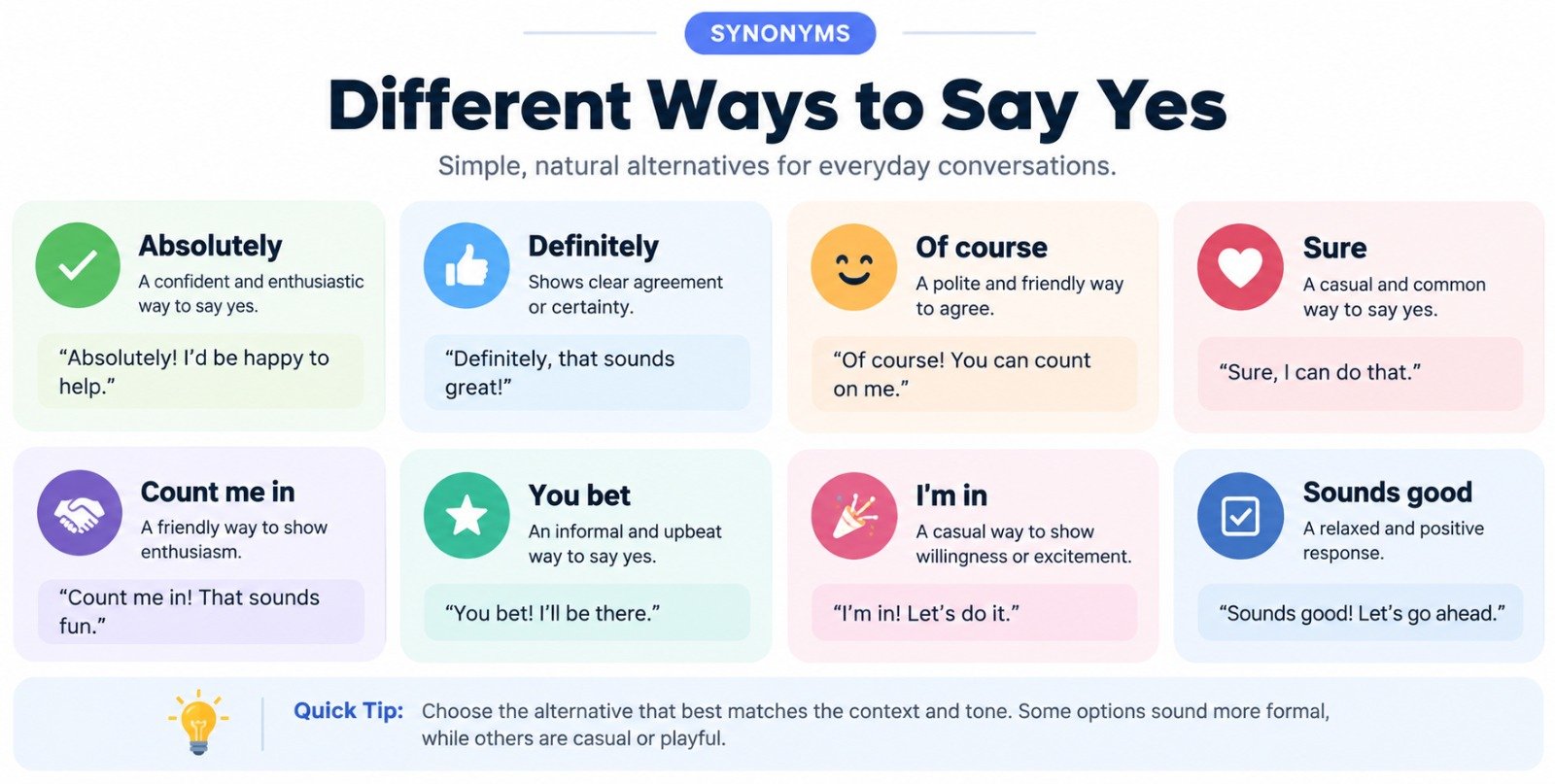
Saying “yes” is simple, but sometimes a plain yes does not quite express what you mean. You may want to sound enthusiastic, polite, professional, playful, or more natural in a conversation. The good news is that English has plenty of different ways to say yes, and each expression carries its own tone.
From everyday options such as “sure” and “sounds good” to more enthusiastic responses such as “absolutely” and “count me in,” the right choice depends on the situation. Below, you’ll find useful ways to say yes, including funny ways to say yes and other natural alternatives you can use in conversations, emails, texts, and professional settings.
Different Ways to Say Yes at a Glance
Not every alternative to “yes” means exactly the same thing. Some show strong agreement, while others communicate willingness, acceptance, enthusiasm, or participation.
| Expression | Tone | Best Used For |
|---|---|---|
| Absolutely | Enthusiastic | Strong agreement |
| Certainly | Polite/Formal | Requests and professional situations |
| Of course | Warm/Friendly | Agreeing or giving permission |
| Definitely | Confident | Strong confirmation |
| Sure | Casual | Everyday conversation |
| Sounds good | Casual | Accepting a suggestion |
| I agree | Neutral | Opinions and ideas |
| I’d be happy to | Polite | Requests and offers |
| Count me in | Friendly | Invitations and activities |
| I’m on board | Casual/Professional | Supporting a plan |
| By all means | Formal/Polite | Giving permission |
| Consider it done | Confident | Agreeing to complete something |
| Heck yes! | Very Casual | Excited agreement |
| Say no more | Playful | Immediate agreement |
| I’m sold | Casual | Being convinced by an idea |
Other Ways to Say Yes in Everyday Conversation
When you’re talking with friends, family members, classmates, or coworkers, you usually don’t need a formal expression. Natural conversational phrases work best.
Other Ways to Say Yes Casually
- Sure.
- Yeah.
- Yep.
- Yup.
- Definitely.
- For sure.
- Totally.
- You bet.
- Sounds good.
- No problem.
- Absolutely.
- Why not?
- I’m in.
- Deal.
- You got it.
For example:
“Want to grab coffee after work?”
“Sure, sounds good.”
Or:
“Are you coming with us?”
“Definitely. I’m in.”
“Sure” is one of the easiest replacements for “yes,” but its tone can change depending on how it is delivered. In a text message, it is usually casual and friendly. In a professional email, a more specific response such as “Certainly” or “I’d be happy to” can sound more polished.
Other Ways to Say Yes Politely
Sometimes you want to agree without sounding too casual. These expressions are especially useful when responding to requests.
Polite Ways to Say Yes
Certainly
A polite and slightly formal way to agree to a request.
“Could you send me the updated document?”
“Certainly. I’ll send it this afternoon.”
Of course
Warm and natural when you are happy to help or give permission.
“Can I borrow your notes?”
“Of course.”
By all means
A courteous way to give permission or encourage someone to proceed.
“May I take a closer look?”
“By all means.”
I’d be happy to
A friendly and professional way to show willingness.
“Could you help me review this?”
“I’d be happy to.”
I’d be glad to
Similar to “I’d be happy to,” with a warm and cooperative tone.
“Would you like me to arrange the meeting?”
“I’d be glad to.”
Other Ways to Say Yes Professionally
A professional “yes” often needs to communicate more than agreement. It may confirm a decision, accept a proposal, or show that you are ready to take action.
Professional Alternatives to Yes
- Certainly.
- Absolutely.
- I agree.
- Agreed.
- I’m happy to proceed.
- That works for me.
- I’m on board.
- I can confirm that.
- That sounds good.
- I’m comfortable with that.
- I’d be happy to proceed.
- That’s acceptable.
- I’m willing to proceed.
- Consider it done.
Consider the difference between these responses:
“Yes, I agree.”
and
“That works for me. I’m happy to proceed.”
The second response gives the reader more information about your position and sounds more natural in many workplace situations.
However, “I’m on board” is more conversational than formal, while “I concur” is formal and can sound stiff in ordinary workplace communication. Choosing the right phrase is more important than simply choosing the most sophisticated-sounding synonym.
Other Ways to Say Yes in an Email
Email requires a little more care because the same word can sound different in writing than it does in conversation.
Instead of simply writing “Yes,”, you can say:
- Certainly.
- Absolutely.
- I’d be happy to.
- That works for me.
- I agree with this approach.
- I’m happy to move forward.
- That sounds good to me.
- I can confirm that.
- I’d be glad to help.
- We can proceed with that.
Example
Instead of:
“Yes, Tuesday works.”
Try:
“Tuesday works well for me. I’m happy to proceed.”
For a client or manager, a slightly more complete response can prevent your message from sounding abrupt.
Other Ways to Say Yes When You Agree
Sometimes “yes” means that you agree with someone’s opinion rather than that you accept a request.
In these situations, use expressions such as:
- I agree.
- Absolutely.
- Exactly.
- Definitely.
- That’s right.
- I think so too.
- You’re absolutely right.
- I couldn’t agree more.
- I’m with you on that.
- I feel the same way.
- That’s a good point.
For example:
“I think we should leave earlier to avoid traffic.”
“I agree. That sounds like a good idea.”
Here, “I agree” is more precise than some alternatives because it clearly responds to an opinion or suggestion.
Different Ways to Say Yes Enthusiastically
A simple “yes” can show agreement, but sometimes you want to make your excitement obvious.
Enthusiastic Alternatives
- Absolutely!
- Definitely!
- Heck yes!
- I’m all in!
- Count me in!
- I’d love to!
- Let’s do it!
- I’m totally in!
- You bet!
- Without a doubt!
- That sounds amazing!
- I wouldn’t miss it!
- I’m game!
- Let’s go for it!
- 100%!
For example:
“Do you want to come to the concert with us?”
A neutral answer:
“Yes.”
An enthusiastic answer:
“Absolutely! I wouldn’t miss it.”
The second response communicates genuine excitement rather than simple acceptance.
Funny Ways to Say Yes
If the conversation is relaxed, a humorous response can make your agreement more memorable. These funny ways to say yes work best with people who understand your sense of humor.
Funny Ways to Say Yes
- Heck yes!
- Why the heck not?
- Say no more.
- You got me.
- I’m sold.
- Count me in twice.
- Take my yes!
- Big thumbs up!
- That’s a yes from me.
- You win.
- Where do I sign?
- Put me down for a yes.
- Let’s make questionable decisions!
- My answer is officially yes.
- Permission granted!
- I surrender—yes!
- Absolutely. No further questions.
- You don’t have to ask me twice.
- Consider me convinced.
- A very enthusiastic yes.
For example:
“Want to order pizza instead of cooking?”
“Heck yes. My kitchen is officially closed.”
Humorous expressions depend heavily on context. A phrase that makes a friend laugh could sound unprofessional in a business email, so keep playful alternatives for appropriate situations.
Creative Ways to Say Yes
You don’t always need a direct synonym. Sometimes an expression that implies agreement sounds more natural.
Creative Alternatives to Yes
Count me in
Shows that you want to participate.
“We’re going hiking Saturday.”
“Count me in!”
I’m sold
Means that someone has convinced you.
“The new restaurant has great reviews.”
“I’m sold. Let’s go.”
Sign me up
An energetic way to show that you want to participate.
“We’re taking a weekend cooking class.”
“Sign me up!”
You’ve got yourself a deal
Useful when agreeing to an arrangement or proposal.
“I’ll help you move if you buy dinner.”
“You’ve got yourself a deal.”
Consider it done
Shows that you agree to complete a task.
“Could you send this before noon?”
“Consider it done.”
Let’s make it happen
Shows enthusiasm and willingness to move forward.
“Should we start the project next week?”
“Absolutely. Let’s make it happen.”
Other Ways to Say Yes to an Invitation
Accepting an invitation often calls for a warmer response than simply saying “yes.”
Casual Invitation
“Want to come over Saturday?”
You could say:
- “Sure!”
- “I’m in!”
- “Absolutely!”
- “I’d love to!”
- “Count me in!”
- “Sounds good!”
Formal Invitation
“We would be delighted if you could attend the event.”
A suitable response could be:
“Thank you for the invitation. I’d be delighted to attend.”
For an invitation, “I’d love to” communicates enthusiasm, while “I can attend” is more neutral and practical.
Ways to Say Yes in Text Messages
Texting gives you more freedom to be brief, informal, or playful.
Natural Texting Responses
- Yep!
- Yup!
- Yeah!
- Sure!
- For sure!
- Absolutely!
- Totally!
- Deal!
- Done!
- I’m in!
- Let’s go!
- Sounds good!
- Bet!
- Say less!
- Heck yes!
The best choice depends on who you’re texting. “Bet” and “say less” are highly informal and fit some modern casual conversations, but they are not suitable replacements for “yes” in formal writing.
Ways to Say Yes Without Actually Saying “Yes”
Sometimes you can communicate agreement without using the word at all.
Try:
- Sounds good.
- That works for me.
- I’m in.
- Count me in.
- Let’s do it.
- Absolutely.
- I’d love to.
- Go ahead.
- You’ve got a deal.
- I’m on board.
- Consider it done.
- That’s fine with me.
- I’m happy with that.
- Let’s make it happen.
These expressions are especially useful when you want your response to sound more conversational or specific.
Which Alternative to “Yes” Should You Choose?
The best alternative depends on what you’re agreeing to.
If someone asks for a favor, “Certainly” or “I’d be happy to” works well.
If you’re agreeing with an opinion, “I agree,” “Exactly,” or “You’re absolutely right” is more appropriate.
If you’re accepting an invitation, “I’d love to,” “Count me in,” or “I’m in” sounds natural.
If you’re agreeing to a plan, “Sounds good,” “That works for me,” or “Let’s do it” may be better.
If you want to show excitement, choose “Absolutely!” “Definitely!” or “Heck yes!”
And if you’re joking with friends, something like “Where do I sign?” or “Why the heck not?” can add personality.
The key is to match the phrase to the relationship, situation, and level of enthusiasm.
Common Mistakes When Replacing “Yes”
Not every phrase that communicates agreement can be substituted for “yes” in every sentence.
“I Agree” vs. “I Accept”
I agree usually means you share someone’s opinion or support an idea.
“I agree with your suggestion.”
I accept usually means you are accepting an offer, proposal, invitation, or condition.
“I accept your offer.”
“Certainly” vs. “Sure”
Certainly is more polite and formal.
“Certainly, I can help with that.”
Sure is generally more casual.
“Sure, I can help.”
“Absolutely” vs. “Definitely”
Both can express strong agreement, but they aren’t always interchangeable.
Absolutely can sound like enthusiastic confirmation or strong agreement.
“Would you like to join us?”
“Absolutely!”
Definitely often emphasizes certainty.
“Are you coming tomorrow?”
“Definitely.”
“Count Me In” vs. “I Agree”
Count me in means you want to participate.
“We’re having a game night Friday.”
“Count me in!”
It does not simply mean that you agree with an opinion.
50 Different Ways to Say Yes
Here is a quick reference list you can save for future conversations:
- Yes, absolutely.
- Certainly.
- Of course.
- Definitely.
- Sure.
- Sure thing.
- For sure.
- You bet.
- Absolutely.
- Indeed.
- Agreed.
- I agree.
- I accept.
- By all means.
- Without a doubt.
- I’d be happy to.
- I’d be glad to.
- That works for me.
- Sounds good.
- I’m on board.
- Count me in.
- I’m in.
- I’m all in.
- I’m game.
- I’m all for it.
- Sign me up.
- I’m sold.
- You got it.
- Deal.
- Done.
- Consider it done.
- Let’s do it.
- Let’s go for it.
- Let’s make it happen.
- You’ve got yourself a deal.
- I wouldn’t miss it.
- I’d love to.
- Totally.
- Yep.
- Yup.
- Heck yes!
- Why the heck not?
- Say no more.
- Take my yes!
- Big thumbs up!
- Where do I sign?
- You win.
- That’s a yes from me.
- Put me down for a yes.
- You don’t have to ask me twice.
Frequently Asked Questions
What are some different ways to say yes?
Some natural alternatives include absolutely, certainly, of course, definitely, sure, sounds good, I agree, count me in, I’m in, and I’d be happy to. The best choice depends on the situation and tone you want.
What are other ways to say yes professionally?
For professional communication, try certainly, absolutely, I agree, that works for me, I’m happy to proceed, I can confirm that, or I’d be happy to. These usually sound more polished than very casual responses such as “yep” or “yeah.”
What are some funny ways to say yes?
Funny options include “heck yes,” “why the heck not?”, “say no more,” “where do I sign?”, “take my yes,” “you win,” and “count me in twice.” Use these with friends or in other relaxed situations rather than formal communication.
How do you say yes without saying yes?
You can say “sounds good,” “that works for me,” “I’m in,” “count me in,” “let’s do it,” “I’d love to,” “you’ve got a deal,” or “consider it done.” These expressions communicate agreement without using the actual word “yes.”
What is a polite way to say yes?
Certainly, of course, by all means, I’d be happy to, and I’d be glad to are polite choices. They work particularly well when responding to requests or offering assistance.
What is a casual way to say yes?
Common casual options include sure, yeah, yep, yup, totally, for sure, sounds good, you bet, and I’m in. The choice depends on how informal you want to sound.
What is an enthusiastic way to say yes?
Try absolutely, definitely, heck yes, I’m all in, count me in, I’d love to, let’s do it, or I wouldn’t miss it when you want to make your excitement clear.
Is “sure” another way to say yes?
Yes, “sure” can mean yes in casual conversation, especially when accepting a request or suggestion. However, it can sometimes sound less enthusiastic than “absolutely” or “definitely.”
Is “absolutely” stronger than “yes”?
Usually, yes. “Absolutely” often communicates strong agreement or enthusiasm rather than simple confirmation. For example, “Yes, I’ll come” is neutral, while “Absolutely, I’ll come!” sounds more enthusiastic.
Conclusion
There are plenty of different ways to say yes, but the most natural choice depends on what you are agreeing to and who you are talking to. Use certainly or I’d be happy to when you need a polite response, sounds good or I’m in for casual situations, and absolutely or count me in when you want more enthusiasm. Save the funny ways to say yes for relaxed conversations where humor fits naturally.
Good communication is not just about finding another word; it is about choosing the expression that matches your meaning, audience, and tone. Grammarifyr makes these small differences easier to understand, helping you choose words that sound natural in the situation you are actually in.
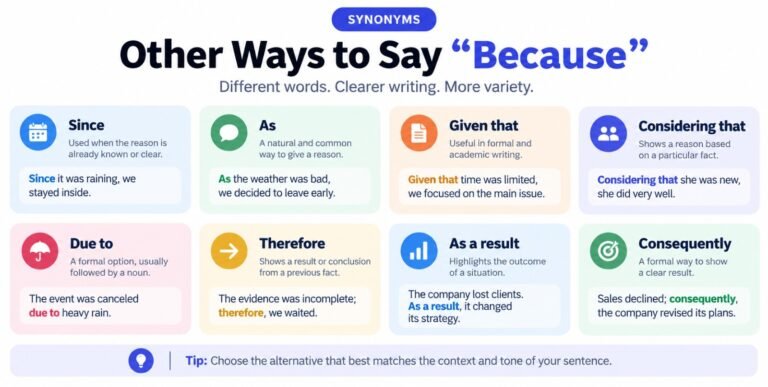
You may also Read : Other Ways to Say “Because”: 25 Natural Alternatives for Better Writing
One Comment