Other Ways to Say Good Luck: 40+ Natural Phrases for Every Situation
“Good luck” is simple, friendly, and perfectly natural, but it is not the only way to wish someone success. Depending on the situation, you may want to sound more professional, encouraging, funny, warm, or confident. The best alternative is the one that matches the person, occasion, and tone.
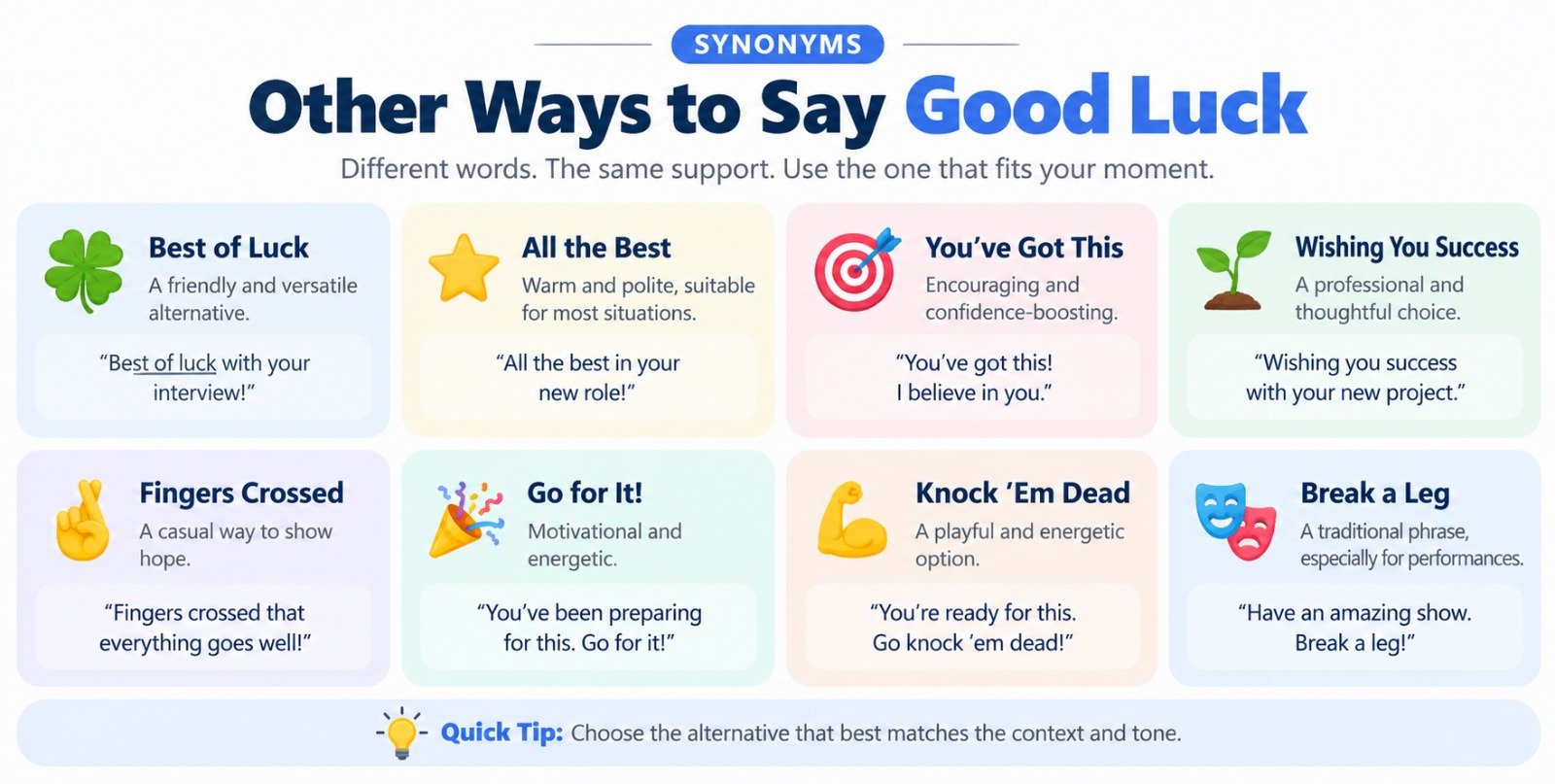
Here are some of the most useful other ways to say good luck, with examples to help you choose the right expression.
Quick Comparison: Other Ways to Say Good Luck
| Phrase | Tone | Best Used For |
|---|---|---|
| Best of luck | Warm, neutral | Almost any situation |
| All the best | Polite, warm | Messages, farewells, work |
| Wishing you success | Professional | Work, exams, major goals |
| You’ve got this | Encouraging | Friends, exams, interviews |
| I’m rooting for you | Supportive | Friends and family |
| Fingers crossed | Casual | Uncertain outcomes |
| Hope it goes well | Natural, friendly | Everyday situations |
| Go for it! | Motivational | Challenges and opportunities |
| Break a leg | Playful, traditional | Performances |
| Knock ’em dead | Energetic | Performances or presentations |
| Go crush it! | Casual, confident | Sports, work, challenges |
| Wishing you all the best | Polite, warm | Professional or personal messages |
Not all of these expressions mean exactly the same thing. For example, “wishing you success” focuses on the desired result, while “you’ve got this” expresses confidence in the person’s ability. “Break a leg” is an idiom traditionally associated with performances and should not be treated as a universal replacement for “good luck.”
Other Ways to Say Good Luck
Best of Luck
“Best of luck” is probably the closest natural alternative to “good luck.” It is friendly, concise, and suitable for many situations.
Example:
“Best of luck with your interview tomorrow!”
All the Best
“All the best” is warm and versatile. It works especially well at the end of a message when someone is starting something new.
Example:
“All the best in your new position!”
Wishing You the Best
This phrase sounds thoughtful without being overly formal. It works for friends, coworkers, classmates, and family members.
Example:
“Wishing you the best as you start your new adventure.”
Wishing You Success
“Wishing you success” puts the focus directly on achievement. It is particularly useful in professional or academic situations.
Example:
“Wishing you success with your new project.”
I Hope Everything Goes Well
This is a natural alternative when you want to express genuine concern and support rather than simply mention luck.
Example:
“I hope everything goes well at your appointment tomorrow.”
You’ve Got This
“You’ve got this” is less about luck and more about confidence. It tells someone that you believe they are capable of succeeding.
Example:
“You’ve studied hard for this exam. You’ve got this!”
I’m Rooting for You
This is warm and personal. It tells someone that you are actively supporting them and hoping they succeed.
Example:
“I know how much this opportunity means to you. I’m rooting for you!”
Fingers Crossed
“Fingers crossed” expresses hope that something will turn out well. It is casual and often used when the outcome is uncertain.
Example:
“Fingers crossed that you get the job!”
Hope It Goes Well
This is one of the easiest alternatives to use in everyday conversation. It sounds natural and sincere.
Example:
“Good luck with your presentation. I hope it goes well!”
Do Your Best
“Do your best” focuses on effort rather than the outcome. It can be encouraging, although its tone depends on the situation and relationship.
Example:
“Don’t worry about being perfect. Just do your best.”
Professional Ways to Say Good Luck
In a workplace email or professional message, “good luck” is not wrong. However, a more specific phrase can sound polished and thoughtful.
Wishing You Every Success
This is a formal and respectful choice for professional communication.
Example:
“Wishing you every success in your new role.”
I Wish You Great Success
This sounds more formal and works well in professional notes, congratulations, or messages about an important goal.
Example:
“I wish you great success with the launch.”
Best Wishes for Your Presentation
This option is useful when you know exactly what the person is preparing for.
Example:
“Best wishes for your presentation tomorrow.”
Wishing You All the Best in Your New Role
This works particularly well when a colleague is changing positions or starting a new job.
Example:
“Wishing you all the best in your new role. I’m sure you’ll do well.”
I Hope Everything Goes Smoothly
Instead of focusing on luck, this phrase expresses the hope that a professional event will proceed successfully.
Example:
“I hope everything goes smoothly with the client meeting.”
Best of Luck With Your Interview
“Best of luck” is still completely appropriate at work when the message is friendly and straightforward.
Example:
“Best of luck with your interview tomorrow. I’m sure you’ll make a great impression.”
Friendly and Casual Ways to Say Good Luck
When talking to friends, you can be more relaxed and expressive.
You’ll Do Great
This is a simple way to reassure someone that you expect them to succeed.
Example:
“Don’t stress about the presentation. You’ll do great.”
Go for It!
“Go for it!” encourages someone to take an opportunity or give something their best effort.
Example:
“You’ve been thinking about applying for months. Go for it!”
Go Get ’Em!
This energetic phrase is usually used to motivate someone before a challenge, competition, or important event.
Example:
“Your team has worked hard all season. Go get ’em!”
Give It Your Best Shot
This means to make your strongest effort.
Example:
“Give it your best shot and don’t worry about the result.”
I Believe in You
This is more personal than simply wishing someone luck. It shows confidence in the person’s ability.
Example:
“You’ve prepared for this for weeks, and I believe in you.”
You’re Going to Nail It
“You’re going to nail it” is an informal way to say that you expect someone to perform extremely well.
Example:
“You know the material inside out. You’re going to nail it.”
Motivational Ways to Say Good Luck
Sometimes the person does not need luck as much as they need encouragement.
Go Crush It!
“Go crush it!” is energetic and informal. It works well with friends, teammates, and coworkers you know well.
Example:
“Big presentation today? Go crush it!”
Knock It Out of the Park
This expression means to perform exceptionally well. It is especially natural in American English and is often used for presentations, projects, performances, and other challenges.
Example:
“You’ve prepared an excellent presentation. Go knock it out of the park!”
Show Them What You Can Do
This phrase encourages someone to demonstrate their skills and confidence.
Example:
“You’ve worked hard for this opportunity. Go show them what you can do.”
Make It Happen
“Make it happen” is direct and motivational. It focuses on taking action rather than waiting for luck.
Example:
“You’ve got the opportunity now. Make it happen!”
Believe in Yourself
This is useful when someone is nervous or lacks confidence.
Example:
“You’re more prepared than you think. Believe in yourself.”
Funny and Playful Ways to Say Good Luck
Humorous expressions work best when you know the person will appreciate the joke.
Break a Leg
“Break a leg” is a traditional idiom used to wish performers success, particularly before a theater performance. It does not literally mean that you want someone to get injured.
Example:
“You’re going on stage in five minutes. Break a leg!”
Because of its strong association with performance, it is not necessarily the best choice for every situation.
Knock ’Em Dead
“Knock ’em dead” is an energetic and playful way of telling someone to impress an audience.
Example:
“You’re ready for the presentation. Go knock ’em dead!”
May the Odds Be in Your Favor
This humorous expression refers to uncertain competition and is often used playfully.
Example:
“Your interview starts in ten minutes. May the odds be in your favor!”
Don’t Mess It Up!
With a close friend, this can be a funny way to show encouragement. However, it can sound rude or discouraging with someone you do not know well.
Example:
“Your big audition is today. Don’t mess it up!”
The relationship matters here: what sounds funny between close friends could sound insulting in a professional message.
Other Ways to Say Good Luck on a Test or Exam
Before an exam, phrases that build confidence often sound more helpful than simply saying “good luck.”
You’ve Got This
“Take a deep breath. You’ve got this.”
Do Your Best
“Don’t panic. Read each question carefully and do your best.”
I Know You’ll Do Great
“You studied consistently all week. I know you’ll do great.”
Believe in Yourself
“You’re prepared for this exam, so believe in yourself.”
Give It Your Best Shot
“Give it your best shot and don’t let one difficult question throw you off.”
For a teacher or formal academic message, “Wishing you success on your exam” may sound more appropriate than a highly casual phrase such as “Go crush it!”
Other Ways to Say Good Luck in an Interview
An interview can be stressful, so supportive language is often more useful than a generic wish.
Best of Luck With Your Interview
“Best of luck with your interview this afternoon!”
I’m Rooting for You
“I know this job means a lot to you. I’m rooting for you!”
You’ll Do Great
“You’ve prepared really well. You’ll do great.”
I Hope It Goes Well
“I hope it goes well today. Let me know how it goes!”
Wishing You Success
“Wishing you success in your interview and whatever comes next.”
Other Ways to Say Good Luck Before a Performance
Performances have their own traditional expressions.
Break a Leg
This is the classic performance-related expression.
Example:
“Have fun out there, and break a leg!”
Knock ’Em Dead
This is more energetic and playful.
Example:
“You’ve rehearsed this a hundred times. Knock ’em dead!”
Go Shine
“Go shine” is a warm, modern encouragement that focuses on confidence.
Example:
“The stage is yours. Go shine!”
Give It Everything You’ve Got
This encourages maximum effort and enthusiasm.
Example:
“Enjoy the performance and give it everything you’ve got!”
Other Ways to Say Good Luck Before a Competition or Game
For sports and competitions, energetic language usually works best.
- Go get ’em!
- Go crush it!
- Bring it home!
- Give it your all!
- Play your best!
- You’ve got this!
- Show them what you can do!
- I’m rooting for you!
- Give it everything you’ve got!
- Knock it out of the park!
Example:
“Your team has trained for this moment all season. Go get ’em!”
Other Ways to Say Good Luck in a Text
Text messages usually call for short, natural phrases. You do not need something overly formal.
Try:
- “You’ve got this!”
- “Go for it!”
- “You’ll do great!”
- “Fingers crossed!”
- “I’m rooting for you!”
- “Go crush it!”
- “Best of luck!”
- “Hope it goes well!”
- “You’re going to nail it!”
- “I believe in you!”
For example:
Friend: “I’m about to walk into my interview.”
You: “You’ve got this! I’m rooting for you.”
That sounds warmer and more personal than simply repeating “Good luck!”
How to Choose the Right Alternative
The best expression depends on who you are speaking to, what they are doing, and how close you are to them.
For a professional email, choose something such as “Wishing you every success” or “Best wishes for your presentation.”
For a close friend, “You’ve got this,” “I’m rooting for you,” or “Go crush it!” may feel more natural.
For a performance, “Break a leg” or “Knock ’em dead” can work because these expressions have a strong performance-related or playful association.
For an exam, “You’ll do great,” “Do your best,” or “I believe in you” can provide reassurance and confidence.
The key is not to find a perfect synonym. It is to choose wording that communicates the kind of support you actually want to give.
Common Mistakes to Avoid
Using “Break a Leg” in Every Situation
“Break a leg” is best known as a performance-related idiom. It may sound strange if you use it in a serious business email or before an ordinary appointment.
Using Very Casual Slang With Professional Contacts
“Go crush it!” can sound encouraging among friends or familiar coworkers, but it may be too informal for a client or senior executive.
Confusing Luck With Encouragement
“You’ve got this” does not literally wish someone luck. Instead, it expresses confidence in their ability. That difference makes it powerful, but it is not interchangeable with every use of “good luck.”
Overthinking a Simple Message
You do not always need an elaborate phrase. “Best of luck!” is natural, polite, and appropriate in a huge range of situations.
Frequently Asked Questions
What is another way to say “good luck”?
Some of the most natural alternatives are “best of luck,” “all the best,” “wishing you success,” “you’ve got this,” “I’m rooting for you,” and “hope it goes well.” The best choice depends on the situation and your relationship with the person.
What is a professional way to say “good luck”?
For professional communication, try “wishing you every success,” “wishing you all the best,” “best wishes for your presentation,” or “I wish you great success.” These options work well in emails, workplace messages, and formal notes.
What is a friendly way to say “good luck”?
Friendly options include “you’ve got this,” “you’ll do great,” “I’m rooting for you,” “go for it,” and “go crush it.” These phrases sound supportive and natural in conversations with friends.
Is “break a leg” another way to say “good luck”?
Yes, but it is a contextual expression. “Break a leg” is traditionally associated with wishing performers success, especially before a theater performance. It is not the best universal substitute for “good luck.”
What can I say instead of “good luck” in a text?
For a text message, short expressions usually work best. Try “You’ve got this!”, “Fingers crossed!”, “Go for it!”, “I’m rooting for you!”, “You’ll do great!”, or “Hope it goes well!”
What is a motivational way to say good luck?
Try “You’ve got this,” “Go crush it,” “Give it your best shot,” “Believe in yourself,” “Show them what you can do,” or “Make it happen.” These phrases focus on confidence and effort rather than luck alone.
What is a good way to wish someone luck before an exam?
“You’ve got this,” “Do your best,” “I believe in you,” “You’ll do great,” and “Wishing you success on your exam” are all useful choices. For a close friend, a more casual phrase may feel warmer.
Final Thoughts
There are plenty of natural other ways to say good luck, but the strongest choice depends on the moment. Use a polished expression such as “wishing you every success” in professional communication, a supportive phrase such as “you’ve got this” with friends, and a playful idiom such as “break a leg” when the context calls for it.
The goal is not simply to replace two words with two different words. Good communication means choosing an expression that fits the person, occasion, relationship, and emotion behind your message. That is the kind of wording guidance Grammarifyr aims to make clear, so you can choose the right words for every situation.
You may also Read : 30 Ways to Say Sorry for Your Loss: Heartfelt Alternatives for Every Situation