Compair or Compare: Meaning and Correct Usage
It is easy to see why compair and compare can cause confusion. They sound almost identical when spoken aloud, and the ending of compare can sound like “pair.” However, when you are writing standard English, there is a clear answer. The correct spelling is compare. The form compair is generally a spelling mistake when the intended word is the verb compare. Understanding the meaning, pronunciation, and related forms can make this spelling much easier to remember.
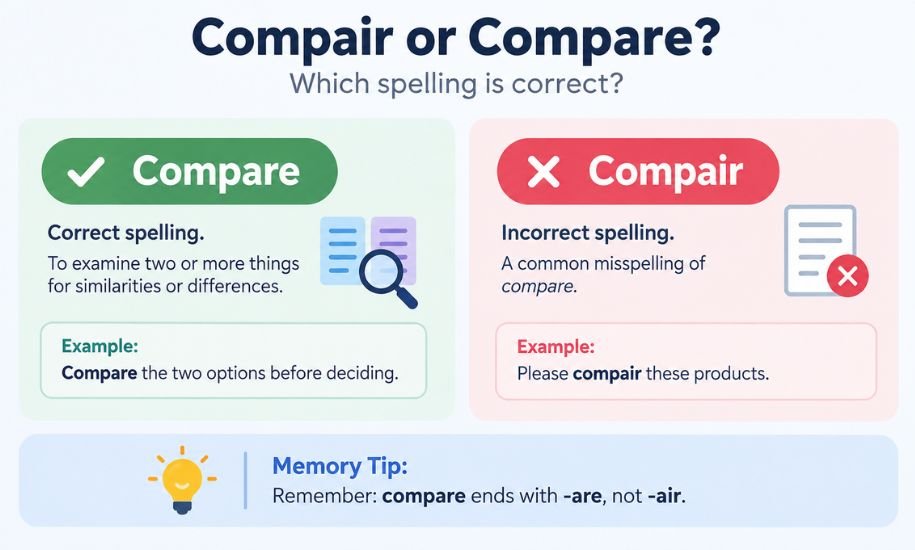
Compare is the correct spelling in standard English. Compair is a misspelling when you mean “to examine two or more things for similarities and differences.” The correct word is spelled with -are, not -air.
Compair or Compare: Which Is Correct?
The correct form is compare.
Compare is a standard English verb. It means to examine two or more people, things, ideas, or situations to identify their similarities, differences, qualities, or relative value.
Compair, on the other hand, is not the standard spelling of this verb. If you write compair when you mean compare, it should be corrected.
| Word | Standard spelling? | Meaning | Example |
|---|---|---|---|
| Compare | Yes | Examine things for similarities or differences | Compare the two options before deciding. |
| Compair | No, as the spelling of this verb | Usually a misspelling of compare | ❌ Please compair these products. |
So, if you are deciding between compair or compare, choose compare.
What Does “Compare” Mean?
Compare is a verb. It describes the process of examining two or more things in relation to each other.
You might compare things because you want to discover:
- how they are alike
- how they are different
- which is better for a particular purpose
- how their qualities or characteristics differ
For example:
- Compare the prices before you buy anything.
- The teacher asked us to compare the two poems.
- We should compare both proposals carefully.
- Can you compare these two laptops for me?
The word can be used in many everyday, academic, and professional situations.
Compare in Different Contexts
The object being compared can be almost anything.
People:
It is difficult to compare two athletes from different generations.
Products:
We compared the features of three different phones.
Ideas:
The essay compares two approaches to education.
Experiences:
She compared her new job with her previous position.
In each example, compare involves putting things side by side mentally or directly and considering their relationship.
Is “Compair” a Real Word?
When compair is used as an attempted spelling of the verb compare, it is considered a misspelling in standard English.
It should not be used in formal writing, school assignments, professional documents, or other situations where standard spelling is expected.
For example:
Incorrect:
Please compair the two reports.
Correct:
Please compare the two reports.
There is one important qualification: CompAir can appear as a proper name or brand name. That does not make compair an alternative spelling of the ordinary English verb. When you mean the act of examining two things, the word you need is compare.
Why Are “Compair” and “Compare” Confused?
The main source of confusion is pronunciation.
Compare is commonly pronounced approximately like kuhm-PAIR. The final sound therefore resembles the English word pair, which is spelled -air.
Someone who relies heavily on pronunciation when spelling may naturally write:
com + pair = compair
But English spelling does not always follow pronunciation exactly. In this case, the correct spelling is:
com + pare = compare
The spelling compare needs to be learned as a whole rather than reconstructed from the way the word sounds.
Compare: Correct Usage Examples
Here are several examples showing how the correct spelling works in natural sentences:
- Compare the two plans before choosing one.
- We need to compare the results with last year’s figures.
- The article compares two different approaches.
- She compared the prices at several stores.
- The students are comparing the characters in the two novels.
- It is useful to compare different sources before reaching a conclusion.
Notice how the spelling remains based on compar- in its different grammatical forms.
Compare Word Forms
| Form | Example |
|---|---|
| Base form | compare |
| Third-person singular | compares |
| Past tense | compared |
| Past participle | compared |
| Present participle | comparing |
| Noun | comparison |
| Adjective | comparable |
For example:
We compare the products.
She compares the products.
We compared the products yesterday.
They are comparing the products now.
This pattern can help reinforce the correct spelling.
Correct vs. Incorrect Sentences
Seeing the two forms side by side makes the difference straightforward.
Correct
Let’s compare the two offers.
Incorrect
Let’s compair the two offers.
Correct
You should compare the ingredients before buying the products.
Incorrect
You should compair the ingredients before buying the products.
Correct
The report compares the performance of both companies.
Incorrect
The report compairs the performance of both companies.
The incorrect versions reflect the same spelling error: replacing the -are ending with -air.
Compare vs. Contrast
Although compare and contrast are related, they are not always interchangeable.
Compare can involve both similarities and differences.
The report compares the two educational systems.
This could mean that the report discusses what the systems have in common as well as how they differ.
Contrast usually puts greater emphasis on differences.
The report contrasts the two educational systems.
A simple way to remember the distinction is:
- Compare = examine things in relation to one another.
- Contrast = emphasize differences between things.
This distinction is particularly useful in academic writing, where an assignment may specifically ask you to “compare and contrast” two subjects.
Compare To or Compare With?
Both compare to and compare with are established constructions, although they can carry slightly different emphases.
Compare to is often used when one thing is likened to another:
The poet compared her smile to sunshine.
Compare with is often used when two things are examined side by side:
The researcher compared the new results with the earlier results.
In actual modern English, the distinction is not absolute. Context determines which construction sounds most appropriate.
The important point for the spelling question is that both begin with compare, never compair.
Other Ways to Say “Compare”
Depending on your sentence, several words can express a similar idea. They are not exact replacements in every context, but they can be useful alternatives.
Contrast
Use this when emphasizing differences.
The study contrasts rural and urban lifestyles.
Evaluate
Use this when judging quality, effectiveness, or value.
We need to evaluate the two proposals.
Examine
Use this when looking at something carefully.
The report examines the two possible solutions.
Assess
Use this when determining the quality, importance, or effectiveness of something.
The committee assessed both applications.
Analyze
Use this when examining something in detail.
The researchers analyzed the results of both experiments.
Differentiate
Use this when identifying distinctions between things.
The guide explains how to differentiate between the two varieties.
The best choice depends on what you actually want to communicate. Compare remains the natural general-purpose word when you are examining things in relation to each other.
An Easy Way to Remember the Spelling
A simple memory trick is to remember that compare contains pare, not pair.
Think of:
compare → pare
The ending is -are:
compare
It is not:
compair
You can also remember some related forms:
- compare
- compared
- comparing
- comparison
- comparable
They all begin with compar-.
If you are unsure, write compare and then check whether the rest of the sentence makes sense.
Common Mistakes to Avoid
1. Writing “compair”
This is the most direct error.
❌ We need to compair the results.
✅ We need to compare the results.
2. Writing “compairs”
Adding an s does not make the misspelling correct.
❌ She compairs the prices.
✅ She compares the prices.
3. Writing “compaired”
The past-tense form is compared, not compaired.
❌ They compaired the two products.
✅ They compared the two products.
4. Writing “compairing”
The correct present participle is comparing.
❌ We are compairing the options.
✅ We are comparing the options.
5. Assuming spelling should match pronunciation
English contains many words whose spelling cannot be predicted perfectly from pronunciation. Compare is one example. Hearing “pair” at the end does not mean the word should be spelled with -air.
Frequently Asked Questions
Is “compair” or “compare” correct?
Compare is correct when you mean to examine two or more things for similarities, differences, or relative qualities. Compair is normally a misspelling of compare and should not be used as the spelling of this verb in standard English.
Is “compair” a word?
Compair is not the standard spelling of the English verb compare. However, CompAir may occur as a proper name or brand. That specific use should not be confused with the ordinary English word compare.
How do you spell compare correctly?
The correct spelling is C-O-M-P-A-R-E: compare. A useful reminder is that it ends in -are, not -air.
What is the past tense of compare?
The past tense and past participle are both compared.
She compared the two reports.
Not compaired.
What is the difference between compare and contrast?
Compare means to examine things in relation to each other, including similarities and differences. Contrast generally focuses more specifically on differences.
How can I remember the spelling?
Remember compare contains pare: com + pare. The final part is spelled -are, even though the word’s pronunciation sounds similar to “pair.”
Final Verdict: Compair or Compare?
When you mean to examine two or more things and consider their similarities, differences, or qualities, the correct spelling is compare. Compair is a spelling error in this context, largely encouraged by the way compare sounds when spoken. Remember com + pare = compare, and you will have an easy way to avoid the mistake. For more clear explanations of confusing English words and spellings, Grammarifyr helps you know the difference and use the right words.
You may also Read : Ves or Vez: Meaning and Differences Explained
One Comment