Man or Men: Meaning and Usage Explained
English learners often hesitate over man and men because the two words look almost identical, yet they are used differently. The distinction is simple once you connect each form with the number of people being described. Man is the singular form, while men is its irregular plural. Knowing when to use each also helps you choose the correct article, demonstrative, and verb in a sentence. Let’s look at the difference with clear rules and practical examples.
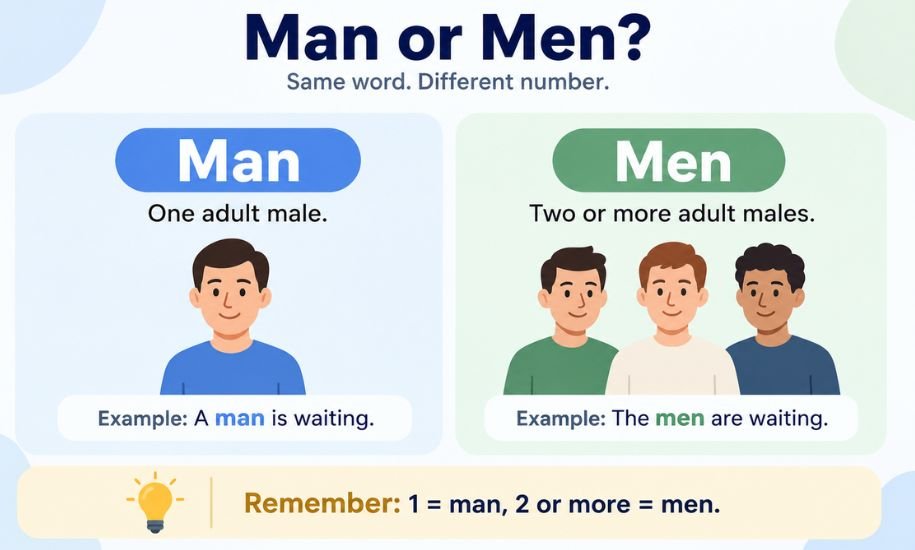
Man refers to one adult male, while men refers to two or more adult males. For example, “A man is waiting outside” is singular, while “Three men are waiting outside” is plural. The plural form is irregular: man → men, not “mans.”
Man vs. Men: The Key Difference
The main difference is number.
| Word | Number | Meaning | Example |
|---|---|---|---|
| man | Singular | One adult male | A man is sitting there. |
| men | Plural | Two or more adult males | The men are sitting there. |
So, if you are talking about one person, use man. If you are talking about more than one, use men.
- One man arrived early.
- Two men arrived early.
- Several men were waiting.
- A man called this morning.
This is why the choice between the two is a matter of grammatical number rather than spelling preference.
What Does “Man” Mean?
Man is a singular countable noun that normally means one adult male human being.
Because it is singular and countable, it can be used with a, an does not apply here because man begins with a consonant sound, or other singular determiners such as the, this, that, or each.
Examples:
- A man is standing near the entrance.
- The man in the blue jacket is my uncle.
- That man works at the library.
- Each man received a separate ticket.
Notice that the singular form can also affect the verb:
The man is waiting.
Not:
The man are waiting.
The noun man takes singular verbs such as is, was, and has when it functions as a singular subject.
What Does “Men” Mean?
Men is the irregular plural of man. It refers to two or more adult males.
Examples:
- The men are talking outside.
- Three men entered the room.
- Several men volunteered to help.
- Those men work together.
Because men is plural, it does not normally take a or an directly before it.
Correct:
A man is waiting.
Correct:
Two men are waiting.
Incorrect:
A men is waiting.
The plural noun also requires a plural verb:
The men are waiting.
Not:
The men is waiting.
Why Are Man and Men Confused?
The two forms are easy to confuse because their spellings are very similar. The difference is just one vowel letter, but the grammatical number changes completely.
English has many irregular plurals that do not simply add -s or -es:
- man → men
- woman → women
- child → children
- foot → feet
- tooth → teeth
A learner who expects every plural noun to end in -s might incorrectly write mans. That form is not the standard plural of man.
The same irregular pattern also means that you cannot determine the correct form just by adding or removing a letter. You need to know whether the noun is singular or plural.
When Should You Use “Man”?
Use man when referring to one adult male.
With “a”
I saw a man at the station.
With “the”
The man you met yesterday is my neighbor.
With “this” or “that”
This man helped me find the address.
That man is the store manager.
With “one”
One man answered the question.
In each case, the noun refers to a single individual.
When Should You Use “Men”?
Use men when referring to two or more adult males.
With numbers
Two men were repairing the road.
Five men attended the meeting.
With quantity words
Several men joined the discussion.
Many men have worked on the project.
With plural demonstratives
These men are members of the same team.
Those men live nearby.
You can also use men without a determiner when speaking generally:
Men and women can experience different social expectations.
The context determines whether the word refers to a particular group or men generally.
Is It “Man or Men” in a Sentence?
The correct choice depends on the number you mean.
Compare these sentences:
A man is walking toward the house.
This describes one person.
Two men are walking toward the house.
This describes two people.
Another useful pair is:
The man was wearing a black coat.
The men were wearing black coats.
The change from man to men also changes was to were because the subject changes from singular to plural.
A simple test
Ask yourself:
How many?
- One → man
- More than one → men
For example:
- One → man
- Two → men
- Ten → men
- Several → men
- Many → men
This quick test solves most cases.
“A Man” or “Men”?
The phrase a man is correct when you mean one adult male.
A man called while you were away.
The word a is a singular indefinite article, so it must be followed by a singular countable noun.
You cannot normally say:
A men called while you were away. ❌
Instead, if there is more than one person, use a plural expression:
Two men called while you were away.
Several men called while you were away.
The men called while you were away.
This is one of the most common errors involving the two forms.
Common Grammar Mistakes
1. Using “mans” as the plural
Incorrect:
Three mans were standing outside.
Correct:
Three men were standing outside.
Men is the standard plural form.
2. Using “a” before “men”
Incorrect:
I spoke with a men yesterday.
Correct:
I spoke with a man yesterday.
Or, if you mean multiple people:
I spoke with two men yesterday.
3. Using a singular verb with “men”
Incorrect:
The men is working outside.
Correct:
The men are working outside.
Because men is plural, it normally takes plural verb forms.
4. Using “man” after a plural number
Incorrect:
Four man entered the building.
Correct:
Four men entered the building.
A number greater than one normally requires the plural noun.
5. Mixing “this” and “these”
Incorrect:
These man are my colleagues.
Correct:
These men are my colleagues.
These is plural, so it needs the plural noun men.
Man, Men, Man’s, and Men’s
Possessive forms can create another layer of confusion.
For one man, the singular possessive is man’s:
The man’s car is parked outside.
This means the car belongs to one man.
For multiple men, the plural possessive is men’s:
The men’s uniforms were delivered.
Here, the uniforms belong to or are associated with multiple men.
Compare:
- one man → the man’s jacket
- several men → the men’s jackets
Because men is an irregular plural that does not end in -s, its possessive form takes ’s.
Pronunciation: Man vs. Men
Pronunciation can also help distinguish the words.
- man has the vowel sound found in words such as cat and map.
- men has the vowel sound found in words such as pen and bed.
So although the spelling is similar, the vowel sounds are different.
This can be particularly helpful for English learners who encounter the words in conversation before seeing them written down.
An Easy Way to Remember the Difference
Use this simple number rule:
1 = man
2+ = men
Think of the pair as:
one man → two men
You can also remember a few examples together:
- a man
- one man
- two men
- several men
- many men
If the sentence contains a, one, this, or that, a singular noun is usually required, so man is likely to be the correct form. If it contains two, several, many, these, or those, men is generally appropriate.
Frequently Asked Questions
Is “men or man” correct?
Both man and men are correct words, but they have different grammatical uses. Man is singular and refers to one adult male, while men is plural and refers to two or more adult males.
Is it men or man for one person?
Use man for one person. For example, “One man was waiting outside” is correct. Men should be used when referring to more than one adult male.
Is it man or men after “a”?
Use man after a: a man. The phrase a men is incorrect in standard English because a is a singular indefinite article and men is plural.
What is the men or man meaning?
Man generally means one adult male human being, while men is the plural form referring to two or more adult males. The two words therefore differ primarily in grammatical number.
What is the plural of man?
The plural of man is men. It is an irregular plural, so the standard form is not mans. For example, “one man” becomes “three men.”
What is the difference between man’s and men’s?
Man’s is the singular possessive form, referring to one man, while men’s is the plural possessive form, referring to multiple men. For example, “the man’s hat” refers to one man, while “the men’s hats” refers to multiple men.
The Bottom Line
The man or men difference comes down to singular and plural number. Use man for one adult male and men for two or more. Remember one man, two men, and you will have the basic rule covered. For more clear explanations of confusing English forms, Grammarifyr follows the same goal: Know the Difference. Use the Right Words.
You may also Read : Fulfil or Fulfill: British and American English
One Comment