Cacoon or Cocoon: Meaning and Difference
It is easy to hesitate over cacoon or cocoon, especially because the two spellings look and sound similar. If you are talking about the protective covering associated with a developing moth or another insect, cocoon is the word you need. However, there is an interesting exception: cacoon is also a real, very uncommon English word, but it refers to a tropical bean or seed rather than an insect covering. Knowing this small distinction can help you choose the right spelling in context.
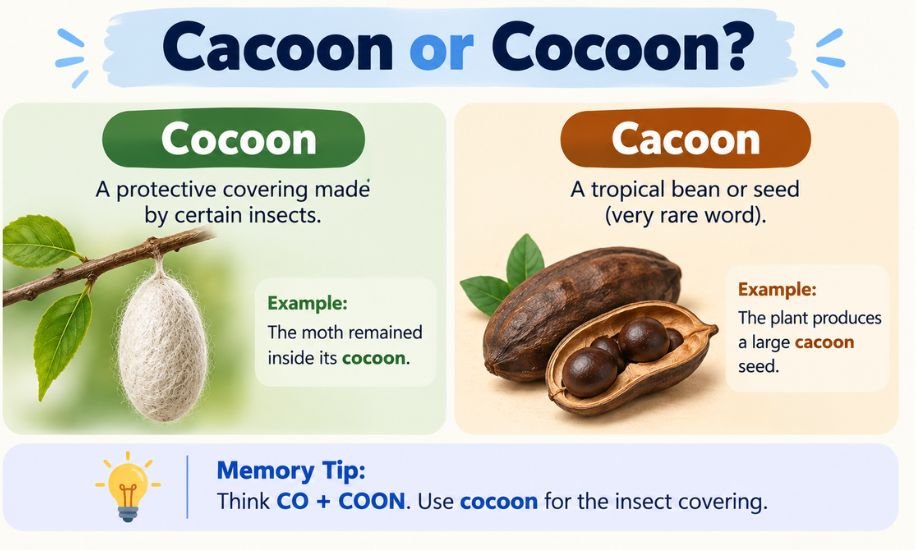
Cocoon is the correct spelling when you mean the protective covering made by certain insects during development. Cacoon is a separate and very rare word referring to a tropical bean or seed, but it is often used mistakenly when someone means “cocoon.”
Cocoon or Cacoon: What’s the Difference?
The two words have different meanings, even though cacoon is sometimes written accidentally in place of cocoon.
| Feature | Cocoon | Cacoon |
|---|---|---|
| Standard word? | Yes | Yes, but rare |
| Main meaning | Protective covering made by certain insects | A tropical bean or seed |
| Common use | Insects, moths, figurative protection | Botanical context |
| Related to butterfly development? | Sometimes discussed, although butterflies form chrysalises | No |
| Common everyday English? | Yes | No |
| Example | The moth emerged from its cocoon. | The cacoon is a large tropical seed. |
So, if your sentence is about a moth, caterpillar, insect, or protective covering, use cocoon.
What Does “Cocoon” Mean?
Cocoon is a noun that generally refers to a protective covering produced by certain insect larvae before or during their pupal stage.
Many moth caterpillars create cocoons from silk or other materials. Inside this protective structure, the insect undergoes an important stage of development.
For example:
- The caterpillar spun a cocoon on a tree branch.
- The moth remained inside its cocoon while developing.
- We found an empty cocoon in the garden.
- The insect eventually emerged from the cocoon.
The word also has a figurative meaning. A person, place, or situation can be described as a cocoon when it provides a feeling of protection, comfort, or isolation.
For example:
The quiet bedroom became a cozy cocoon during the storm.
In this use, there is no actual insect or silk covering. The word is being used metaphorically to describe a protected environment.
Is “Cacoon” a Real Word?
Yes, but this is where the spelling comparison gets more interesting.
Cacoon is a legitimate but extremely uncommon English noun. Dictionaries such as Collins record it as the name for a large bean or seed associated with a tropical climbing plant, particularly Entada scandens.
This meaning has little connection with the familiar word cocoon.
For example:
The tropical plant produces a large cacoon seed.
Because this botanical meaning is uncommon, most people who write cacoon in an ordinary sentence about insects are probably intending to write cocoon.
That means it would be inaccurate to say that cacoon is simply “not a word.” It is a word, but it is not the normal word for an insect’s protective covering.
Why Do People Confuse These Spellings?
The confusion is understandable because only one vowel separates the two spellings:
cacoon
cocoon
When someone hears the word rather than sees it written, the first unstressed vowel can be difficult to identify. This can lead to an incorrect spelling.
There is also a visual reason for the mistake. English contains many words whose vowel patterns are not immediately predictable from pronunciation, so writers sometimes choose the spelling that seems natural to them.
For everyday writing, however, the distinction is straightforward:
Insect covering → cocoon
Rare tropical seed → cacoon
Cocoon Pronunciation
The standard pronunciation of cocoon is represented in dictionaries as /kəˈkuːn/.
The main stress falls on the second syllable.
cocoon
kəˈkuːnAdd to flashcards
Give feedback
The pronunciation is another reason spelling mistakes can occur. The first vowel is relatively weak, so someone unfamiliar with the written form may not immediately know whether the word begins with ca- or co-.
Cocoon and Butterfly: Are They the Same Thing?
A common question involves cocoon and butterfly terminology.
Although people sometimes talk about a “butterfly cocoon,” butterflies generally form a chrysalis, rather than a silk cocoon.
A chrysalis is the pupa of a butterfly. Many moth caterpillars, on the other hand, create a silk cocoon around their pupal stage.
A simple way to distinguish them is:
- Butterfly → chrysalis
- Many moths → cocoon
- Pupa → developmental stage
This does not mean that the word cocoon can never appear in a general discussion of butterflies. In casual language, people may use it broadly. But if you are describing butterfly biology precisely, chrysalis is the more accurate term for the butterfly’s pupal structure.
Correct and Incorrect Examples
Seeing the word in context makes the distinction easier.
When you mean an insect covering
Correct: The caterpillar built a cocoon beneath the leaf.
Incorrect for this meaning: The caterpillar built a cacoon beneath the leaf.
More examples
- The moth spent several days inside its cocoon.
- A small cocoon was attached to the branch.
- The children watched the insect emerge from its cocoon.
- The gardener discovered several cocoons among the plants.
When “cacoon” has its rare botanical meaning
Cacoon can be used when referring to the tropical bean or seed described by dictionaries.
For example:
The researcher identified the plant’s large cacoon seed.
This is a specialized use and is unlikely to occur in ordinary conversation or general writing.
An Easy Way to Remember the Correct Spelling
If you are talking about an insect’s protective covering, remember:
COCOON has two “CO” parts: CO + COON.
Think:
Caterpillar → COCOON
That simple association can help prevent the common cacoon spelling mistake.
Another useful rule is to ask yourself what you are describing.
If the answer is an insect’s protective covering, choose cocoon.
If you genuinely mean the rare tropical seed, then cacoon may be the appropriate word.
Common Mistakes to Avoid
1. Treating “cacoon” as the standard spelling
In ordinary writing about insects, cacoon should not replace cocoon.
Write:
The moth emerged from its cocoon.
Not:
The moth emerged from its cacoon.
2. Saying that “cacoon” never exists
This is a different kind of mistake. Although rare, cacoon has a dictionary-recognized botanical meaning.
Therefore, it is better to say that it is rare and usually not the word intended in insect-related contexts, rather than claiming that it is universally incorrect.
3. Calling every butterfly pupa a cocoon
Butterflies develop inside chrysalises. The term cocoon is more specifically associated with protective coverings spun by many moth larvae and certain other insects.
4. Assuming similar spellings mean similar meanings
The difference between the first vowels is small, but the meanings are completely different in their standard uses.
How to Choose the Right Word
When writing an article, school assignment, email, or general piece of text, use this quick decision guide:
Are you talking about a moth or insect’s protective covering?
→ Use cocoon.
Are you describing a comfortable or protective environment figuratively?
→ Use cocoon.
Are you specifically referring to the rare tropical bean or seed?
→ Cacoon may be correct.
Are you describing a butterfly’s pupal stage?
→ Chrysalis is generally the more precise term.
This makes the choice much easier than simply memorizing one spelling and calling the other wrong.
Frequently Asked Questions
Is “cacoon” or “cocoon” correct?
Cocoon is correct when you mean the protective covering made by certain insects. Cacoon is also a real but rare word for a tropical bean or seed, so its status depends on the intended meaning.
What is the meaning of cocoon?
A cocoon is a protective covering made by certain insect larvae, especially many moth caterpillars, around their pupal stage. The word can also describe a person or place that provides a feeling of protection, comfort, or isolation.
Is cacoon a word?
Yes. Cacoon is a rare English noun referring to a large tropical bean or seed associated with certain climbing plants. It should not normally be used as an alternative spelling for the insect-related word cocoon.
How do you spell the insect covering?
The correct spelling is cocoon, with an o after the initial c: C-O-C-O-O-N.
Is a butterfly’s covering called a cocoon?
Usually, no. A butterfly develops inside a chrysalis, while many moth caterpillars form a cocoon around their pupal stage. In casual conversation, however, people sometimes use “cocoon” more broadly.
What is the easiest way to remember cocoon?
Remember that the word contains “co” twice: CO + COON. If you are talking about the protective covering associated with a moth or other insect, cocoon is the spelling to use.
The Bottom Line
For ordinary writing, cocoon is the word you need when referring to an insect’s protective covering. Cacoon is not simply a misspelling—it is a rare botanical noun for a tropical seed—but it does not have the same everyday meaning. If you’re checking spelling for an insect-related sentence, choose cocoon. Grammarifyr helps make distinctions like this clearer so you can know the difference and use the right words.
You may also Read : Totalling or Totaling: British and American English
One Comment