Access or Acess: Correct Spelling and Usage
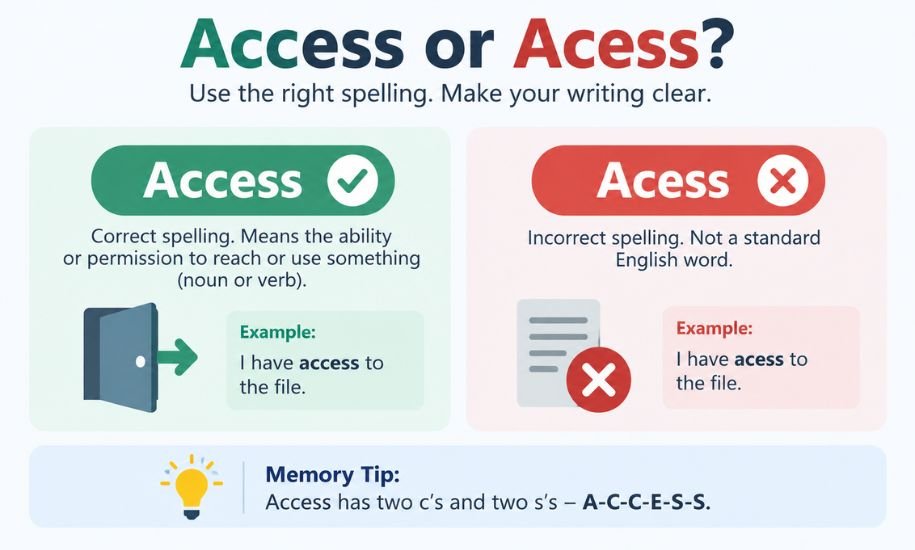
If you have ever hesitated between “Access or Acess”, the answer is straightforward: access is the correct spelling. The form “acess” is a spelling mistake, not an alternative English word. The confusion usually happens because the word contains repeated letters, making it easy to leave out one of the two c’s when writing or typing it. Understanding the correct spelling is only the first step, however, because access can also be used as both a noun and a verb, with slightly different grammar patterns.
Access is the correct spelling, while acess is incorrect in standard English. “Access” can mean the ability or permission to reach or use something when it is a noun, and it can mean to reach or use something when it is a verb.
Access or Acess: The Correct Form
The correct spelling is:
Access ✅
The incorrect spelling is:
Acess ❌
The standard spelling contains two c’s and two s’s:
A-C-C-E-S-S
There is no American-versus-British spelling difference here. Both American English and British English use access.
| Feature | Access | Acess |
|---|---|---|
| Correct spelling? | Yes ✅ | No ❌ |
| Standard English word? | Yes | No |
| Can be a noun? | Yes | No |
| Can be a verb? | Yes | No |
| Example | “I have access to the files.” | “I have acess to the files.” ❌ |
If you are writing an email, essay, website, report, application, or any other formal text, always use access.
What Does “Access” Mean?
The word access has several related meanings, but they all involve the idea of reaching, entering, obtaining, or using something.
As a noun, access commonly means the ability, opportunity, permission, or means to reach or use something.
For example:
- Employees have access to the company database.
- The building provides wheelchair access.
- Students need access to reliable educational resources.
- I was given access to the private folder.
In these examples, access refers to the opportunity or ability to use or reach something.
As a verb, access means to reach, open, obtain, or use something.
For example:
- I can access my account online.
- She accessed the document yesterday.
- You can access the files from your computer.
- The technician accessed the system remotely.
This noun-and-verb distinction is particularly important when choosing whether to use access to or simply access.
Access as a Noun
When access functions as a noun, it is frequently followed by to.
The basic pattern is:
access + to + something
Examples include:
- access to information
- access to education
- access to healthcare
- access to the internet
- access to a building
- access to an account
Consider these sentences:
The students have access to the online library.
We need access to the main entrance.
She was denied access to the records.
In each case, access is a noun describing the ability or permission to reach or use something.
Access as a Verb
Access can also function as a verb. In this form, it normally takes its object directly.
The pattern is:
access + object
For example:
I can access the website.
He accessed the file.
They accessed the information.
You can access your account using your password.
Notice that to is not placed between the verb and its object.
Therefore:
Correct: I can access the website. ✅
Incorrect: I can access to the website. ❌
This is one of the most important grammar points associated with this word. People sometimes add to because they are familiar with the noun phrase access to, but the construction changes when the word is used as a verb.
Is “Acess” a Real Word?
No. Acess is not the standard spelling of an English word meaning permission, entry, or ability to use something.
It is simply a misspelling of access.
For example:
Incorrect:
The employee has acess to the database.
Correct:
The employee has access to the database.
Likewise:
Incorrect:
You can acess the account online.
Correct:
You can access the account online.
There is no separate definition that needs to be assigned to “acess.” If you see it in ordinary English writing, it should normally be corrected to access.
Why Do People Write “Acess”?
The error is easy to understand because access has consecutive repeated letters.
The correct spelling is:
AC + C + ESS
When writing quickly, someone may remember the general sound of the word but omit one of the two c’s, producing acess.
Other incorrect variations can also occur, such as:
- acces ❌
- acsess ❌
- acess ❌
The safest form to remember is:
ACCESS ✅
It has CC in the middle and ends with SS.
Access or Acess Spelling: An Easy Way to Remember
A simple memory trick is:
Access = Double C + Double S
Break the word into two parts:
AC + C + ESS
Or simply remember:
CC + SS
So when you are unsure whether the word contains one or two c’s, remember that access has two c’s.
You can also connect the spelling to the idea of a connection or channel to something. The spelling itself is the important part, though: access, never acess, in standard English.
Access From or Access Of?
Another related question concerns the prepositions used with access.
The most common construction when identifying something that can be reached or used is:
access to
For example:
We need access to the building.
Everyone should have access to accurate information.
She has access to the company’s records.
The phrase access from can also be correct, but it serves a different purpose. From can identify the location, route, device, or source through which something is reached.
For example:
The building has access from the main road.
You can access the account from your phone.
Here, from tells us where the access originates or through what route or device it occurs.
What About “Access Of”?
Access of is generally not the normal construction when you mean the ability or permission to use something.
For example:
Incorrect:
Employees have access of the database. ❌
Correct:
Employees have access to the database. ✅
However, this does not mean that the individual words access and of can never appear next to each other in English. The issue is that of normally should not replace to in the standard construction expressing availability or permission.
A useful rule is:
Access to something = ability or permission to reach or use it.
Access from somewhere = the route, location, source, or means through which it can be reached.
Examples of Correct Usage
Seeing the word in different grammatical contexts makes the distinction easier.
As a noun
The students have access to the new computers.
The hotel offers easy access to the beach.
We were given access to the records.
The building has disabled access.
As a verb
Please access the document before the meeting.
She accessed her account from her laptop.
Users can access the service at any time.
The administrator accessed the system to make the necessary changes.
With “from”
You can access the website from any device.
The property has direct access from the main street.
These examples demonstrate why context matters more than simply memorizing one phrase.
Common Mistakes to Avoid
1. Writing “Acess”
Acess is a misspelling.
❌ Acess to information
✅ Access to information
2. Using only one “c”
The correct spelling contains cc.
❌ Aces
❌ Acess
✅ Access
3. Adding “to” after the verb
When access is a verb, the object follows directly.
❌ I need to access to the website.
✅ I need to access the website.
4. Using “of” instead of “to”
When access is a noun describing permission or ability to use something, to is normally the correct preposition.
❌ access of the files
✅ access to the files
5. Assuming it is a British/American spelling difference
It isn’t. Access is the standard spelling in both major varieties of English.
How to Choose the Right Construction
A quick test can help.
If you mean the ability or permission to use something, use:
access to
I have access to the database.
If you mean the action of reaching or using something, use access as a verb:
I can access the database.
If you want to identify where or through what something can be reached, from may be appropriate:
I can access the database from my laptop.
This simple distinction prevents many grammatical errors.
Frequently Asked Questions
Is “acess” or “access” correct?
Access is correct. Acess is a misspelling and should not be used in standard English. The correct form contains two c’s and two s’s: access.
What is the definition of access?
As a noun, access means the ability, opportunity, permission, or means to reach or use something. As a verb, it means to reach, open, obtain, or use something.
Is access a noun or a verb?
It can be both. As a noun, we commonly say “access to information.” As a verb, we say “access the information.” The grammar changes depending on how the word functions in the sentence.
Do you say “access to” or “access of”?
For the usual meaning of having the ability or permission to use something, access to is correct.
She has access to the files.
“Access of” should not normally be used as a substitute for “access to.”
Is “access from” grammatically correct?
Yes, depending on the sentence. “From” can indicate the route, location, device, or source through which something is accessed.
You can access the account from your phone.
How can I remember the spelling?
Remember ACCESS = double C + double S. If you see acess with only one c, it is missing a letter. Writing the word as A-C-C-E-S-S can help reinforce the correct spelling.
Final Verdict: Access or Acess?
The correct choice is access. The spelling acess is an error, not an accepted alternative. Remember that the word contains two c’s and two s’s, and pay attention to its grammatical role: use access to when it is a noun, but use access directly with an object when it is a verb. For more clear explanations of confusing English words and correct usage, Grammarifyr follows the simple principle: know the difference and use the right words.
You may also Read : Inact or Enact: Meaning, Spelling and Usage
One Comment