Weird or Wierd: Meaning, Spelling, and Examples
Have you ever wondered whether the correct spelling is wierd or weird? These two versions look almost identical, so it is easy to mix up the letters when writing quickly. However, only one is the standard spelling used in modern English. The confusion often comes from the familiar spelling rule “I before E,” which makes the incorrect version seem reasonable. Understanding the correct spelling, its meaning, and a simple way to remember it can help you avoid this mistake in everyday writing, schoolwork, emails, and professional documents.
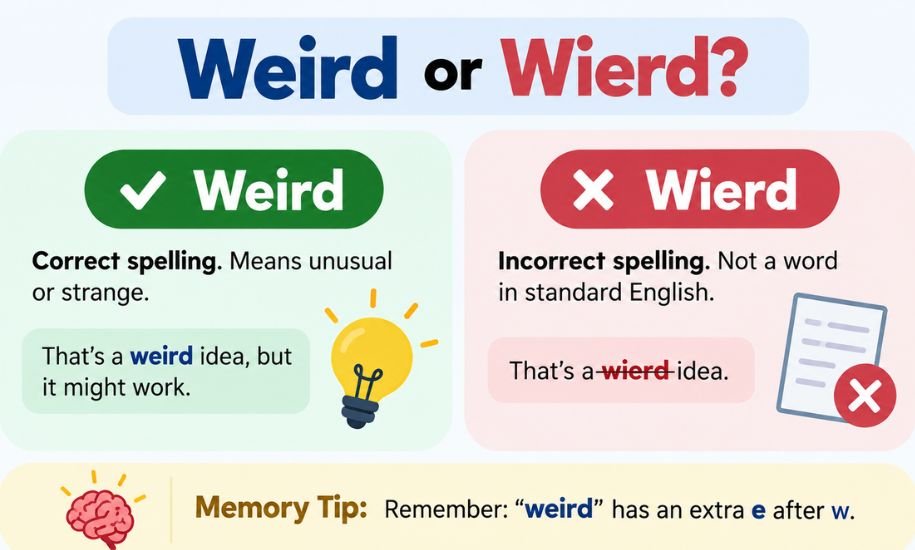
Weird is the correct spelling in modern standard English. Wierd is a common misspelling and should generally be avoided in formal and everyday writing. The word weird means strange, unusual, unexpected, or sometimes mysterious.
Wierd or Weird: What’s the Difference?
The main difference is spelling, not meaning. If you want to describe something strange or unusual, you should write weird, with the E before the I.
| Feature | Weird | Wierd |
|---|---|---|
| Correct spelling | Yes | No, in modern standard English |
| Meaning | Strange or unusual | No separate standard meaning |
| Part of speech | Primarily an adjective | Not a standard alternative |
| Formal writing | Acceptable | Should be avoided |
| Example | That was a weird dream. | That was a wierd dream. |
Weird is the spelling to use in essays, articles, messages, reports, and other forms of writing. Although the incorrect version may appear in informal online conversations, that does not make it the standard form.
What Does Weird Mean?
The adjective weird describes something that is unusual, unexpected, strange, or different from what people normally experience. Depending on the situation, it can communicate curiosity, surprise, discomfort, or even fear.
For example, a strange noise coming from an empty room might sound weird. An unexpected coincidence might feel weird, while an unusual fashion choice could be described as weird in a playful way.
Here are some natural examples:
- The lights started flickering, and we heard a weird noise upstairs.
- I had a weird dream about walking through an empty city.
- It felt weird to return to my old school after ten years.
- She has a weird sense of humour that makes everyone laugh.
- There was something weird about the way the stranger behaved.
The meaning depends on context. Calling something weird does not always mean it is bad. It can simply mean that it is different from what someone expects.
What Does It Mean to Call Someone Weird?
A weird person is someone perceived as unusual, unconventional, or different from what others consider normal. The description might refer to their behaviour, interests, sense of humour, appearance, or way of thinking.
For example:
- My friend collects unusual objects, but I think that makes him interesting rather than weird.
- He sometimes says unexpected things, so people consider him a little weird.
- She enjoys unusual hobbies and proudly describes herself as weird.
The word can sound insulting if it is used to judge or mock someone. In a friendly conversation, however, it may express affection or appreciation for someone’s individuality. Words such as quirky, unconventional, or unique can be more positive alternatives.
Why Is Weird Spelled With EI Instead of IE?
One reason writers make this mistake is the familiar spelling rule: “I before E except after C.”
This rule appears to work in words such as believe, field, and chief. As a result, people may naturally write wierd because they expect the I to come before the E.
However, the rule has exceptions, and English spelling cannot always be predicted by a single pattern. Weird is one of the words you need to remember separately.
Compare these examples:
- Believe — I comes before E.
- Field — I comes before E.
- Chief — I comes before E.
- Weird — E comes before I.
The correct spelling is W-E-I-R-D. Remembering the actual letter sequence is more reliable than applying the general rule to every word.
How to Pronounce Weird
The word weird has one syllable. Its pronunciation varies slightly between British and American English.
- British English: /wɪəd/
- American English: /wɪrd/
For many speakers, the word sounds similar to “weerd.” You can listen to both regional pronunciations using the Cambridge Dictionary pronunciation guide.
Pronunciation can help you recognise the word when listening, but it does not tell you which letters to write. Since the incorrect spelling looks plausible, it is useful to learn the spelling and pronunciation together.
Correct and Incorrect Examples in Sentences
The easiest way to understand the difference is to see how the word works in everyday writing.
| Incorrect sentence | Correct sentence |
|---|---|
| That was a wierd thing to say. | That was a weird thing to say. |
| I had a wierd dream last night. | I had a weird dream last night. |
| This place feels wierd. | This place feels weird. |
| He has a wierd sense of humour. | He has a weird sense of humour. |
| Something wierd happened yesterday. | Something weird happened yesterday. |
In every example, the correction involves changing the letter order. The meaning and grammatical role remain the same.
Here are a few additional examples showing different uses:
Describing a situation: “It was weird that nobody answered the phone.”
Describing a feeling: “I felt weird after missing my usual morning routine.”
Describing an object: “We found a weird-looking sculpture in the garden.”
Describing an experience: “Meeting someone with exactly the same birthday was a weird coincidence.”
These examples show that weird can describe people, objects, feelings, events, and situations.
Synonyms for Weird
If you want to avoid repeating weird in your writing, several alternatives can express similar ideas. The best choice depends on the meaning you want to communicate.
| Synonym | Meaning or tone | Example |
|---|---|---|
| Strange | Unfamiliar or unexpected | I heard a strange sound. |
| Odd | Not usual or normal | There is something odd about this message. |
| Unusual | Different from what is typical | She has an unusual hobby. |
| Peculiar | Distinctively strange | He noticed a peculiar smell. |
| Bizarre | Extremely unusual | It was a bizarre coincidence. |
| Eerie | Mysterious or unsettling | The empty house looked eerie. |
| Uncanny | Strangely surprising or mysterious | She has an uncanny ability to remember faces. |
| Quirky | Unusual in an interesting or charming way | He has a quirky sense of humour. |
These words have slightly different shades of meaning. For example, eerie often suggests fear or uneasiness, while quirky is frequently positive. Choose the word that best matches the situation rather than treating every synonym as interchangeable.
Is Wierd Ever a Correct Word?
In modern standard English, wierd is generally considered a misspelling of weird. It does not have a separate, commonly accepted meaning that makes it interchangeable with the correct spelling.
You may occasionally encounter the sequence wierd in historical material, names, usernames, or deliberately altered spellings. Such appearances do not mean it is the correct choice for ordinary English prose.
There is also a historical detail worth knowing: older forms and variants related to weird existed in the history of English. The word itself is connected to the Old English wyrd, meaning fate or destiny. However, this historical background does not change the spelling expected in contemporary standard English.
For school assignments, business writing, published articles, and formal communication, use weird.
An Easy Way to Remember the Correct Spelling
A practical memory trick is to focus on the unusual letter order in W-E-I-R-D.
Instead of trying to apply “I before E” every time, memorise weird as one complete spelling. You can also practise it alongside a short sentence:
- Weird spelling, unusual meaning.
- That is a weird idea.
- I had a weird dream.
Another useful habit is to pause when typing the word. Check that the E comes immediately after the W and before the I. A quick spelling check can prevent the same mistake from appearing repeatedly in your writing.
Frequently Asked Questions
1. Is it wierd or weird?
Weird is correct in modern standard English. Wierd is a common spelling mistake. Whenever you want to describe something strange, unusual, or unexpected, write weird.
2. What is the meaning of weird?
Weird means strange, unusual, unexpected, or sometimes mysterious. It can describe an experience, feeling, object, person, or situation. Depending on the context, it may have a negative, neutral, humorous, or positive tone.
3. Why isn’t weird spelled wierd?
English has many exceptions to the “I before E” spelling rule. Although wierd may look logical, the accepted modern spelling is weird. Remembering the exact letter sequence is the simplest way to avoid the error.
4. Is weird spelled differently in British and American English?
No. Both British and American English use weird. The pronunciation can differ between the two varieties, but the spelling remains the same.
5. What is a synonym for weird?
Common synonyms include strange, odd, unusual, peculiar, bizarre, and uncanny. If you want a more positive description of someone or something unusual, quirky may be a better choice.
6. Is weird an adjective or a noun?
Weird is primarily an adjective, as in “a weird experience.” Related forms include weirdly, an adverb, and weirdness, a noun. The word also has historical connections to fate or destiny, but its everyday modern use is mainly adjectival.
Final Verdict: Weird Is the Correct Spelling
When choosing between these two spellings, remember to write weird, not wierd. The word describes something strange, unusual, or unexpected, and its spelling is the same in British and American English. Memorising W-E-I-R-D will help you avoid this common mistake in everyday communication. At Grammarifyr, our goal is simple: to help you understand confusing words, improve your spelling, and choose the right words with confidence.
You may also Read : Apologize or Apologise? Spelling and Grammar Guide

One Comment