Scrapped or Scraped: Meaning and Usage Explained
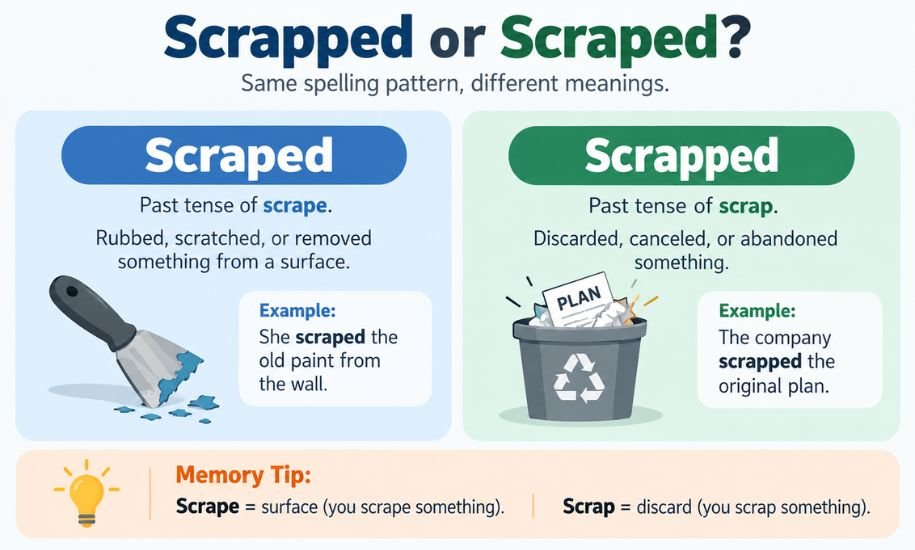
It is easy to mix up scrapped and scraped. They look almost identical, but they come from two different verbs and describe very different actions. Scraped is the past tense of scrape, while scrapped is the past tense of scrap. One usually involves rubbing, scratching, or removing something from a surface; the other commonly means abandoning, discarding, or getting rid of something. Understanding the base verbs makes the distinction much easier to remember.
Scraped and scrapped are both correct words, but they have different meanings. Scraped comes from scrape and usually means rubbed, scratched, or removed from a surface. Scrapped comes from scrap and usually means discarded, canceled, or abandoned.
Scraped vs. Scrapped: The Key Difference
The easiest way to distinguish these words is to look at their base verbs.
| Word | Base verb | Main meaning | Example |
|---|---|---|---|
| scraped | scrape | rubbed, scratched, or removed | I scraped my knee. |
| scrapped | scrap | discarded, canceled, or abandoned | The company scrapped the project. |
So, if something comes into contact with a surface and gets rubbed or removed, scraped is generally the right choice.
If something is abandoned, discarded, or broken up, scrapped is generally appropriate.
Compare these sentences:
- She scraped the mud off her boots.
- She scrapped her original plan.
The first sentence describes removing something. The second describes abandoning something.
What Does “Scraped” Mean?
Scraped is the past tense and past participle of scrape.
The verb scrape has several related meanings. It can describe rubbing against a surface, removing material from something, or causing a minor injury through friction.
For example:
- He scraped the ice from the windshield.
- I scraped my elbow on the wall.
- She scraped the burnt food from the bottom of the pan.
- The shovel scraped against the concrete.
In each case, there is an idea of contact, friction, scratching, or removal.
Scraped can also have other meanings
The word is not limited to physical surfaces. English also uses scrape in expressions such as scrape by, meaning to manage or succeed with difficulty.
We barely scraped through the final round.
In computing, scrape can also mean to extract information from a website or another digital source.
The program scraped publicly available product information from several websites.
Thus, the central idea behind scraped is not simply “damaged.” It can involve rubbing, removing, gathering, or extracting, depending on context.
What Does “Scrapped” Mean?
Scrapped is the past tense and past participle of scrap.
As a verb, scrap commonly means to discard something, abandon an idea or plan, or decide that something is no longer going to be used.
For example:
- The team scrapped the original design.
- The council scrapped the proposal.
- They scrapped the damaged vehicle.
- The manufacturer scrapped the outdated equipment.
Here, nothing is necessarily being rubbed against a surface. Instead, something is being discarded, abandoned, or taken out of use.
The word is especially common when discussing plans, projects, proposals, designs, policies, and old equipment.
“Scrapped” can refer to recycling
Scrap is also a noun referring to discarded or leftover material.
For example:
The old machine was scrapped for its metal parts.
This means the machine was discarded and potentially broken down so its materials could be recovered or recycled.
That meaning explains why scrapped is often associated with old vehicles, machinery, metal, and other unwanted materials.
Scrape or Scrap: Understanding the Base Verbs
If you are unsure which past-tense form to use, go back to the infinitive.
Scrape
Scrape means to rub, scratch, remove, or gather something, often using contact with a surface.
Examples:
- Scrape the paint from the door.
- He scraped his hand on the rough wall.
- She scraped the last bit of sauce from the bowl.
Past tense:
scrape → scraped
Scrap
Scrap means to discard, abandon, or get rid of something.
Examples:
- They scrapped the proposal.
- The factory scrapped the defective parts.
- We decided to scrap the old design.
Past tense:
scrap → scrapped
This simple base-verb test solves most cases.
Scrapping or Scraping?
The same distinction applies to the -ing forms.
Scraping comes from scrape:
- He is scraping paint from the wall.
- She was scraping ice from the car.
- The software is scraping data from websites.
Scrapping comes from scrap:
- They are scrapping the old plan.
- The company is scrapping the project.
- The factory is scrapping damaged equipment.
So the pattern is:
scrape → scraped → scraping
scrap → scrapped → scrapping
The extra p in scrapped and scrapping reflects the spelling of the base verb scrap.
Why Does “Scrapped” Have Two Ps?
The spelling difference becomes easier when you start with the original verb.
Scrape ends in a silent e, so the e is removed before adding -ed:
scrape + ed → scraped
With scrap, the final consonant is doubled before the ending:
scrap + ed → scrapped
The same thing happens with -ing:
scrape → scraping
scrap → scrapping
Therefore, scrapped is not an alternative spelling of scraped. The additional p identifies a different base word.
Correct and Incorrect Usage
Because the words are so similar, seeing them side by side can help.
When you mean removing something
Correct:
Maria scraped the mud off her shoes.
Incorrect for this meaning:
Maria scrapped the mud off her shoes.
The first sentence describes physically removing mud from the shoes.
When you mean abandoning a plan
Correct:
The developers scrapped the original plan.
Incorrect for this meaning:
The developers scraped the original plan.
The intended meaning is that the plan was abandoned.
When you mean a minor injury
Correct:
He scraped his knee while playing outside.
Incorrect for this meaning:
He scrapped his knee while playing outside.
A scraped knee results from rubbing or contact with a rough surface.
When you mean getting rid of an old vehicle
Correct:
They scrapped the damaged car.
Here, the car was discarded or dismantled rather than physically scraped.
Common Mistakes to Avoid
1. Using “scraped” for canceled plans
A project that has been canceled has usually been scrapped.
- Correct: The company scrapped the project.
- Not appropriate: The company scraped the project.
2. Using “scrapped” for an injury
An injury caused by rubbing against a rough surface is a scrape.
- Correct: I scraped my knee.
- Not appropriate: I scrapped my knee.
3. Confusing “scrap” with “scrape”
The base verbs are different, so their meanings must be considered before choosing the past tense.
- scrape → remove/rub/scratch
- scrap → discard/abandon
4. Treating the extra P as optional
Scraped and scrapped are not spelling variants. Both are legitimate words, but they belong to different verbs.
An Easy Way to Remember the Difference
Think of scraped as something that happens against a surface.
Scrape → surface
You scrape paint, ice, dirt, or your knee.
Think of scrapped as something being thrown away or abandoned.
Scrap → discard
You scrap a plan, project, machine, or old vehicle.
A quick mental check is:
Did something get rubbed or removed? → scraped
Was something abandoned or discarded? → scrapped
Examples in Everyday English
Here are some contrasting examples to reinforce the distinction:
- The child scraped his knee on the pavement.
- The committee scrapped the proposed schedule.
- She scraped the sticker from the glass.
- The manufacturer scrapped the defective units.
- He scraped the remaining paint from the surface.
- The studio scrapped the planned sequel.
- The tool scraped against the metal.
- The owner scrapped the rusted vehicle.
Notice that the words cannot simply be swapped. Changing one for the other changes the meaning or makes the sentence unnatural.
How to Choose the Right Word
When deciding between the two, ask what happened to the object or idea.
If something was rubbed, scratched, or removed, choose scraped.
The knife scraped the residue from the bowl.
If something was canceled, abandoned, discarded, or dismantled, choose scrapped.
The company scrapped the old production plan.
You can also identify the correct word by converting the sentence back to the present tense:
- They scraped the paint. → They scrape the paint.
- They scrapped the plan. → They scrap the plan.
If scrape fits the meaning, use scraped. If scrap fits, use scrapped.
Frequently Asked Questions
Is “scrapped” a correct word?
Yes. Scrapped is the standard past tense and past participle of scrap. It commonly means discarded, abandoned, canceled, or broken up for disposal or recycling.
Is “scraped” a correct word?
Yes. Scraped is the standard past tense and past participle of scrape. It can describe rubbing or scratching a surface, removing something, suffering a minor scrape, or extracting information in certain contexts.
What is the difference between scrape and scrap?
Scrape generally involves rubbing, scratching, removing, or extracting something. Scrap generally means to discard, abandon, or get rid of something. Their past forms are scraped and scrapped, respectively.
Is it “scrapping” or “scraping”?
Both are correct, but they have different meanings. Scraping comes from scrape and refers to rubbing, removing, or extracting. Scrapping comes from scrap and means discarding, abandoning, or getting rid of something.
Why does “scrapped” have two Ps?
The word comes from scrap, not scrape. When the suffix -ed is added, the final consonant is doubled, producing scrapped. The corresponding -ing form is scrapping.
Which is correct: “scrapped or scraped”?
Both are correct words. The choice depends on meaning. Use scraped for actions involving rubbing, scratching, or removal, and scrapped for things that have been discarded, canceled, or abandoned.
The Bottom Line
Scraped and scrapped are both correct, but they are not interchangeable. Scraped comes from scrape and generally describes rubbing, scratching, removing, or extracting something. Scrapped comes from scrap and generally describes discarding, canceling, abandoning, or dismantling something. Remember scrape → scraped and scrap → scrapped, and the difference becomes much easier to spot. For more straightforward explanations of easily confused English words, Grammarifyr helps you know the difference and use the right words.
You may also Read : Forteen or Fourteen: Correct Spelling of 14
One Comment