Fact or Opinion Explained With Examples
When reading a book, watching the news, or listening to someone explain an idea, it is important to recognise the difference between a fact and an opinion. A fact is a statement that can be checked using evidence, while an opinion expresses a personal belief, feeling, or judgment. However, the distinction is not always obvious. Some statements combine verifiable information with personal preferences, and others sound convincing without being true. Learning how to identify each type of statement can improve reading comprehension, writing, critical thinking, and your ability to evaluate information.
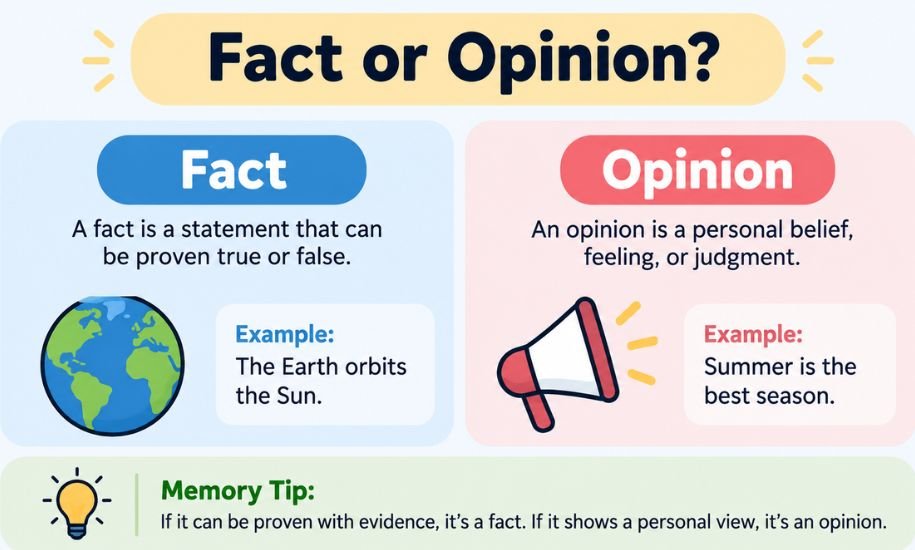
A fact is a statement that can be verified or disproved using reliable evidence. An opinion expresses someone’s personal belief, preference, feeling, or judgment. For example, “A triangle has three sides” is a fact, while “Geometry is the most interesting subject” is an opinion.
What Is a Fact?
A fact is a statement that can be tested against evidence, observation, measurement, or reliable records. It makes a claim that can be evaluated as true or false.
Facts appear in science, mathematics, history, journalism, and everyday conversations. They help readers understand what can be established through evidence rather than personal preference.
For example, the statement “A standard week has seven days” is factual because it can be checked against the conventional calendar system.
Examples of facts
- The Earth revolves around the Sun.
- A triangle has three sides.
- Bees produce honey.
- A standard year has 12 months.
- Water freezes at approximately 0°C under standard atmospheric pressure.
Each statement can be checked using an appropriate source or method.
However, an important point is that a statement does not become a fact simply because someone says it confidently. For example, “Every bird can fly” is a factual claim, but it is false because some birds, including penguins and ostriches, cannot fly.
The key is whether a statement can be verified, not whether it sounds believable.
What Is an Opinion?
An opinion expresses what someone thinks, feels, believes, prefers, or considers important. Unlike a straightforward factual statement, an opinion often depends on personal experience, values, tastes, or interpretation.
For instance, “Summer is the best season” is an opinion. One person might enjoy warm weather, while another might prefer cooler temperatures.
Opinions are not necessarily unreasonable or uninformed. Someone can support a viewpoint with evidence and logical arguments, but the judgment itself may remain subjective.
Examples of opinions
- Chocolate ice cream tastes better than vanilla.
- Reading novels is more enjoyable than watching films.
- Winter is the most beautiful season.
- Football is the most exciting sport.
- Everyone should learn to play a musical instrument.
These statements express preferences or judgments that people may disagree about.
Words such as best, worst, beautiful, boring, and delicious often indicate an opinion. However, clue words alone are not enough to classify a statement. You must consider its actual meaning and context.
Fact vs. Opinion: Key Differences
The following table summarises the main differences.
| Feature | Fact | Opinion |
|---|---|---|
| Meaning | A verifiable claim | A personal belief or judgment |
| Evidence | Can be checked against relevant evidence | May be based on feelings, values, or interpretation |
| Agreement | Evidence can help establish whether the claim is true | People may reasonably disagree |
| Common clues | Dates, measurements, records, observable details | Best, worst, beautiful, boring, should, prefer |
| Example | The Earth has one natural satellite. | The Moon is the most beautiful object in the sky. |
| Main purpose | To state information that can be verified | To express a viewpoint or evaluation |
One important distinction is that facts are not always easy to verify. Some claims require specialist knowledge, reliable documentation, or further investigation. Similarly, an opinion may be supported by research without becoming an objective fact.
Fact or Opinion Examples With Answers
The best way to understand the difference is to examine statements from everyday life.
| Statement | Answer | Reason |
|---|---|---|
| A spider has eight legs. | Fact | This describes the typical body structure of spiders. |
| Spiders are fascinating creatures. | Opinion | Fascination is a personal reaction. |
| The human body has two lungs. | Fact | This is a verifiable anatomical claim about typical human anatomy. |
| School uniforms look better than casual clothes. | Opinion | Appearance and preference are subjective. |
| A standard week contains seven days. | Fact | This can be verified using a calendar. |
| Pizza is the best food for dinner. | Opinion | People have different food preferences. |
| The Pacific Ocean is the largest ocean on Earth. | Fact | Geographic evidence establishes its relative size. |
| Reading is more useful than playing video games. | Opinion | The judgment depends on what someone values and the circumstances. |
| Plants need light for photosynthesis. | Fact | This is supported by scientific evidence. |
| Every student should study music. | Opinion | It expresses a recommendation about education. |
Can a sentence contain both?
Yes. Some sentences combine factual information with an opinion.
Consider this example:
“The historic library, built more than a century ago, is the most beautiful building in town.”
The building’s age can be checked using reliable historical records. The claim that it is the most beautiful building expresses a subjective judgment.
Another example is:
“Our school won five football matches this season, making it the best school in the district.”
The number of victories may be verified through match records. Calling the school the best depends on the criteria being used, such as sports performance, academic results, or overall reputation.
When analysing these sentences, separate the verifiable details from the judgments rather than automatically labelling every part the same way.
How to Identify a Fact or Opinion
You can use a few practical questions to decide what kind of statement you are reading.
1. Can the statement be verified?
Ask whether reliable evidence, observation, measurement, or records could establish whether the claim is true or false.
For example, “The library opens at 9 a.m.” can be checked against its official opening hours.
2. Does the statement express a preference?
Statements about what someone likes, dislikes, enjoys, or considers superior are usually opinions.
For example, “The library is the most peaceful place in town” expresses a judgment that may differ from one person to another.
3. Look for judgment words
Words such as best, worst, beautiful, terrible, and should can help you recognise an opinion.
However, these words do not always settle the question. “The best-selling book sold 50,000 copies” includes a claim that can be checked against sales data, depending on the source and time period.
4. Check the evidence and context
A factual claim can be inaccurate, exaggerated, or misleading. If someone says that a particular product is the safest available, ask what evidence supports that comparison.
Similarly, an opinion may contain factual information. Read the entire sentence carefully before deciding.
5. Separate facts from conclusions
Consider this statement:
“The restaurant received 200 customer reviews, so it must be the best restaurant in the city.”
The number of reviews can be verified. The conclusion that the restaurant is the best is a judgment that requires clear criteria and additional evidence.
This approach is especially useful when reading advertisements, opinion articles, and news reports.
Fact or Opinion Worksheet: Practice Questions
Try classifying the following statements before checking the answers.
Instructions: Write Fact or Opinion beside each statement.
- The Earth travels around the Sun.
- Blue is the most attractive colour.
- A rectangle has four sides.
- Homemade meals taste better than restaurant meals.
- Bees are insects.
- Everyone should exercise in the morning.
- The human heart pumps blood around the body.
- Autumn is the nicest season.
- A standard hour contains 60 minutes.
- Science is more interesting than history.
Answer key
- Fact — The Earth’s orbit around the Sun is established by scientific evidence.
- Opinion — Colour preferences vary.
- Fact — A rectangle is a four-sided geometric shape.
- Opinion — Taste depends on personal preference and circumstances.
- Fact — Bees belong to the insect group.
- Opinion — This is a recommendation, not a universally applicable factual statement.
- Fact — The heart’s role in circulating blood is established by biology.
- Opinion — People differ in their seasonal preferences.
- Fact — A standard hour is defined as 60 minutes.
- Opinion — Interest in school subjects is subjective.
Remember that a fact can be false if the claim is inaccurate. For example, “All insects have eight legs” is a factual claim that can be disproved; it is not an opinion.
Fact or Opinion Quiz
Test your understanding with this short multiple-choice quiz.
Question 1: Which statement is an opinion?
A. A year has 12 months.
B. The Sun is a star.
C. Summer is the best season.
D. A triangle has three sides.
Correct answer: C. The word “best” expresses a subjective preference.
Question 2: Which statement can be checked using evidence?
A. Dogs are the friendliest animals.
B. Coffee tastes better than tea.
C. The Pacific Ocean is the largest ocean.
D. Classical music is the most relaxing music.
Correct answer: C. Geographic evidence can establish the relative sizes of the oceans.
Question 3: Is “The film won three awards and is the greatest film ever made” a fact or an opinion?
Correct answer: Both. The number of awards can be verified. Calling the film the greatest ever made is a subjective judgment.
Question 4: Does an incorrect factual statement become an opinion?
Correct answer: No. A claim can be factually incorrect while still being testable against evidence.
Question 5: Which phrase most clearly signals a personal viewpoint?
A. According to the official record
B. The measurement shows
C. I believe
D. The report confirms
Correct answer: C. “I believe” signals a personal viewpoint, although the rest of the sentence may still contain verifiable claims.
Why Distinguishing Facts From Opinions Matters
Recognising the difference helps you become a more careful reader and communicator.
In schoolwork, it helps you understand reading passages, answer comprehension questions, and support written arguments with evidence. In journalism and media literacy, it helps you distinguish reported information from commentary and evaluate whether a claim is supported by reliable sources.
It is also useful in everyday conversations. When someone shares a strong opinion, you can recognise it as a viewpoint rather than automatically accepting it as an established fact.
The distinction is not about deciding that facts are always more valuable than opinions. Both can be useful. Facts provide verifiable information, while opinions help people express preferences, evaluate experiences, and discuss what they believe should happen.
Frequently Asked Questions
1. What is the simplest way to explain the difference?
A fact is something that can be checked against evidence. An opinion is what someone thinks, feels, or believes. For example, “A week has seven days” is a fact, while “Seven-day weeks are too long” is an opinion.
2. Can an opinion be supported by facts?
Yes. A person can use statistics, research, and real-world examples to support an opinion. However, the conclusion may still depend on personal values or judgment. Supporting evidence can make an opinion more persuasive without turning every part of it into an objective fact.
3. Are all statements containing “I think” opinions?
No. “I think the meeting starts at 10 a.m.” expresses uncertainty about a factual matter that can be checked. The phrase signals the speaker’s perspective, but the underlying claim may still be verifiable.
4. What is a fact or opinion game?
It is an educational activity in which players read statements and decide whether each one is factual or expresses a viewpoint. Teachers and parents can use cards, quizzes, sorting exercises, or short reading passages to make the activity engaging.
5. Why do worksheets include answers?
An answer key helps learners check their understanding and see why a statement belongs in a particular category. Explanations are especially valuable because they teach students to evaluate evidence and meaning instead of relying only on clue words.
6. Can a news article contain both facts and opinions?
Yes. A news report may include verifiable information, while an editorial or commentary presents interpretations and judgments. Readers should examine the type of article, the evidence provided, and the distinction between reported events and the writer’s conclusions.
Final Verdict: Fact or Opinion?
The essential difference is verifiability. Facts can be tested against evidence, while opinions express personal beliefs, preferences, feelings, or judgments. Some statements contain both, so it is important to examine each claim carefully rather than relying only on words that sound factual or subjective. With practice, you can develop stronger reading comprehension and critical-thinking skills. Grammarifyr helps readers understand these distinctions and choose the right words with confidence.
You may also Read : Lifes or Lives: Spelling Rules and Examples Explained