Smooth or Smoothe: Meaning and Correct Usage
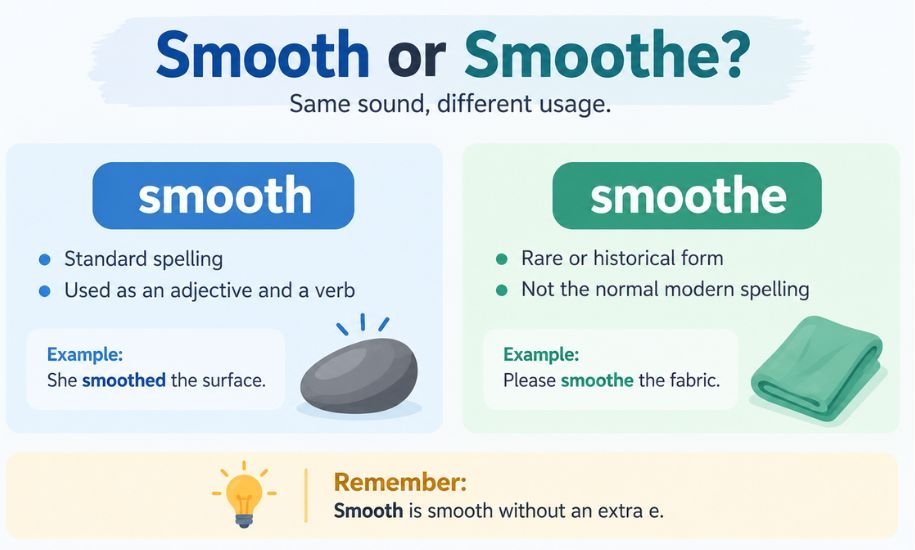
If you are unsure whether to write smooth or smoothe, the choice is usually straightforward. Smooth is the standard modern English spelling and can be used as both an adjective and a verb. Smoothe does exist in some dictionaries as a rare or historical/alternative form, but it is not the normal spelling used in contemporary standard English. Understanding this small distinction can help you avoid an unnecessary spelling error while also recognizing why you may occasionally encounter the longer form.
Smooth is the standard spelling in modern English. It can be an adjective meaning “even” or “not rough” and a verb meaning “to make smooth.” Smoothe is a rare or historical alternative form, so smooth is the appropriate choice for ordinary modern writing.
Smooth or Smoothe: Which Form Should You Use?
For everyday English, choose smooth.
| Form | Modern standard English? | Main use |
|---|---|---|
| smooth | Yes | Adjective and verb |
| smoothe | Rare/historical alternative | Occasional older or variant usage |
The important point is that smooth is already a verb. You do not need to add an e to turn it into an action word.
For example:
- Please smooth the paper.
- She smoothed her jacket.
- He is smoothing the surface.
Writing smoothe in these situations is generally unnecessary and may look like a spelling mistake to modern readers.
What Does “Smooth” Mean?
Smooth has several related meanings, but the basic idea is something that is even, gentle, or free from roughness.
As an adjective, it can describe a physical surface:
- The stone has a smooth surface.
- This fabric feels smooth against the skin.
- The table is perfectly smooth.
It can also describe something that happens without difficulty, interruption, or unpleasant complications:
- We had a smooth journey.
- The transition was smooth.
- Everything went smoothly after the changes were made.
The word can also describe a person’s manner, voice, movement, or style depending on context:
- He has a smooth speaking voice.
- The dancer made a smooth movement.
- She gave a smooth presentation.
Smooth as a Verb
Smooth is also a regular verb. It means to make something even, flat, neat, or less rough.
Examples:
- Smooth the dough with your hands.
- She smoothed the wrinkles from the fabric.
- Use sandpaper to smooth the rough edge.
- He smoothed his hair before leaving.
This is one reason there is no need for smoothe as the normal modern spelling.
Is “Smoothe” a Real Word?
This question deserves a little nuance.
Smoothe can be found in dictionaries and historical records as an alternative form of smooth. It is therefore not accurate to claim that the spelling has never existed or can never be found in English.
However, its status is very different from the ordinary modern form. In contemporary standard writing, smooth is overwhelmingly the natural choice.
So, if you are writing an email, article, school assignment, report, website page, or other modern English text, use smooth.
For example:
Standard modern usage:
Please smooth the surface before painting it.
Rare/dated alternative:
Please smoothe the surface before painting it.
The first version is the one modern readers would normally expect.
Why Do People Write “Smoothe”?
The spelling smoothe looks plausible because English has many verbs that end in a silent e.
Consider:
- soothe
- bathe
- breathe
- clothe
A writer who knows these patterns might naturally assume that the verb related to smooth should also end in -e.
There is another possible source of confusion: smooth and soothe look and sound somewhat similar, but they have different meanings.
Smooth means to make even or less rough:
She smoothed the paper with her hand.
Soothe means to calm, comfort, or relieve:
The music helped soothe the child.
Remembering that smooth is already the complete base form helps prevent the extra e.
Smooth, Smoothed, and Smoothing
Because this word is a regular verb, its common forms follow a straightforward pattern.
| Verb form | Example |
|---|---|
| Base form | smooth |
| Third-person singular | smooths |
| Past tense | smoothed |
| Past participle | smoothed |
| Present participle | smoothing |
Examples:
Present:
She smooths the fabric before sewing.
Past:
He smoothed the wrinkles from his shirt.
Present progressive:
The machine is smoothing the surface.
Notice that smooth remains the base spelling throughout these forms.
What About “Smoothes”?
You may occasionally see smoothes as a third-person singular form:
She smoothes the fabric.
This form is attested, although smooths is also standard and is often preferred because it follows the normal pattern of adding -s.
This is a different issue from smoothe. The base verb remains smooth.
Smoothly or Smoothely?
The standard adverb is smoothly.
For example:
The meeting went smoothly.
The car moved smoothly along the road.
The software update installed smoothly.
The spelling smoothely is not the normal modern form.
A useful pattern is:
smooth → smoothly
Rather than:
smoothe → smoothely
This is another situation where adding an unnecessary e creates a spelling that modern readers generally do not expect.
Correct and Incorrect Examples
Seeing the forms side by side makes the distinction easier.
Correct
The baby’s skin feels smooth.
Please smooth the paper before folding it.
She smoothed her dress.
The road provides a smooth ride.
The project went smoothly.
He is smoothing the surface with a tool.
Generally avoid in modern standard writing
The baby’s skin feels smoothe.
Please smoothe the paper.
The project went smoothely.
The issue is not that readers can never encounter these spellings. Rather, smooth and smoothly are the normal modern forms.
“Smooth” vs. “Soothe”
Because these words can be confused, it is worth keeping their meanings separate.
| Word | Meaning | Example |
|---|---|---|
| smooth | Make even or remove roughness | She smoothed the paper. |
| soothe | Calm, comfort, or relieve | The song soothed the baby. |
You smooth a surface, fabric, wrinkle, or rough edge.
You soothe a person, emotion, pain, or irritation.
For example:
She smoothed the wrinkles from the shirt.
The gentle music soothed him.
Using smoothe when you mean smooth can therefore be a spelling issue, while confusing smooth with soothe can change the meaning entirely.
Common Mistakes to Avoid
1. Adding an unnecessary “e”
Incorrect for normal modern usage:
Smoothe the surface.
Better:
Smooth the surface.
The base verb is already smooth.
2. Writing “smoothely”
The usual adverb is smoothly.
The transition went smoothly.
3. Writing “smothed”
The past tense is smoothed, not smothed.
She smoothed her hair.
The double o remains in the past-tense form.
4. Confusing “smooth” with “soothe”
These words have different meanings. Check the sentence carefully before choosing one.
5. Assuming every dictionary-listed form is equally common
A word can be historically recorded or accepted as a variant without being the normal choice for contemporary writing. Smoothe is a good example of this distinction.
An Easy Way to Remember the Spelling
Think of smooth as a complete word that already contains everything you need:
SMOOTH
If you mean “make even,” use smooth:
Smooth the paper.
If you mean “even or not rough,” use smooth:
The surface is smooth.
If you need the adverb, use:
smooth → smoothly
There is no need to insert an extra e.
A simple memory rule is:
Smooth is smooth without an extra e.
Is “Smooth Sailing” the Correct Expression?
Yes. The established expression is smooth sailing.
It means that something is progressing easily or without significant problems.
For example:
Once the paperwork was completed, it was smooth sailing.
The first few weeks were difficult, but everything has been smooth sailing since then.
The standard spelling is smooth sailing, not smoothe sailing.
Final Verdict: Smooth or Smoothe?
For contemporary standard English, smooth is the form to choose. It works naturally as both an adjective and a verb, while smoothly is the standard adverbial form. Smoothe has a documented history as a rare or alternative form, but it is not the normal choice for modern writing.
When in doubt, keep the spelling simple: smooth. For clear explanations of similar English word and spelling questions, Grammarifyr helps you know the difference and use the right words.
FAQs
Is “smoothe” a correct spelling?
Smoothe is documented as a rare, historical, or alternative form of smooth, so it is not simply an invented word. However, smooth is the standard modern spelling and is the appropriate choice in ordinary contemporary writing.
Is “smooth” both a noun and a verb?
Smooth is commonly used as an adjective and a verb. It can describe something even or free from roughness, and as a verb it means to make something smooth or even. It also appears in other grammatical forms such as smoothed, smoothing, and smoothly.
Should I write “smoothly” or “smoothely”?
Use smoothly in standard modern English. For example: “The meeting went smoothly.” The spelling smoothely is not the normal contemporary form.
Is “smooths” or “smoothes” correct?
Both forms can be found, but smooths is a standard and common third-person singular form of smooth. For example: “She smooths the fabric before cutting it.” The base verb is always smooth.
What is the difference between smooth and soothe?
Smooth relates to making something even, level, or less rough, while soothe means to calm, comfort, or relieve. For example, you can smooth a wrinkle but soothe an upset child.
Is “smooth” the correct spelling in both American and British English?
Yes. Smooth is the standard spelling in both American and British English. This is not a case like color/colour or center/centre, where the regional spellings differ.
You may also Read : Center or Centre: US and UK Spelling Explained