Sence or Sense: Correct Spelling and Meaning
If you have written “sence” instead of “sense,” you are dealing with a spelling mistake rather than two different English words. The standard spelling is sense, and it can refer to meaning, understanding, judgment, awareness, or one of the physical senses. The confusion is understandable because the incorrect form looks and sounds plausible. This guide explains the correct spelling, the meaning of sense, the phrase makes sense, useful synonyms, and simple ways to avoid the mistake.
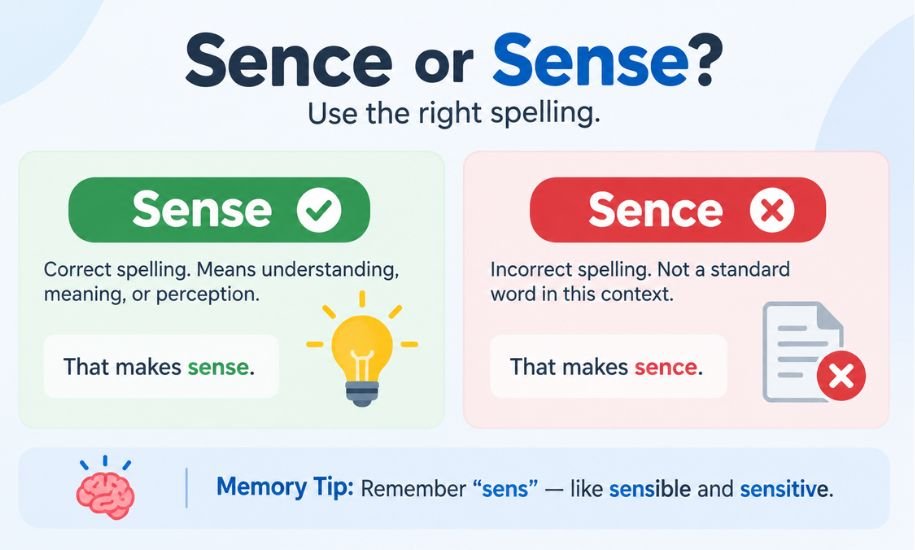
Sense is the correct standard-English spelling. Sence is a misspelling and should not be used in standard writing. For example, write “That makes sense,” not “That makes sence.”
Sense vs. Sence: A Quick Comparison
| Feature | Sense | Sence |
|---|---|---|
| Standard spelling? | Yes | No |
| Meaning | Has several meanings | No standard meaning as the intended spelling of sense |
| Part of speech | Noun and verb | Not the standard form |
| Example | “That makes sense.” | “That makes sence.” ❌ |
| Use in formal writing | Correct | Avoid |
The important point is that sense and sence are not two alternative spellings like color and colour. Only sense is the standard spelling of the word being discussed here.
What Does “Sense” Mean?
Sense is a versatile English word with several meanings. It can be used as both a noun and a verb.
As a noun, it can describe an understanding of something, practical judgment, an impression, or a physical ability to perceive the world.
For example:
- The sentence does not make sense.
- She has excellent common sense.
- I had a sense that something was wrong.
- Dogs have a powerful sense of smell.
As a verb, sense means to notice, perceive, or become aware of something.
Examples:
- I could sense that he was nervous.
- She sensed something unusual in the room.
- He immediately sensed that the situation had changed.
The exact meaning therefore depends on how the word is used in a sentence.
Is “Sence” a Real Word?
In the context of this spelling comparison, sence is not the standard spelling of sense. If you want to refer to meaning, awareness, judgment, perception, or a sensory ability, use sense.
For example:
Correct:
I don’t understand what you mean. It doesn’t make sense.
Incorrect:
I don’t understand what you mean. It doesn’t make sence.
Similarly:
Correct:
She has a good sense of humor.
Incorrect:
She has a good sence of humor.
It is best not to assign a separate definition to sence. In ordinary modern English writing, it is generally a spelling error for sense.
How to Spell the Word Correctly
If you are wondering how to spell sence or sense, remember the correct sequence:
S-E-N-S-E
The word contains “sens” before the final e.
Correct forms
- sense
- senses
- sensed
- sensing
- sensible
- sensitive
- sensory
Incorrect form
- sence ❌
A useful memory aid is to associate sense with related words beginning with sens-, such as sensible, sensitive, and sensory. The shared sens pattern can make the correct spelling easier to recall.
“Makes Sence” or “Makes Sense”?
The correct phrase is makes sense.
Correct:
Your explanation makes sense.
Incorrect:
Your explanation makes sence.
The expression make sense means that something is logical, understandable, or reasonable.
For example:
- That explanation makes sense.
- Her decision makes sense.
- It doesn’t make sense to leave before sunrise.
- The instructions finally made sense after I read them twice.
- His argument makes perfect sense.
The same spelling applies regardless of the verb tense:
| Correct expression | Example |
|---|---|
| make sense | These instructions make sense. |
| makes sense | Your answer makes sense. |
| made sense | His explanation made sense. |
| making sense | The situation is finally making sense. |
So whenever you use this expression, remember that it is always sense, never sence.
“Make Sense” vs. “Make Sense Of”
These two expressions are related but have slightly different uses.
Make sense
Make sense means that something is logical or understandable.
Her explanation makes sense.
The explanation is clear and reasonable.
Make sense of something
Make sense of means to understand or interpret something.
I can’t make sense of these complicated instructions.
Here, the speaker is trying to understand the instructions.
Compare:
- The explanation makes sense. = The explanation is logical.
- I can make sense of the explanation. = I can understand the explanation.
This distinction is useful because both expressions appear frequently in everyday English.
Common Meanings of “Sense”
Because sense has several meanings, understanding the context is important.
1. Meaning or significance
Here, sense refers to what something means.
What sense do you get from that sentence?
I understand the general sense of the message.
2. Practical judgment
In expressions such as common sense, the word refers to practical judgment.
You need some common sense when dealing with unfamiliar equipment.
3. Awareness or impression
Sense can describe a feeling or awareness that something is happening.
I had a sense that someone was watching us.
She sensed that her friend was upset.
4. Physical perception
The word can refer to one of the body’s sensory faculties.
The traditional five senses are:
- sight
- hearing
- smell
- taste
- touch
Examples include:
He has a strong sense of smell.
Her sense of hearing is very sensitive.
5. Understanding
Sense can also refer to someone’s ability to understand something.
I couldn’t make sense of the report.
In this case, sense is connected with comprehension and interpretation.
Sense Synonyms
There is no useful synonym for sence because it is a misspelling. However, sense has many possible synonyms depending on its meaning.
| Meaning of sense | Possible synonyms |
|---|---|
| Meaning | meaning, significance, interpretation |
| Understanding | comprehension, understanding, grasp |
| Awareness | awareness, perception, recognition |
| Judgment | judgment, wisdom, prudence, discernment |
| Feeling | impression, feeling, intuition, hunch |
| Perception | perception, awareness, detection |
For example, if sense means meaning, significance may work as a synonym:
I don’t understand the sense of the statement.
I don’t understand the significance of the statement.
But if sense refers to one of the physical senses, these synonyms would not necessarily work. The correct replacement always depends on context.
Why Do People Write “Sence”?
The error is largely understandable because sence looks like a plausible English spelling. English spelling does not always allow writers to predict the correct letters simply from pronunciation.
The mistake can also happen when someone types quickly or spells the word according to how it sounds.
The safest approach is to remember the sens- spelling pattern:
sense → sensible → sensitive → sensory
These related words reinforce the spelling sens, rather than senc.
Common Mistakes to Avoid
1. Writing “makes sence”
❌ The answer makes sence.
✅ The answer makes sense.
2. Using “sence” for a feeling
❌ I had a strange sence that something was wrong.
✅ I had a strange sense that something was wrong.
3. Misspelling “common sense”
❌ Everyone should use common sence.
✅ Everyone should use common sense.
4. Using “sence” as a verb
❌ I could sence that she was worried.
✅ I could sense that she was worried.
5. Assuming the two spellings have different meanings
They do not represent the ordinary standard distinction between two valid English words. When you mean sense, use sense.
Examples in Everyday English
Here are some natural examples showing different uses:
- That doesn’t make sense.
- I can sense that you’re worried.
- She has a strong sense of humor.
- He has a good sense of direction.
- We need to make sense of these figures.
- The word has a different sense in this context.
- Common sense would tell you to check the instructions first.
- I had a strange sense of familiarity when I entered the building.
Notice that the spelling remains sense in every example.
How to Remember the Correct Spelling
The easiest rule is simple:
Sense has “sens” in the middle, not “senc.”
Think of related words:
sense → sensible → sensitive → sensory
You can also remember the common phrase:
It makes sense.
If you are writing makes sence, stop and replace it with makes sense.
This is especially useful because the phrase is so common that memorizing it as a complete expression can reinforce the correct spelling.
Frequently Asked Questions
Is “sence” or “sense” correct?
Sense is correct. Sence is a misspelling when you intend the standard English word meaning meaning, understanding, perception, awareness, judgment, or a sensory faculty.
How do you spell “sence” correctly?
The correct spelling is sense, written S-E-N-S-E. The word contains sens followed by a final e.
Is it “makes sence” or “makes sense”?
The correct expression is makes sense. For example, “Your explanation makes sense.” Makes sence is an incorrect spelling.
What is the meaning of “sense” in English?
Sense has several meanings. It can refer to meaning, understanding, practical judgment, awareness, perception, or one of the physical senses. As a verb, it can mean to notice or perceive something.
What is a synonym for “sense”?
The best synonym depends on the context. Possible alternatives include meaning, understanding, awareness, perception, judgment, feeling, intuition, and significance.
Is “sence” acceptable in formal writing?
No. When you mean the standard word sense, use sense in formal and informal writing. The spelling sence should be treated as a spelling error.
Final Verdict: Sence or Sense?
Sense is the correct spelling. Sence is a misspelling and should not replace it in standard English. Whether you mean meaning, common sense, a sense of smell, or the verb to sense, the spelling remains sense. For more straightforward explanations of confusing English words and spellings, Grammarifyr helps you Know the Difference. Use the Right Words.
You may also Read : Worshipped or Worshiped: British and American English


One Comment