Worshiped or Worshipped: American or British English?
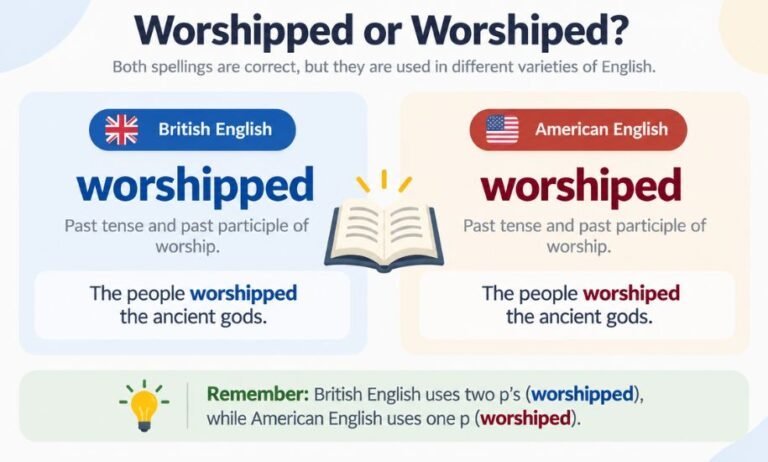
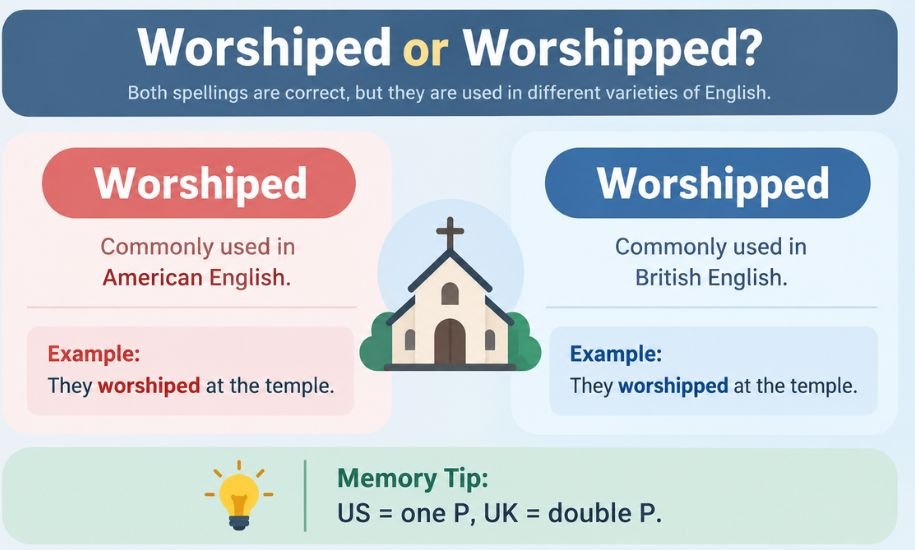
If you are unsure whether to write worshiped or worshipped, you are dealing with a difference in English spelling conventions, not two different meanings. Both forms are accepted, but they are preferred in different varieties of English. Worshiped is commonly used in American English, while worshipped is the usual British English spelling. The same pattern appears in worshiping and worshipping. Understanding the regional difference makes it much easier to choose the right form and keep your writing consistent.
Worshiped and worshipped are both correct. Worshiped is the common American English spelling, while worshipped is the usual British English form. They are both the past tense and past participle of worship and have the same meaning.
Worshiped or Worshipped: Which Is Correct?
Both spellings are correct.
| Form | Typical usage | Grammar | Meaning |
|---|---|---|---|
| worshiped | American English | Past tense/past participle | Showed religious devotion or intense admiration |
| worshipped | British English | Past tense/past participle | Showed religious devotion or intense admiration |
Cambridge lists worshipped as the past simple and past participle and specifically notes worshiped as the US spelling. Collins likewise gives worshiped and worshipped as accepted forms and identifies the single-p forms with American usage.
So these two sentences are both correct:
- American English: The ancient people worshiped several gods.
- British English: The ancient people worshipped several gods.
The spelling changes, but the meaning does not.
What Does “Worship” Mean?
Worship can be used as both a verb and a noun.
As a verb, it can mean to show strong respect, devotion, or reverence toward God or a deity. It can also mean attending a religious ceremony. In a broader, nonreligious sense, worship can describe intense admiration or devotion toward a person or thing.
Examples:
- Christians worship God through prayer and religious services.
- The community worships at a local church.
- Ancient people worshiped their gods.
- Some fans almost worship famous performers.
As a noun, worship can refer to the act of honoring or adoring a deity, or to a religious service.
For example:
The family attended worship on Sunday.
Their worship included prayers and hymns.
The word therefore has a broader range than simply referring to one particular religious practice.
Why Is There One “P” in One Version and Two in the Other?
The difference comes from regional spelling conventions.
American English commonly uses:
- worshiped
- worshiping
- worshiper
British English commonly uses:
- worshipped
- worshipping
- worshipper
Collins lists worshiped or worshipped and worshiping or worshipping as forms of the verb, while Cambridge describes the British -pp- forms and notes the American -p- alternatives.
This means the spelling difference is similar to other British/American variations in which a consonant may be doubled in British English but not in American English.
The important point is that worshipped is not a different verb from worshiped. They are simply regional spelling variants.
Worshiping or Worshipping: What About the -ing Form?
The same distinction applies when worship takes the -ing ending.
American English: Worshiping
The congregation was worshiping together.
British English: Worshipping
The congregation was worshipping together.
Both forms are correct. Cambridge gives worshipping as the present participle and notes worshiping as the US alternative.
This gives you a useful pattern:
| American English | British English |
|---|---|
| worshiped | worshipped |
| worshiping | worshipping |
| worshiper | worshipper |
If you are writing for an American audience, the first column will usually feel more natural. If your publication follows British English, the second column is generally the better choice.
Worshipped or Worshiped in a Sentence
Because the two forms have identical meanings, the choice depends mainly on the variety of English you are using.
American English examples
The civilization worshiped several different gods.
The villagers worshiped at the temple for generations.
The ancient statue was worshiped as a sacred object.
British English examples
The civilization worshipped several different gods.
The villagers worshipped at the temple for generations.
The ancient statue was worshipped as a sacred object.
None of these sentences changes meaning because of the extra p.
Do Christians Worship God or Jesus?
The question “do Christians worship God or Jesus?” involves theology rather than spelling.
Christian traditions do not all explain the relationship between God and Jesus in exactly the same way. In mainstream Trinitarian Christianity, however, Jesus is understood as divine and is worshiped within Christian belief in the one God.
Catholic teaching, for example, explicitly describes Jesus as receiving the worship of adoration. The Catechism states that Christ is honored with the worship of adoration in the Eucharist. It also describes Christian worship as directed to the one God.
The Catechism’s discussion of Jesus as Lord also connects the honor due to Jesus with the honor due to God the Father.
So, when discussing does Christianity worship God or Jesus, it is more accurate to explain the relevant Christian doctrine than to present the question as a simple choice between two separate objects of worship.
Different Christian denominations may express their theology in somewhat different ways, so a general statement should not be treated as a description of every Christian tradition.
Do Catholics Worship Jesus or Mary?
Catholic teaching makes an important distinction between adoration and veneration.
According to the United States Conference of Catholic Bishops, the highest honor given to God is called adoration, while the honor given to Mary and the saints is called veneration.
The Catechism similarly explains that devotion to Mary differs essentially from the adoration given to Christ, the Father, and the Holy Spirit.
Therefore, the question “do Catholics worship Mary or Jesus?” can be answered more precisely as follows:
- Catholics worship God.
- Jesus Christ receives worship and adoration in Catholic teaching.
- Mary is honored and venerated.
- Catholic teaching distinguishes Marian devotion from the adoration given to God.
This distinction matters because the everyday meaning of worship can be broader than the technical theological terminology used by Catholic teaching.
Common Mistakes With These Spellings
1. Treating one spelling as universally wrong
It is incorrect to say that worshiped is always wrong or that worshipped is always wrong. Both are established forms.
Instead, consider your intended variety of English.
2. Mixing spelling conventions
A writer might use worshiped in one sentence and worshipping in another. While readers will understand both, consistent regional spelling generally produces cleaner writing.
For American English, use forms such as:
worshiped → worshiping → worshiper
For British English, use:
worshipped → worshipping → worshipper
3. Assuming the extra “p” changes the meaning
It does not.
Worshiped and worshipped describe the same past action.
4. Treating “worship” and “worshiped” as interchangeable
They are related forms, but they do different grammatical jobs.
They worship at the church every Sunday.
Here, worship is the present-tense verb.
They worshiped at the church last Sunday.
Here, worshiped is the past tense.
An Easy Way to Remember the Difference
Think of the spelling as a regional pattern:
US: one P
- worshiped
- worshiping
- worshiper
UK: two P’s
- worshipped
- worshipping
- worshipper
A simple memory aid is:
US = one P; UK = double P.
This is a useful writing shortcut, but remember that actual usage can be more varied than a strict rule suggests. Major dictionaries recognize both forms, so the most important goal is to follow the spelling convention of the publication or audience you are writing for.
Which Form Should You Use?
Choose the spelling that matches your target audience.
If you are writing American English, use:
The people worshiped at the temple.
If you are writing British English, use:
The people worshipped at the temple.
For a website serving an international audience, either spelling can work. The key is consistency. If the rest of your article follows American spelling, worshiped will fit naturally. If your site follows British English conventions, choose worshipped.
The same principle applies to worshiping/worshipping and worshiper/worshipper.
Frequently Asked Questions
Is “worshiped” a correct spelling?
Yes. Worshiped is a correct spelling and is commonly used in American English. It is the past tense and past participle of worship. British English commonly uses the alternative spelling worshipped.
Is “worshipped” a correct spelling?
Yes. Worshipped is a standard spelling, particularly in British English. It has exactly the same meaning and grammatical function as American English worshiped.
Is worshiping or worshipping correct?
Both are correct. Worshiping is commonly used in American English, while worshipping is the usual British English form. Both are the present participle of worship.
What is the past tense of worship?
The past tense can be worshiped or worshipped. The first is commonly associated with American English, while the second is commonly associated with British English.
Do Catholics worship Mary?
Official Catholic teaching distinguishes between worship or adoration given to God and veneration given to Mary and the saints. The USCCB explicitly describes this distinction, while the Catechism says Marian devotion differs essentially from the adoration given to God.
Should I use worshiped or worshipped in American English?
Worshiped is the usual American spelling. If your writing follows American English consistently, it is the natural choice. Worshipped is also an established form, so it should not be treated as a meaningless or invented spelling.
Final Verdict: Worshiped or Worshipped?
Worshiped and worshipped are both correct. Use worshiped when following American English conventions and worshipped when following British English conventions. The same regional distinction applies to worshiping and worshipping. For clear, consistent writing, choose the spelling that matches your intended audience and stick with it. Grammarifyr helps make these small but important English differences easier to understand and use correctly.
You may also Read : Tweak or Tweek: Correct Spelling Explained