Nosey or Nosy: Meaning and Correct Spelling
If you are unsure whether to write “nosey” or “nosy,” you are not dealing with a simple correct-versus-incorrect spelling mistake. Both forms are accepted in English, and they have the same meaning and pronunciation. The main difference is that nosy is generally treated as the standard headword, while nosey is a recognized variant spelling. Both describe someone who is overly interested in other people’s private affairs.
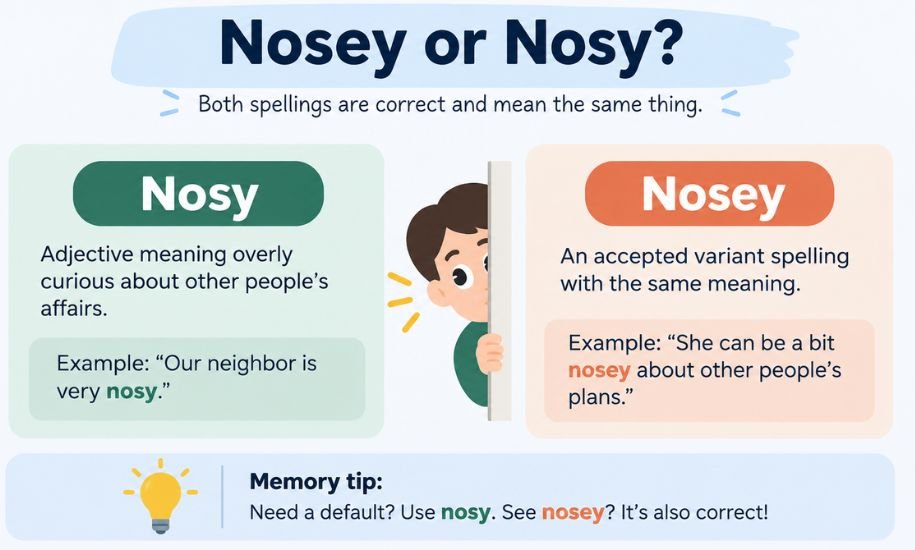
Both “nosy” and “nosey” are correct. They are alternative spellings of the same adjective, meaning excessively curious about other people’s business. “Nosy” is generally the preferred or more common form, while “nosey” is an established variant.
Nosy or Nosey: What’s the Difference?
There is no difference in meaning between nosy and nosey. Both are adjectives used for someone who takes too much interest in matters that are private or none of their business.
| Feature | Nosy | Nosey |
|---|---|---|
| Correct spelling? | Yes | Yes |
| Part of speech | Adjective | Adjective |
| Meaning | Intrusively curious | Intrusively curious |
| Pronunciation | Same | Same |
| Usage | Standard/common form | Accepted variant |
| Example | “He is being nosy.” | “He is being nosey.” |
The important point is that nosey is not simply a misspelling of nosy. It is a recognized alternative spelling.
For most general writing, nosy is a straightforward choice. However, seeing nosey in a book, website, message, or conversation does not mean the writer has necessarily made a spelling error.
What Does “Nosy” Mean?
Nosy is an adjective that describes someone who is too interested in other people’s personal lives, activities, or private information.
It usually has a negative or disapproving sense because it suggests that someone’s curiosity has gone beyond what is appropriate.
For example:
- My neighbor is very nosy and always asks about my visitors.
- Don’t be nosy about their personal relationship.
- She asked a nosy question about his salary.
- The children became nosy when they noticed the unusual package.
Being curious is not automatically the same as being nosy. A person can be curious because they genuinely want to learn something, while a nosy person is usually interested in information that is personal or not their business.
Curious vs. Nosy
Consider these two sentences:
I am curious about how the machine works.
Here, curious is neutral and suggests a desire to understand something.
I am curious about how much my neighbor earns.
This may sound more personal, depending on the context.
You’re being nosy about your neighbor’s salary.
Here, nosy clearly suggests that the curiosity is intrusive.
What Does “Nosey” Mean?
Nosey has the same meaning as nosy. It is an accepted variant spelling of the adjective.
For example:
- She is always nosey about other people’s plans.
- Don’t be nosey; they’ll tell you when they’re ready.
- His nosey questions made the conversation uncomfortable.
Changing the spelling from nosy to nosey does not change the word’s meaning.
The extra e may make the word look as though it is directly connected to the noun nose, but in modern usage, nosey functions simply as a variant spelling of nosy.
Is It Nosy or Nosey?
If you are asking “is it nosy or nosey?”, the answer is either one can be correct.
However, if you want the simplest default spelling, use nosy.
For example:
My brother is being nosy.
This is standard and widely understood.
You can also write:
My brother is being nosey.
That sentence is also acceptable because nosey is an established variant.
The choice is therefore not about choosing between two different meanings. It is primarily a choice between two spellings of the same adjective.
Why Are Both Spellings Used?
The confusion largely comes from the relationship between the word and the noun nose.
The adjective describes someone who metaphorically sticks their “nose” into other people’s affairs. Because nose is spelled with an e, some writers naturally spell the adjective nosey.
The shorter form nosy is also firmly established in English and is generally the preferred dictionary headword.
This explains why you may encounter both spellings even in carefully edited English.
The important lesson is simple: do not automatically treat “nosey” as a typo.
How Do You Spell Nosey or Nosy?
If you are wondering how do you spell nosey or nosy, there are two accepted forms:
- nosy
- nosey
If you need to select one spelling for general-purpose writing, nosy is a good default.
For example:
Don’t be nosy about things that don’t concern you.
But if you encounter:
Don’t be nosey about things that don’t concern you.
the sentence is still grammatically and semantically correct.
Which Form Should You Use?
Consistency is more important than trying to treat one form as universally correct and the other as universally wrong.
If you are writing an article, essay, email, or other formal text, nosy is usually the safest choice because it is the primary form listed by major English dictionaries.
If you are following a particular publication’s house style, however, follow that style consistently.
Nosy in American and British English
Both spellings can be found in English varieties on both sides of the Atlantic, so it would be misleading to say that nosy is American and nosey is exclusively British.
Major dictionaries recognize nosey as a variant of nosy. British English sources also use and recognize the shorter spelling.
Therefore, the distinction is not as simple as:
American = nosy
British = nosey
A better rule is:
Nosy is the standard/main form, while nosey is an accepted variant.
If your audience uses either American or British English, nosy will be understood without difficulty.
Examples of Correct Usage
Here are some natural examples using nosy:
- Why are you being so nosy?
- Our nosy neighbor always wants to know where we are going.
- She asked a nosy question about my finances.
- I don’t want to sound nosy, but what happened?
- The reporter was accused of being too nosy about the actor’s private life.
The same sentences can use nosey without changing their meaning:
- Why are you being so nosey?
- Our nosey neighbor always wants to know where we are going.
- She asked a nosey question about my finances.
- I don’t want to sound nosey, but what happened?
- The reporter was accused of being too nosey about the actor’s private life.
Both versions work.
Common Mistakes to Avoid
1. Assuming “nosey” is always wrong
This is the biggest mistake.
Nosey is an accepted variant, so it should not automatically be corrected to nosy.
2. Thinking the two spellings have different meanings
They do not have separate meanings in ordinary modern usage.
She is nosy.
and
She is nosey.
communicate the same idea.
3. Treating “nosy” as a noun
Nosy is normally an adjective.
Correct:
He is a nosy person.
Incorrect:
He is a nosy.
If you want a noun, you could say:
He is a nosy person.
or:
He is always poking his nose into other people’s business.
4. Confusing curiosity with nosiness
Not every person who wants information is being nosy.
Curious can be neutral or positive, whereas nosy normally suggests excessive or intrusive interest.
5. Mixing spellings inconsistently
Because both forms are accepted, writers sometimes switch between them unnecessarily.
For polished writing, choose one form and use it consistently within the same piece.
An Easy Way to Remember the Difference
There is actually no difference to memorize between the meanings because nosy and nosey are variants.
A practical rule is:
Need a default? Choose “nosy.”
See “nosey”? Don’t automatically mark it wrong.
The shorter spelling is easy to remember because it drops the e from nose, producing nosy.
Related Forms
The adjective can also appear in comparative and superlative forms.
With nosy, you may encounter:
- nosy
- nosier
- nosiest
Examples:
My sister is nosier than I am.
He is the nosiest person in the office.
Forms based on nosey can also be encountered, although the shorter forms are often more convenient in ordinary writing.
Is “Nosey” Acceptable in Formal Writing?
Yes, nosey is an accepted spelling, but nosy is generally the more straightforward choice when you want the primary standard form.
That does not mean nosey becomes incorrect in formal writing. If you are editing for a particular publication, academic institution, or organization, its preferred style should take priority.
For general professional writing, choosing nosy can avoid unnecessary questions about the spelling.
Frequently Asked Questions
Is “nosy” or “nosey” correct?
Both are correct. Nosy is generally used as the primary spelling, while nosey is a recognized variant. Both mean excessively interested in other people’s private affairs.
Is it nosy or nosey in American English?
Both forms can be used, although nosy is the standard form you are most likely to choose in general American English writing. Nosey is also recognized as a variant.
Is it nosey or nosy in British English?
Both spellings are acceptable in British English. Nosey is a recognized British variant, but nosy is also a valid spelling and should not be treated as an American-only form.
How do you spell the word: “nosy” or “nosey”?
You can spell it either nosy or nosey. If you want a simple default, use nosy.
Does “nosy” have a negative meaning?
Usually, yes. Nosy generally describes someone who shows too much interest in another person’s private affairs. However, the strength of the negative meaning depends on context.
Are “nosy” and “nosey” pronounced differently?
No. The two spellings are normally pronounced the same. The difference is in spelling, not pronunciation or meaning.
The Bottom Line
Nosy and nosey are both correct spellings of the same adjective. Nosy is generally the preferred default form, while nosey is an established alternative. Both describe intrusive or excessive curiosity about other people’s affairs, so the choice is mainly about spelling rather than meaning. For clear, consistent general writing, nosy is the easiest form to use. Grammarifyr helps make these small but confusing English distinctions easier to understand and apply correctly.
You may also Read : Insure or Ensure: Meaning and Usage Explained