Insure or Ensure: Meaning and Usage Explained
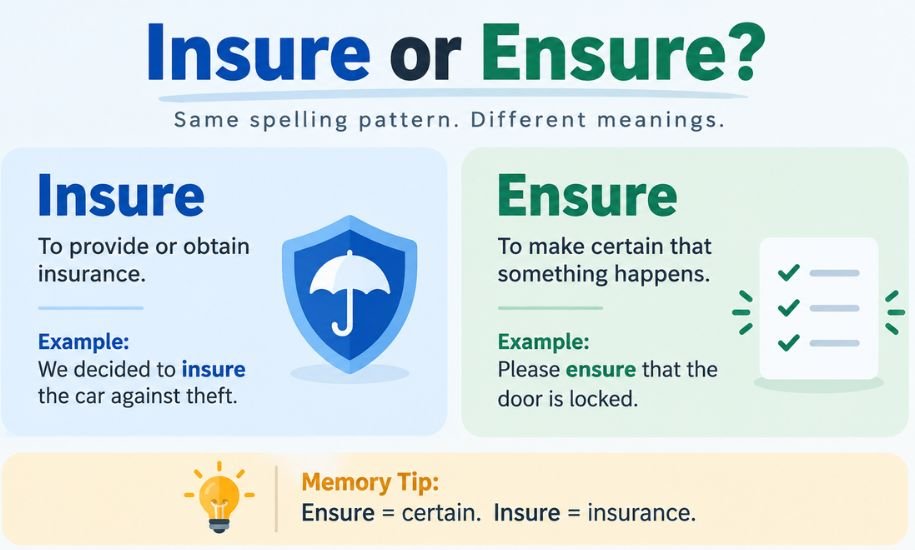
Insure and ensure are both correct English words, but they usually have different meanings. The confusion comes from their nearly identical spelling and pronunciation, as well as the fact that American English sometimes uses insure with the meaning of ensure. In most situations, however, the easiest rule is straightforward: use ensure when you mean “make certain,” and use insure when you mean “provide or obtain insurance.”
Ensure means to make something certain or make sure something happens. Insure normally relates to protecting a person or property through insurance. Both are valid words, and in American English, insure can also be used to mean “ensure.”
Insure or Ensure: Which One Should You Use?
The choice depends on what you are trying to say.
| Word | Usual meaning | Example |
|---|---|---|
| ensure | Make certain; make sure something happens | “Please ensure that the door is locked.” |
| insure | Protect against financial loss through insurance | “We need to insure the house.” |
If you can replace the word with “make sure,” ensure is usually the right choice.
Please ensure that all forms are completed.
If you are talking about an insurance policy or protection against financial loss, use insure.
They decided to insure the vehicle against theft.
This distinction is also recommended by Microsoft’s Style Guide, which uses ensure for “make sure” or “guarantee” and insure for providing insurance.
What Does “Ensure” Mean?
Ensure is a verb meaning to make certain that something happens or is definite.
It is commonly followed by a noun phrase or a clause beginning with that.
Examples:
- Please ensure that all windows are closed.
- The new system helps ensure accurate records.
- We checked the equipment to ensure everyone’s safety.
- Good planning can ensure a smooth launch.
- The manager took extra steps to ensure that the work was completed on time.
Oxford defines ensure as making sure that something happens or is definite. Cambridge similarly defines it as making something certain to happen.
Common patterns with “ensure”
You will often see structures such as:
- ensure that + clause
- ensure + noun
- ensure something for someone
For example:
The company introduced new procedures to ensure that customers receive accurate information.
These measures ensure safety for workers.
The victory ensured the team a place in the final.
The word is particularly useful when discussing steps, actions, rules, procedures, or conditions intended to produce a certain result.
What Does “Insure” Mean?
Insure is most commonly associated with insurance.
As a verb, it can mean to obtain insurance for yourself or your property, or to provide insurance coverage for someone or something.
Examples:
- We should insure the car against theft.
- The homeowner decided to insure the property against fire.
- The company refused to insure the building.
- She insured her valuable artwork.
- The policy insures the vehicle against accidental damage.
Cambridge defines insure in its insurance sense as protecting yourself or your property against damage or loss through an insurance arrangement. Oxford likewise lists buying insurance and providing insurance as its primary meanings.
Common patterns with “insure”
Some useful constructions include:
insure something against something
They insured the house against fire.
insure something for an amount
The painting was insured for $1 million.
insure someone
The company agreed to insure the driver.
These patterns make the insurance meaning easy to recognize.
When to Use Ensure or Insure
A simple meaning-based test can help.
Use “ensure” for certainty
Choose ensure when you mean:
- make sure
- make certain
- guarantee an outcome
- take steps to make something happen
Examples:
Please ensure that your application is complete.
The inspection was carried out to ensure safety.
We need to ensure that everyone receives the correct information.
In each case, there is no insurance involved. The idea is simply making something certain.
Use “insure” for insurance
Choose insure when discussing:
- cars
- houses
- buildings
- property
- valuable possessions
- financial protection
- insurance policies
- protection against damage, loss, illness, or similar risks
Examples:
You should insure your car against theft.
The business insured its property against fire.
The company will insure the equipment during transportation.
Here, insure has its standard insurance-related meaning.
Is “Insure” Ever Used to Mean “Ensure”?
Yes. This is the important regional exception.
In American English, insure can also mean to make certain, effectively overlapping with ensure. Cambridge explicitly lists this meaning in its American English entry, and Oxford identifies insure as an alternative to ensure, especially in North American English.
For example:
We wanted to insure that the event would run smoothly.
This usage exists, but it can create ambiguity because insure is strongly associated with insurance.
For clear general-purpose writing, ensure is usually the better choice when the intended meaning is “make certain.” Microsoft’s style guidance makes the same distinction for worldwide readability.
So:
Please ensure that the information is correct.
is generally clearer than:
Please insure that the information is correct.
The second sentence can be understood in American English, but the first makes the intended meaning immediately obvious.
Ensuring or Insuring: Which Is Correct?
Both ensuring and insuring are correct, but they come from different verbs and normally carry different meanings.
Ensuring
Ensuring is the present participle of ensure.
It means making something certain or making sure something happens.
Examples:
We are ensuring that every order is checked.
The new procedures are aimed at ensuring safety.
She is responsible for ensuring that the records are accurate.
Insuring
Insuring is the present participle of insure.
It normally refers to providing or obtaining insurance.
Examples:
They are insuring the building against fire.
The company specializes in insuring commercial vehicles.
He is considering insuring his new car.
Oxford lists ensuring as the -ing form of ensure and insuring as the -ing form of insure.
A quick comparison
Ensuring = making certain
Insuring = obtaining or providing insurance
That distinction makes the choice much easier.
Examples: Correct and Incorrect Usage
Here are some examples that show the difference clearly.
Example 1: Making something certain
Correct:
Please ensure that all doors are locked.
Not the clearest choice:
Please insure that all doors are locked.
The first sentence clearly expresses the meaning “make sure.”
Example 2: Protecting property
Correct:
We decided to insure the house against flooding.
Incorrect for the intended meaning:
We decided to ensure the house against flooding.
The second sentence does not express the insurance relationship.
Example 3: Checking accuracy
Correct:
The editor reviewed the figures to ensure their accuracy.
Here, the editor is making certain that the figures are accurate.
Example 4: Insurance coverage
Correct:
The company insured the equipment against accidental damage.
The sentence concerns insurance protection, so insured is appropriate.
Example 5: A regional American-English usage
Possible in American English:
The additional checks were introduced to insure accuracy.
Clearer general-purpose alternative:
The additional checks were introduced to ensure accuracy.
Both can be understood in American English, but ensure avoids confusion with the insurance meaning. Cambridge and Oxford both recognize the overlap.
Why Are These Words So Easy to Confuse?
The two words are closely related in form, pronunciation, and meaning. They also overlap in some varieties of English.
There is another useful reason for the confusion: insure historically developed as a variant related to ensure. Oxford’s word-origin information connects the two words and notes their historical relationship.
Modern usage has nevertheless developed a practical distinction that is helpful for writers:
- ensure → certainty
- insure → insurance
That distinction is especially useful in formal, educational, and international writing because it reduces ambiguity.
Ensure vs. Insure vs. Assure
There is a third word that is often confused with these two: assure.
The three words can be separated by their usual meanings:
| Word | Main idea | Example |
|---|---|---|
| ensure | Make something certain | “The checks ensure accuracy.” |
| insure | Provide or obtain insurance | “They insured the car.” |
| assure | Give someone confidence or tell someone positively | “I assure you that it is safe.” |
A simple way to distinguish them is:
Ensure a result.
Insure against a risk.
Assure a person.
Microsoft’s style guidance uses essentially this three-way distinction for clearer communication.
An Easy Way to Remember the Difference
Try this simple association:
ENSURE = CERTAIN
If you can replace the word with make sure, choose ensure.
We checked the list to ensure everything was included.
INSURE = INSURANCE
If you are talking about an insurance policy or financial protection, choose insure.
We insured the car against theft.
The spelling itself is not a perfect rule, but this association works well for everyday writing.
Common Mistakes to Avoid
1. Using “insure” whenever you mean “make sure”
In standard general-purpose writing, prefer:
Ensure that you save a copy.
rather than:
Insure that you save a copy.
The latter is possible in American English, but ensure is clearer.
2. Using “ensure” when talking about an insurance policy
If you mean financial protection, ensure is not normally the appropriate word.
The company insured the warehouse against fire.
3. Assuming “insure” is always wrong outside insurance
That is too broad. American English recognizes insure as another form of ensure in the sense of making something certain.
4. Confusing “ensuring” with “insuring”
Remember:
Ensuring safety = making safety certain.
Insuring a building = providing or obtaining insurance for it.
Frequently Asked Questions
Is “insure or ensure” asking about two correct words?
Yes. Both insure and ensure are legitimate English words. They normally have different meanings: ensure concerns making something certain, while insure usually concerns insurance. In American English, insure can also mean ensure.
Is it “ensure or insure” when I mean “make sure”?
Ensure is the clearest choice in general writing.
Please ensure that the door is locked.
American English also permits insure in this sense, but ensure avoids possible confusion with insurance.
Is it “ensuring” or “insuring”?
Both are correct. Ensuring means making something certain, while insuring normally means obtaining or providing insurance.
They are ensuring compliance with the rules.
They are insuring the property against damage.
Can “insure” mean “ensure”?
Yes. Dictionaries recognize this usage in American English. Cambridge labels insure as also meaning “make certain,” while Oxford identifies it as an alternative to ensure, especially in North American English.
Which word should I use in formal writing?
When you mean make certain, use ensure. When you mean provide or obtain insurance, use insure. This distinction is clear and widely useful, particularly when writing for an international audience.
The Bottom Line
Ensure and insure are both correct, but they usually point to different ideas. Use ensure when you mean make sure or make certain, and use insure when you mean protect through insurance. American English also allows insure to mean ensure, but choosing ensure for the “make certain” meaning is often the clearest option. For more straightforward explanations of confusing English words, Grammarifyr helps you know the difference and use the right words.
You may also Read : Their or There: Meaning and Examples